
Daniel Lubetzky
Season 13 Episode 10 | 26m 46sVideo has Closed Captions
Daniel Lubetzky, KIND Snacks founder, discusses the influence of his Holocaust survivor father.
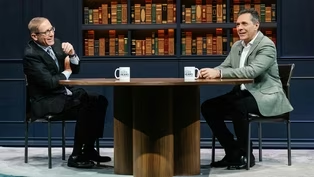
Daniel Lubetzky, KIND Snacks and Builders Movement Founder, and Shark on "Shark Tank," discusses his career, the influence of his Holocaust survivor father, and his efforts to build societal bridges on common ground.
Problems playing video? | Closed Captioning Feedback
Problems playing video? | Closed Captioning Feedback
Overheard with Evan Smith is a local public television program presented by Austin PBS
Support for Overheard with Evan Smith is provided by: HillCo Partners, Claire & Carl Stuart, Christine & Philip Dial, Eller Group, Diane Land & Steve Adler, and Karey & Chris...
Daniel Lubetzky
Season 13 Episode 10 | 26m 46sVideo has Closed Captions
Daniel Lubetzky, KIND Snacks and Builders Movement Founder, and Shark on "Shark Tank," discusses his career, the influence of his Holocaust survivor father, and his efforts to build societal bridges on common ground.
Problems playing video? | Closed Captioning Feedback
How to Watch Overheard with Evan Smith
Overheard with Evan Smith is available to stream on pbs.org and the free PBS App, available on iPhone, Apple TV, Android TV, Android smartphones, Amazon Fire TV, Amazon Fire Tablet, Roku, Samsung Smart TV, and Vizio.
Buy Now
Providing Support for PBS.org
Learn Moreabout PBS online sponsorship- [Narrator] Funding for "Overheard with Evan Smith" comes from HillCo Partners, a Texas government affairs consultancy, Claire and Carl Stuart, Christine and Philip Dial, Eller Group, specializing in crisis management, litigation, and public affairs communication, ellergroup.com, Diane Land and Steve Adler, and Karey and Chris Oddo.
- I'm Evan Smith.
You know him as a Shark on ABC's "Shark Tank," and as the investor, philanthropist, and entrepreneur who founded KIND Snacks.
But what he really wants to sell you on is bringing the country together.
He's Daniel Lubetzky.
This is "Overheard."
(gentle instrumental music) A platform and a voice is a powerful thing.
(audience cheering) You really turn the conversation around about what leadership should be about.
Are we blowing this, are we doing the thing we shouldn't be doing by giving into the attention junkie?
As an industry, we have an obligation to hold ourselves to the same standards that we hold everybody else to.
This is "Overheard."
(audience clapping) Daniel Lubetzky, welcome.
- Thank you, Evan.
It's a pleasure being with you.
- Good to see you my friend.
I want to start by talking about your story, which begins in Mexico.
But actually, I know that your story actually begins not in Mexico.
It begins with your dad, which means we're talking about Eastern Europe.
We're talking about a very different time.
And he was such an inspiration to you, and so much of your life is essentially living out the lessons that he taught you that I think we have to go back that far.
- Yeah, both my mom and dad were a big influence in my life.
But my dad's experience, thankfully my mom didn't have to go through it, but he was nine years old when World War II started, 12 years old when he was sent to a concentration camp in Dachau, and 15 1/2 when he was liberated by American soldiers.
And he was about six foot tall and weighed 70 pounds.
And he was, after six months of being in a hospital and six months of being in a refugee camp, he then immigrated to Mexico where an aunt and uncle of his had fled before the war.
- Yeah.
- And that's the beginning of his second life.
- Yeah, and he saw the kindness of people in that period.
Like he, it was obviously a horrible time for him and in his life.
- Well, he never told it to us.
We just inferred it.
He never said, "I saw the kindness of people."
He never said, he just lived his life that way.
- But we know that he was the beneficiary of kindness.
- Well, he told his stories of the realities, but then I'm inferring, I'm connecting those dots.
But he just lived his life with kindness.
And we came to Texas when I turned 15 1/2, 16-years-old when I got here.
- Right, so born and raised in Mexico City for the first period.
- For the first period.
And then a lot of people that met my dad in Laredo, Texas, in San Antonio, Texas, everywhere, even today when I meet them sometimes they start crying telling me how much he impacted their lives.
And whether it was the president of the bank or the bank teller, he, how do you say when you go on a boat and you create a wake?
- Yeah.
- He created a wake of kindness and respect.
And this is me interpreting his life that after having a second lease on life, he found a way to try to bring light to the world and to not let that darkness consume him.
Because as I was growing up in Mexico City, I was surrounded by other fellow friends of my father who were also Holocaust survivors.
And pretty much every Holocaust survivor that I met fit into two categories.
It was the people that were consumed by the suffering and had a lot of bitterness in them.
They were kind to me, but they were always embroiled in that darkness.
They couldn't escape that.
Or they were people that were full of life, but they had to shut out that episode in their lives.
And my dad was, I really don't know anybody else that allowed himself to remember all of the horrors of what he went through.
When he reminded us he was consumed by it, but then always found a way to spring up and bring light.
And also, always, to your point Evan, found a way to remind himself that were it not because of the kindness of others he would've not survived.
- Right, so that was obviously a big part of your relationship, but he also was a very successful businessman.
- Yeah.
- And you saw that, and you became this, right?
Like there's a long way from there to here, but the inspiration of your dad as a success, as a self-starter, right, that was a big deal for you.
- I definitely saw that.
I don't think that I connected, or still today, connect the dots of who he was and what he became to me because, and I'm not, this is not false humility.
I'm very proud of all the stuff I've accomplished, I've accomplished a lot.
- Right.
- But there's no way you can compare yourself to what he did.
He arrived to Mexico with a third-grade education, - With nothing, right.
- Because that's when the war started.
He didn't speak Spanish or English.
And the way he educated himself is he would get used encyclopedias and read them cover to cover, volume A, volume B, volume C. By the time he passed away he spoke nine languages.
He had read 5,000 books.
- Yeah.
- He started a business from nothing.
And so, there's no way that anybody can really compare themselves to what he was.
I ask myself why I'm an entrepreneur.
I have a friend of mine who was staying over with me who's a fellow entrepreneur, and for him, the way he explains it is when he sees something he wants to create he gets so passionate because he wants to solve the puzzle.
- Right.
- And he wants to find a way to bring something good to humanity by, and he's a risk-taker, but also he just loves the challenge.
And I think all entrepreneurs have some of those things in common.
- Yeah.
- But I don't know where that came from.
I don't know if it's from osmosis, or from seeing my dad, or if it was inside me, or if it's, or early experiences.
I really can't answer that question.
- Say something about the business that he built that was so successful, the real, the high point first.
- Well, he started, he started working two or three shifts in factories.
And then eventually he and his father, who also was with him, built a small jewelry shop.
And then eventually they got the rights from watch companies in Switzerland to sell their watches in duty-free stores.
And this almost sounds like a Jewish joke, but five Holocaust survivors joined forces to build this business in Texas along the border.
And it became very successful.
And they had dozens of stores, and eventually they partnered with others.
- Yeah.
- And they had stores across the border between the United States and Mexico selling duty-free wares.
- And that's how you got to Texas was, in part, because of your father's success in business.
- We wanted to be closer to my dad - Closer, right.
- because he was traveling a lot.
And the headquarters were in Laredo, but we decided to be more close to the cradle of civilization, San Antonio, Texas.
(audience laughing) - Right.
Most important city in the entire country, I agree.
- You've said that before.
- We are together.
- You didn't go to my high school.
- No, no, but we're thinking about this.
- I went to Robert E. Lee High School, and I don't think people call it the cradle of civilization.
Though now it's a magnet school.
It's been transformed now.
They just call it LEE, Liberal Educations for the Enlightenment of the Humanity, something weird.
- Right.
- But for me, it was an interesting experience (laughs).
- Right, I have no doubt.
Now, come back to what you said about entrepreneurs, and why entrepreneurs do what they do.
This makes me want to ask you about "Shark Tank" because you sit there as part of this group of Sharks, and you watch people pitch you on ideas.
They are people who one day would like to be you.
What is it that you look for, knowing what you know about what makes a successful entrepreneur having been one, but also having been around them?
- Just an hour ago, - What is it?
- I was talking to the executive producer of "Shark Tank" and I happened to tell him about the work I'm doing on the civic front, which is really important work.
He said, "Well Daniel, thank you so much for taking the time to talk to me when you're doing these other important things."
And I said, "Clay, what you're doing is no less important," because "Shark Tank" is teaching entrepreneurship.
And what it does really well, like nothing else I've seen, is bring together three generations, the grandparents, the parents, and the kids to watch a show and be both entertained and educated.
It's very engaging.
- Yeah.
- It's fun, the format is fun, but you're learning how to start business, how businesses operate, and you're really being inspired.
And I think in the United States today, we can't take for granted that a lot of people questioning things that we take for granted.
Like that we should appreciate free markets, that we should appreciate rule of law, a level playing field, the opportunity for people to start and pursue their dreams.
And as imperfect as the United States is, and it is, it's better than anything I've ever found.
- Right.
- In terms of, I could have never started KIND from a $10,000 business out of the windowless basement of my apartment building.
- Say something about, I'm glad you brought up the origin story of KIND Snacks, and KIND bars specifically.
Because we've, they're so ubiquitous now.
Like we've heard the story, but we really haven't heard the story from you.
Why did you start that company?
What was the genesis of the idea?
What was the need you identified, like it is really pretty remarkable, the story.
- So, after finishing law school, I started a company called PeaceWorks, that my dream was to use business as a force for bringing people together.
- Yeah.
- And to have American entrepreneurs as catalysts to get Israelis, Palestinians, Jordanians, Egyptians, and Turks together.
That was where I first did my first venture.
Then a PeaceWorks venture in Sri Lanka between Sinhalese and Tamils, in Indonesia between Muslim, Christian, and Buddhist women together, in South Africa, in Chiapas, Mexico.
Like just shows you how little I knew because it was a very small microenterprise with ventures in many continents.
I was just so overextended.
- Yeah.
But the through line is believing that these people who might not necessarily get together could find a way to get together through business.
- The through line in everything I've done, whether it's KIND, PeaceWorks, OneVoice, Builders, everything, is trying to build bridges between people for them to discover each other's humanity.
- [Evan] Yeah.
- At PeaceWorks it's about using market forces and commerce to trade with one another, but that was the extent of it.
Like I didn't know what I was doing.
I was a confused Mexican-Jewish lawyer pedaling, (audience laughing) I haven't even gotten to the punchline guys.
(audience laughing) I was selling a line of sun-dried tomato spreads that I iconically named Moshe Pupik & Ali Mishmunken's World Famous Gourmet Foods.
(audience laughing) - Great, great name.
- And I still haven't figured out why it didn't work out.
- Great name, great name.
(audience laughing) Yeah.
- But the lesson from that, and the lessons from a lot of mistakes are why I ended up eventually just calling it KIND.
But what's interesting in my journey is that all of the failures at PeaceWorks, and there were many, planted the seeds for the success of KIND.
Because I ended up figuring out the food space and developing a lot of people that were rooting for me, even though I didn't know what I was doing.
So, when I finally had the idea, to your question about the genesis of KIND, when I was on the go skipping lunch or dinner in my desk or going door to door selling my wares, and always looking for a snack that I could feel good about eating on the go.
And that's how I had the idea for creating what became KIND.
- Right.
- And we named it KIND after my father.
- Right.
- 'Cause that year that I- - Comes right back to your dad.
- Yeah.
- Yeah.
It's sweet.
- That year that I launched KIND is the year that my dad passed away.
And it's a very weird year, is 2003 because first of all, my mom and dad are everything to me, so are my kids and my wife.
- Yeah.
- But at that point, I haven't met my wife or my kids.
And my dad passes away and I, it's completely, it shattered me.
I was not expecting it.
- [Evan] Yeah.
- And around that time, I was having distractions with another idea, which was to make peace in the Middle East through a movement that we call, that we crafted, called the OneVoice Movement.
So, on top of PeaceWorks struggling and not barely surviving 'cause we were barely making ends meet, I also was trying to launch a movement that ended up becoming the OneVoice Movement that I co-founded with my Palestinian-Israeli co-founder that got close to 10% of the Israeli and Palestinian population to join to try to seize back the agenda for conflict resolution.
And around that time, our PeaceWorks business implodes.
And we have the idea for what's gonna become KIND, but we're struggling.
Part of me is like exhausted.
And part of me wants to throw in the hand towel, throw in the towel, throw the towel to the- - Throw in the towel.
Yeah, yeah.
- Throw in the towel.
But it was small, it was a hand towel.
- It was only a hand towel.
(audience laughing) Right, fortunately it was only a hand towel.
- Throw in the towel.
- Yeah.
- And there was a table.
Thank you whoever's laughing there, (audience laughing) thank you for laughing.
But part of it is not intentional.
Part of it is really that I am a, I still haven't conquered my English.
But we're at a table, maybe slightly larger, like this one and it's rectangular.
And we were like seven or eight in a disheveled office.
I visited recently and showed it from afar to my kids.
I have many stories about that one too.
But we took a vote because I didn't know whether we should go for it.
And part of me, I believe, was exhausted and almost wanting my team's permission to just, each of us take three months to find another job.
I had a law degree from Stanford, and I was paying myself $24,000 a year already for 10 years.
I was a little bit exhausted.
And then my dad passing away and our setbacks at PeaceWorks, and we went around the table and everybody voted to give this one last shot.
And for me, it's fascinating to think that there was a chance that KIND would've never been born.
- Well, the alternate history is we're not sitting here.
- What, you wouldn't be my friend if I don't succeed financially?
- Well, I'd be your friend.
(audience laughing) You might not rise to the level of guest, but you would be my friend.
But no, but seriously, I mean people don't understand, like that's, and that's really the journey of entrepreneurship is there are these moments where it could've gone another way.
- The only reason I put an asterisk to that, because when I've asked myself, "Would I really have given up, or am I telling myself to tell my romantic story?"
And I cannot answer that with certainty.
- Right.
- But I can tell you that we for sure, we had that vote.
And I can tell you that part of me wanted to get off the treadmill.
I think that was a bad analogy.
- But it turns out that this business, this is a wildly successful business over the years, right, yeah.
- And what's fascinating is from the day we said let's go, after 10 years of PeaceWorks' mistakes, like this show's not long enough for me to tell you all of the mistakes, but so many mistakes.
And all of a sudden we decide to launch KIND, and (snapping) it starts working.
And it starts growing, - Yeah.
- doubling in sales every year for 10 years in a row.
Cash flow positively and profitably, and it's hold onto your seats.
And it's fascinating.
And during my PeaceWorks' years, I thought that that bare existence was normal, you know, that's how businesses work.
And then after I was like, "Oh, I guess this is what's normal with KIND."
- Right, well, that level- - But neither of 'em was normal.
- But let's be honest, that level of success is not forever.
- No, it was very, I don't know any other company - Not everybody.
- in the world - Right.
- that achieved the value for investors that mine did.
The people that invested $100,000 in PeaceWorks, because nobody would wanna invest in me.
But my friends did, and they invested in PeaceWorks and I rolled them over into what became KIND.
That investment became a 5 to $7 billion value.
So, they got like 3,000-plus X returns, which.
- Right.
- I was reviewing- - This is why it pays to be your friend.
- Yeah.
(audience laughing) - Exactly, as you said, would I want to be your friend?
- Well, for Greg (indistinct) it worked out.
- I would wanna be your friend.
So, you have really devoted this part of your life to trying to figure out how to end polarization in our country and in our communities.
Explain what your thinking is here.
- Well, it started because of what you said.
Like I started noticing here in our country, in our shores, I never would've imagined when I immigrated to the United States in 1984.
And for me, the romantic me, and it's still who I am.
- Yeah.
- I love the United States.
I am grateful because they, I wouldn't exist if it wasn't that they rescued my father.
I would've not been able to build KIND or anything else.
Like, I think this is the best country on Earth.
But all of a sudden in the last 10 years plus, I start noticing that the tribalism and division and hate that I saw consume the Middle East is happening in our own shores.
And forces like social media, cable news shows, Evan's show, I'm joking.
(audience laughing) - Oh, this is a very nice show, yeah.
- I know, I'm joking.
But a lot of forces of polarization and division are contributing, even the way our government's currently structured.
Gerrymandering helps amplify the voices of the people with the most extremist beliefs rather than the people that are problem-solvers.
So, over the last 10 years we've started thinking about what do we need to do - Right.
- to try to help people seize back the agenda and rediscover what our Founding Fathers gifted us.
And we work in three sectors, media, education, and civics.
In media we've created social media channels and a speakers bureau to try to get voices of builders and to try to help people think, not what they need to think, but how they need to think with a builder's mindset which has the 4 C's, curiosity, creativity, courage, and compassion.
These are the 4 C's that helped me build KIND.
- Yeah.
- They're the 4 C's that help you build companies, build bridges, build schools, build up companies.
- I mean, it really sounds like you're doing a version of the same thing you've always done, which is to emphasize those core values.
- And to try to distill what are the key building blocks for our children to learn the ideologies, the philosophies, for them to wanna be builders rather than destroyers.
So, that's in media.
- Media.
- Same in education, developing curricula for colleges and for K-12 program to teach kids - Right.
- all of these things.
And to not take for granted democracy, free markets, freedom, all of the things that when we were going to school we took for granted.
And then in terms of civics, we've learned that both the Republican and Democratic parties, when they're in power, it's not that they're bad people.
It's just a natural thing.
They wanna prolong their power.
They wanna extend their power.
And so, you have a situation over many, many, many decades, this duopoly of power has made whenever it's a Democratic-controlled state, made it more and more entrenched Democratically.
When it's Republican, make it more and more entrenched.
If you have this city, that city, all of a sudden the government has disproportionate control and they start serving special interests, serving themselves, trying to use the instruments of state to prolong their power rather than to solve problems for the citizens.
- Right.
- And the only way to break it is to break the shackles of that is for citizens to get more engaged, to lean in and say, "Hey, governments serve the people."
And to create the rules that are gonna help - Right.
- that happen.
And that's what we're doing on the civic front.
- You know, I've said this to you many times before, that one of the challenges, worthwhile goal to try to bring people together.
But one of the challenges is polarization is a business model, right?
Right now, the toxic polarization that has crippled this country is working for those people in power.
- My friend Tim Shriver, - May not be working for us, - my friend Tim Shriver - but it's working for them.
- calls it the polarization industrial complex.
- Right.
- Cable news sells more ads and more audiences that way.
All the subscriber-based systems are just feeding people what they want to hear rather than what they need to hear.
Social media algorithms create these alternative realities.
Everybody lives in their bubbles, and the more they click on that the more they get from that.
- Yeah.
- So, everybody thinks that they're right and the other side is wrong.
And what's fascinating to me about the problem is whenever I have these conversations.
I gave a TED Talk, and I explained that everybody agrees with this problem and sees it on the other side.
But they don't see it happening to them, to their own - On their side, right.
Yeah.
- people.
And it's a very serious problem because all of us are part of the problem.
All of us are part of the solution.
All of us suffer from these realities and these incentives.
And even the politicians, it's not that I don't like politicians.
It's just that they're responding to incentives.
If you scream, you're gonna raise more money.
If you scream, you're gonna get invited to the cable news.
If you're scandalous and divisive, you're gonna have more power.
- Yeah.
- So, it ends up happening that that is being rewarded, and that's why politicians are getting stronger and stronger at the extremes.
The only way to break it is to have structural reforms, for all of us to join.
Every single one of you guys here and everybody watching, you have to be to builderstx.org, or buildersmovement.org, and sign up and join and take that little baby step.
Just join buildersmovement.org or builderstx.org, and we'll give you little things you can do.
But ultimately, the only way to win is that all of us hold our politicians accountable and say, "Look, there needs to be gerrymandering reform, that we need to show up at the primaries."
We need to, the only way we win is by all of us to take back ownership.
- What you are not doing, people sometimes misunderstand this.
You're not creating a new party, a new political party.
That's not what this is about.
- Precisely.
We started it because I, - Yeah.
- I thought that what, do we need to rescue back the Democratic party, do we need to rescue back the Republican party?
Do we need to create a third party?
And what I realized is there's enough politicians.
What there's not an, what there's not in existence is - Yeah.
- an accountability project for citizens to ensure accountability from the politicians.
The politicians have plenty of special interests that are influencing them, but there's nobody speaking for the citizens' interest.
A perfect example is the session we just did because we're bringing it to Texas, and we decided that we're gonna prove this civic concept out in Texas.
And we're doing a Citizen Solution session on healthcare.
Citizens help choose what we're gonna focus on.
We took a look at what's most salient, what's more important to citizens, and where is there a gap between what the people want and what the politicians are doing.
Healthcare huge, 86% of Texans believe that healthcare is a mess.
And that if politicians would solve it, they would vote for them.
And if not, they would boot them out.
And there's tons of areas where there's consensus, but special interests like pharma, insurance, and others are not solving it.
And so, everybody's frustrated because there's no transparency, costs are skyrocketing.
Texas is doing, we are proud to have the worst spot in healthcare.
I think we're number 50 on many measurements of healthcare in our state.
- Right.
- And so, we need to change that.
We have an extraordinary state and an extraordinary opportunity for us to, there's a lot of low-hanging fruit, a lot of small things that can do to improve care in rural areas, to improve availability of specialized services in rural areas, to ensure transparency, to reduce cronyism and bureaucracy.
- But the way you're doing it, as we wrap up here, the way you're doing it is ground up and not top down.
- Yes.
- Which I think the key to this is empowering people on the ground.
- Everything I'm saying comes from the citizens.
I would've not chosen healthcare.
I had other passions that I would've preferred to have gone, but it's the citizens that chose that healthcare is what it's gonna do.
- That's what they want.
- And it's the citizens, Citizen Solutions is a methodology to engage citizens.
There's right now an AI model called Ima.
You can talk to Ima and share what your concerns are.
And there's also modules where 14 citizens joined this last weekend in Austin to talk about these issues and come up with proposals that the citizens are crafting.
So, it's citizens coming up with the things.
And the theory is, and I've seen this happening, informed citizens are unbeatable.
This is what's magical about what the Founding Fathers taught us and what we need to rediscover.
Informed citizens are unbeatable because they have the moral authority to go to a politician and say, "This is what we want.
All of us across the political spectrum joined forces and came up with these solutions.
Go and implement it.
And if not, we're gonna vote for somebody else out."
And then the politicians are almost waiting.
They want that leadership from their people, and that's what we need to provide.
- This is your, maybe your greatest creation yet, right?
- I hope so.
- If you can actually- - Well, it's not mine.
It's 350 leaders- - Right, but if you can, if you can make this work.
All right, we are over time.
Daniel Lubetzky, thank you very much for coming and telling your story.
It's good to be with you.
All right, thank you.
(audience clapping) We'd love to have you join us in the studio.
Visit our website at austinpbs.org/overheard to find invitations to interviews, Q&As with our audience and guests, and an archive of past episodes.
- We as citizens have the power, and with that power, the responsibility to do things better and to be active and to be engaged.
And so, I think for me, early on I guess I had a couple little successes.
Made me have the self-confidence to believe that I can make a difference.
And for me that makes all the difference.
- [Narrator] Funding for "Overheard with Evan Smith" comes from HillCo Partners, a Texas government affairs consultancy, Claire and Carl Stuart, Christine and Philip Dial, Eller Group, specializing in crisis management, litigation, and public affairs communication, ellergroup.com, Diane Land and Steve Adler, and Karey and Chris Oddo.
(mellow flute music)
Video has Closed Captions
Clip: S13 Ep10 | 10m 29s | KIND Snacks CEO Daniel Lubetzky discusses the influence of his Holocaust survivor father. (10m 29s)
Providing Support for PBS.org
Learn Moreabout PBS online sponsorship
- News and Public Affairs

Top journalists deliver compelling original analysis of the hour's headlines.

- News and Public Affairs

FRONTLINE is investigative journalism that questions, explains and changes our world.












Support for PBS provided by:
Overheard with Evan Smith is a local public television program presented by Austin PBS
Support for Overheard with Evan Smith is provided by: HillCo Partners, Claire & Carl Stuart, Christine & Philip Dial, Eller Group, Diane Land & Steve Adler, and Karey & Chris...