
December 1, 2025 - PBS News Hour full episode
12/1/2025 | 57m 46sVideo has Closed Captions
December 1, 2025 - PBS News Hour full episode
Monday on the News Hour, the White House confirms the military fired twice at a single alleged drug boat. The Trump administration decides not to commemorate World AIDS Day for the first time in decades. Plus, with the Supreme Court set to weigh in on the controversial practices of crisis pregnancy centers, we explore their growing role in the anti-abortion movement.
Problems playing video? | Closed Captioning Feedback
Problems playing video? | Closed Captioning Feedback
Major corporate funding for the PBS News Hour is provided by BDO, BNSF, Consumer Cellular, American Cruise Lines, and Raymond James. Funding for the PBS NewsHour Weekend is provided by...
Support provided by:

December 1, 2025 - PBS News Hour full episode
12/1/2025 | 57m 46sVideo has Closed Captions
Monday on the News Hour, the White House confirms the military fired twice at a single alleged drug boat. The Trump administration decides not to commemorate World AIDS Day for the first time in decades. Plus, with the Supreme Court set to weigh in on the controversial practices of crisis pregnancy centers, we explore their growing role in the anti-abortion movement.
Problems playing video? | Closed Captioning Feedback
How to Watch PBS News Hour
PBS News Hour is available to stream on pbs.org and the free PBS App, available on iPhone, Apple TV, Android TV, Android smartphones, Amazon Fire TV, Amazon Fire Tablet, Roku, Samsung Smart TV, and Vizio.
Providing Support for PBS.org
Learn Moreabout PBS online sponsorshipAMNA NAWAZ: Good evening.
I'm Amna Nawaz.
GEOFF BENNETT: And I'm Geoff Bennett.
On the "News Hour" tonight: The White House confirms the military fired twice at a single alleged drug boat, sparking bipartisan concern about the strike's legality.
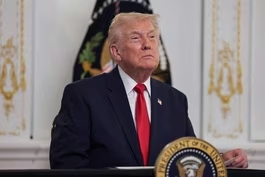
AMNA NAWAZ: The Trump administration decides not to commemorate World AIDS Day for the first time in decades, even as funding cuts risk millions more infections and deaths.
GEOFF BENNETT: And with the Supreme Court set to weigh in on the controversial practices of crisis pregnancy centers, we explore their growing role in the anti-abortion movement.
CARRIE BAKER, Smith College: I wouldn't call them medical providers.
I would call them political organizations who are often not revealing their political agenda, at least initially.
(BREAK) GEOFF BENNETT: Welcome to the "News Hour."
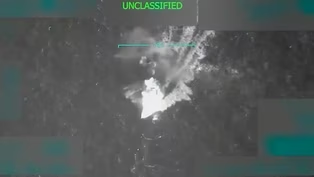
Today, the White House confirmed that the military fired twice at a single alleged drug boat in early September as part of its campaign of airstrikes in the Caribbean.
AMNA NAWAZ: And a source tells the "News Hour" the military knew there were survivors in the water after the first hit.
As Nick Schifrin reports, the developments have sparked bipartisan concern that the strikes were illegal.
NICK SCHIFRIN: On the morning of September the 2nd, an American drone flew over what the U.S.
identified as a boat carrying drugs.
President Trump released this video personally and said a single missile destroyed the boat and killed 11 people he identified as narco-terrorists.
But after the first strike, the White House now confirms there was a second strike ordered by then Joint Special Operations command leader Admiral Frank Bradley.
KAROLINE LEAVITT, White House Press Secretary: Secretary Hegseth authorized Admiral Bradley to conduct these kinetic strikes.
Admiral Bradley worked well within his authority and the law, directing the engagement to ensure the boat was destroyed and the threat to the United States of America was eliminated.
NICK SCHIFRIN: A source familiar confirms to "PBS News Hour" the second strike was taken despite the military knowing there were survivors in the water.
The Washington Post reported it was a response to a verbal order by Secretary Hegseth: "Kill everybody."
KAROLINE LEAVITT: I would reject that the secretary of war ever said that.
However, the president has made it quite clear that if narco-terrorists, again, are trafficking illegal drugs towards the United States, he has the authority to kill them.
NICK SCHIFRIN: More than a month later, the U.S.
military approached survivors differently, rescuing two after this strike on a submarine.
It's not clear what led to the shift.
On Friday night, Hegseth criticized -- quote - - "fabricated, inflammatory and derogatory reporting," but went on to describe the attacks as -- quote -- "specifically intended to be lethal kinetic strikes."
Three minutes later from his personal account, he wrote: "We have only just begun to kill narco-terrorists."
Those responses reinforced already existing bipartisan concern.
The chair and ranking member of the Senate Armed Services Committee said: "The committee is aware of recent news reports and the Department of Defense's initial response regarding alleged follow-on strikes.
The committee has directed inquiries to the department and we will be conducting vigorous oversight."
And the chair and ranking member of the House Armed Services Committee said they too are taking bipartisan action to gather a full accounting of the operation in question.
On Sunday, other Republicans questioned the second strike's legality.
REP.
MIKE TURNER (R-OH): Obviously, if that occurred, that would be -- be very serious, and I agree that that would - - would be an illegal act.
REP.
DON BACON (R-NE): If it was as if the article said, that is a violation of the law of war.
When people want to surrender, you don't kill them.
And they have to pose an imminent threat.
It's hard to believe that two people on a raft trying to survive would pose an imminent threat.
NICK SCHIFRIN: Since that first September strike, the U.S.
has attacked at least 21 boats, killing more than 80.
It's been enabled by a huge regional deployment.
The Navy says about 15 percent of all of its currently deployed ships are in Latin America and the Caribbean.
It includes the world's largest aircraft carrier, which Hegseth visited on Thanksgiving.
PETE HEGSETH, U.S.
Defense Secretary: Out at sea, interdicting cartels, defending the American people, we are grateful for you.
NICK SCHIFRIN: President Trump has also said he's pressuring Venezuelan President Nicolas Maduro.
The two spoke last week.
And, today, President Trump met his national security team to discuss Venezuela, where Maduro yesterday projected positivity.
NICOLAS MADURO, Venezuelan President (through translator): Sanctions, threats, blockades, economic war, and Venezuelans did not cower.
Here, as they say, everyone put on their boots and went to work.
NICK SCHIFRIN: President Trump is deciding whether to take further action, including strikes on Venezuelan soil, while making it clear there will be no apologies for the campaign so far.
For the "PBS News Hour," I'm Nick Schifrin.
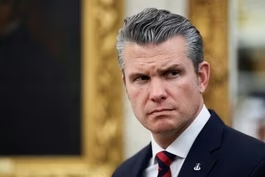
GEOFF BENNETT: For perspective on all of this, we turn now to retired major general Steven Lepper.
He served as the Air Force's deputy judge advocate general and, as such, was the service's second highest ranking uniformed lawyer.
Thank you for being with us.
So, as we just saw in that report, the White House is defending Admiral Frank Bradley, whom the White House today said ordered that follow-up strike that killed survivors on that alleged drug boat in the Caribbean, saying he was acting well within his authority.
Based on what's known, was he?
MAJ.
GEN.
STEVEN LEPPER (RET.
), Former U.S.
Air Force Deputy Judge Advocate General: Well, based on what's known, if he was the commander of the operation, then, yes, he would have been acting within his authority.
GEOFF BENNETT: Well, say more about that.
MAJ.
GEN.
STEVEN LEPPER (RET.
): OK.
Well, I mean, obviously, his authority as the commander extends to the entire operation in the Caribbean, and that would have included both the first strike and the second strike.
The question that we have all been asking over the last several days since the reports first came out are whether or not those orders emanated from a higher level and were simply executed by the admiral and all the people below him in the chain of command or whether the admiral himself ordered the second strike.
Either way, that second strike was a violation of the laws of war.
That second strike, the orders to conduct the second strike were illegal orders, and they should not have been executed.
They should not have been followed by anyone in what we call the kill chain.
GEOFF BENNETT: The defense secretary's reported order, The Washington Post reporting that Defense Secretary Pete Hegseth gave this spoken directive.
This is according to two people with direct knowledge of the operation, according to The Post, that the order was to kill everybody.
MAJ.
GEN.
STEVEN LEPPER (RET.
): Well, as an attorney who spent 35 years advising commanders on military operations and many other things, what that means to me is that the secretary, either intentionally or unintentionally, communicated to everyone below him that there would be no quarter.
And what that means in international law is that A no quarter order basically provides that no one should be left living after the strike.
So it suggests that anyone who surrenders be targeted.
It suggests that, as in this case, any survivors of the first attack be targeted, even if those survivors or anyone surrendering or anyone else who is -- quote -- "out of the fight" can continue to pose a threat to military forces.
GEOFF BENNETT: Well, explain why shooting at shipwrecked survivors is not the same as pursuing retreating enemy fighters on land.
What's the -- what's the distinction?
MAJ.
GEN.
STEVEN LEPPER (RET.
): Well, there is a distinction.
Retreating prisoners on -- or retreating forces on land are actually -- are usually engaged, unless they're surrendering, in a tactical maneuver intended to remove themselves from the battlefield, regroup and then presumably reattack.
They continue to be combatants.
They continue to be targets, lawful targets of the military.
On the other hand, survivors of a boat that has been disabled or destroyed and whose survivors are floating in the water with no means of opposing the force that put them there are considered hors de combat under international law.
They can no longer prosecute their original mission.
And, as such, our responsibility shifts from targeting them while they were in the boat while it was intact to rescuing them now that they're floating in the water, clinging to the wreckage.
GEOFF BENNETT: And there's language from the Defense Department Law of War Manual that spells that out.
I will read from it briefly.
It says: "Members of the armed forces and other persons who are wounded, sick, or shipwrecked, shall be respected and protected in all circumstances.
Such persons are among the categories of persons placed hors de combat," as you just said, out of combat or out of action."
Making them the object of attack is strictly prohibited."
So is there any legitimate gray area here or is what transpired a clear violation of law?
MAJ.
GEN.
STEVEN LEPPER (RET.
): Well, if the surveillance video showed two survivors clinging to wreckage, then there is no question that this was an unlawful order to target those two survivors.
There is nothing in international or domestic U.S.
law that would justify a second strike intended to kill those two survivors.
GEOFF BENNETT: There were U.S.
special ops forces involved in carrying out this strike.
And there are people who argue that special operators can push the bounds of the law.
In your experience, is that true?
MAJ.
GEN.
STEVEN LEPPER (RET.
): No, the rules apply to everyone, whether they are special operations forces or regular military forces.
The rules apply.
The Law of War Manual that you just quoted from a minute ago has an additional provision in it later on in the text that uses the precise example of shooting survivors in the water as an example of an unlawful order.
That order would be unlawful whether it is given to a regular military force or to special operations forces.
There's just no distinction among them as far as the law of war is concerned.
GEOFF BENNETT: Retired Major General Steven Lepper, thanks again for your time and for your perspective.
MAJ.
GEN.
STEVEN LEPPER (RET.
): Thank you.
GEOFF BENNETT: In the day's other headlines: The White House says that a recent MRI performed on President Trump was preventative screening focused on both his heart and abdomen.
It follows the president telling reporters yesterday that he was open to releasing the results, even as he said he didn't know which part of his body had been scanned.
The president's physician said today all of Mr.
Trump's results were -- quote -- "perfectly normal" and added: "Advanced imaging was performed because men in his age group benefit from a thorough evaluation of cardiovascular and abdominal health."
The president received an MRI in October at Walter Reed National Military Medical Center, a visit the White House billed as the president's routine yearly checkup, but the president had already completed his annual physical back in April.
A federal appeals court ruled today that Alina Habba, one of President Trump's former personal attorneys, has been serving unlawfully as the U.S.
attorney in New Jersey.
It deals a major blow to the Trump administration and positions the case for a likely Supreme Court fight.
Habba is one of several U.S.
attorneys the administration has attempted to keep in place through unconventional maneuvers, despite the fact that she was neither confirmed by the U.S.
Senate, nor appointed by district court judges, two established legal paths for holding that job.
She's the latest Trump attorney whose appointment has been challenged.
Last week, a federal judge dropped criminal cases against former FBI Director James Comey and New York Attorney General Letitia James after finding that the acting U.S.
attorney on those cases, Lindsey Halligan, was also unlawfully appointed.
A West Virginia National Guard member who was shot last week in a targeted attack in the nation's capital is still in serious condition, but has showed positive signs in his recovery.
GOV.
PATRICK MORRISEY (R-WV): Andrew is still fighting for his life.
Andrew needs prayers.
GEOFF BENNETT: At a news conference today, West Virginia's governor said Air Force Staff Sergeant Andrew Wolfe still faces a long road ahead, but he says Wolfe responded to a nurse's question with a thumbs up and has started to move his toes.
A fellow Guard member, Army Specialist Sarah Beckstrom, died of her wounds last week.
Investigators are still working to determine a motive in the shooting.
The accused shooter, an Afghan national, has been charged with first-degree murder.
In South Asia, more than 800 people are still missing after last week's catastrophic shooting floods claimed more than 1,000 lives across Indonesia, Thailand, and Sri Lanka.
Over half of those deaths were on Indonesia's Sumatra Island, where landslides left behind miles of thick mud tangled with trees and sheet metal.
As rescuers scramble to recover the dead, families are left to absorb a staggering loss.
MUHAMMAD RAIS, Indonesian Flood Survivor (through translator): This building used to be my house.
This was a mosque.
This was my parents' house, our rice mill, my younger brother's house, and my in-laws.
Now everything is flat with water.
GEOFF BENNETT: The floods brought on by a rare tropical cyclone have displaced nearly 300,000 Indonesians.
That's as a separate storm inundated parts of Sri Lanka.
The president of that island nation said the scale of the damage is unprecedented.
ANURA KUMARA DISSANAYAKE, President of Sri Lanka (through translator): As a country, we are facing the largest and most challenging natural disaster in our history.
We also recognize that we are undertaking the most difficult rescue operation in our nation's history.
This is the first time the entire country has been struck by such a disaster.
GEOFF BENNETT: In Thailand, which was also badly hit, authorities were still working to restore water and electricity.
The Thai prime minister set a seven-day timeline for residents to return home.
And here at home, traveling without a REAL ID will soon cost you.
The Transportation Security Administration says it will start charging air travelers a $45 fee in February if they don't have the newer form of identification.
The government says that fee will help pay for alternative ways to confirm a passenger's identity, including biometrics.
It comes as the TSA reported screening a record 3.13 million air passengers yesterday, the peak travel day for Thanksgiving.
The highest ever number occurred despite weather issues in parts of the Midwest.
On Wall Street today, stocks broke a five-day winning streak and gave back some of last week's rally.
The Dow Jones industrial average lost more than 400 points, or nearly a percent.
The Nasdaq dropped by almost 90, and the S&P 500 ended a half-percent lower.
And today marks 70 years since Rosa Parks was arrested for refusing to give up her seat to a white man on a segregated bus in Alabama.
That historic act of defiance sparked the 13-month Montgomery bus boycott, organized in part by a young Baptist minister named Martin Luther King Jr.
A pivotal moment in the civil rights era, Parks' civil disobedience and the boycott that followed culminated with the U.S.
Supreme Court ruling that segregation on public buses was unconstitutional.
And still to come on the "News Hour": Tamara Keith and Amy Walter break down the latest political headlines; we explore the growing influence of anti-abortion crisis pregnancy centers; and a young farmer gives her Brief But Spectacular take on building community.
AMNA NAWAZ: Communities across the globe commemorated World AIDS Day today, honoring those who've died from the disease and reaffirming a commitment to end an epidemic that's killed more than 44 million people worldwide.
GEOFF BENNETT: But, this year, for the first time in decades, the U.S.
government decided not to mark the occasion.
And the Trump administration has reportedly barred agencies from commemorating or participating in the event as well.
William Brangham has more.
WILLIAM BRANGHAM: Geoff, that directive comes after the administration slashed funding for global HIV/AIDS prevention and treatment projects earlier this year and moved to eliminate many domestic initiatives as well.
In part, because of those steep cuts, the U.N.
now estimates global funding for HIV has dropped 40 percent in two years, and public health leaders argue decades of progress are at risk.
To help us take stock of this current situation, we are joined again by infectious disease expert Dr.
Demetre Daskalakis.
He recently resigned from his leadership role at the CDC, citing the agency's new policies on vaccines, which he argued will endanger people's lives.
Dr.
Daskalakis, so nice to have you back on the program.
World AIDS Day was created almost 40 years ago, at a time when, you're probably not old enough to remember, but stigma in this country of around HIV was oppressive.
And the activist mantra back then was that silence equals death.
Given that, what do you make of the administration saying, we are not commemorating World AIDS Day, we will remain silent on that?
DR.
DEMETRE DASKALAKIS, Former Director, National Center for Immunization and Respiratory Diseases: It's a really painful question to answer.
I mean, I think at the end of the day, so much progress has happened in HIV, but we're not done yet.
And so I think that this really signifies, on a very important day of commemoration, the administration not only not pushing the accelerator on ending the HIV epidemic globally, but actually pumping the brakes.
So I think it fits in with so much of what's happened with the funding and some of the other possibilities of funding that may still happen for the domestic program.
So I think it signals that this is not a priority.
WILLIAM BRANGHAM: The State Department put out a statement that said: "An awareness day is not a strategy.
Under the leadership of President Trump, the State Department is working directly with foreign governments to save lives and increase their responsibility and burden-sharing."
The administration is arguing that the work is still continuing, albeit with a different level of rigor.
What is your response to that assertion?
DR.
DEMETRE DASKALAKIS: So, first of all, it's true a commemoration day is not a strategy, but the things that are a strategy are the things that they're unplugging.
And so a lot of the work that's happening in PEPFAR, so many of the things domestically are actually strategies that have demonstrated effectiveness in reducing the rate of HIV infection, not only domestically, but globally and saved millions of lives.
So the strategy is already being unplugged by the administration, and, really, the commemoration day is just a symptom of that bigger disease.
And that disease is a lack of concern.
So I think that they're looking at PEPFAR as transactional, trying to figure out ways to trade aid for potentially access to specimens and data.
That's not really a strategy that I think is based on good practice, nor based on the important role of the United States in ending HIV globally.
WILLIAM BRANGHAM: As you have been mentioning, we know that there has been tremendous progress made against HIV/AIDS.
I mean, deaths have been plummeting.
There's this remarkable new prevention drug, lenacapavir, that's starting to get into people's arms.
But still over a million people every year contract HIV.
How much of this do you attribute to the administration now stepping away from its long-term funding for some of these projects like PEPFAR?
DR.
DEMETRE DASKALAKIS: Yes, I mean, I think that there's already folks who are modeling how many lives have been endangered or lost based on the pullback from global funding.
What we're going to see is more babies being born with HIV globally and potentially even domestically, more people dying of HIV.
I haven't seen an AIDS ward like I did in the late '90s and 2000s for decades.
And I fear that that's going to come back when we don't have the right infrastructure to support the work necessary.
You brought up lenacapavir.
So that is an amazing intervention.
That and cabotegravir are both long-acting injectables that can prevent HIV infection.
But if there's no infrastructure to deliver that, it may as well do nothing.
If it just sits on the set on the shelf without public health and an infrastructure to deliver it, it's just going to be technology that doesn't have any impact.
And so I'm really scared about it.
I'm scared that this lack of concern by the administration and, frankly, something that is going to erase so much of their legacy with ending the HIV epidemic and even before that Republican administrations that led to PEPFAR, as well as Ryan White, I think that they're dismantling a legacy that is one that I think should be celebrated, rather than ignored.
WILLIAM BRANGHAM: I want to switch gears for one moment, if you don't mind, to your recent work at the CDC, where you oversaw vaccine policy with regards to respiratory diseases like COVID.
Recently, the head of the FDA's vaccine division, Vinay Prasad, wrote a memo that blamed the deaths of 10 children over the last few years on the COVID vaccine.
It did not seem to provide any real evidence for that assertion.
What do you make of that and the other moves that the administration is making with regards to vaccine policy?
DR.
DEMETRE DASKALAKIS: Yes, so first important to say that any death is a sad thing, but I -- just to be very frank, that that memo is in effect a glorified social media post without any information backing it up.
So I think that the responsible thing to do when you have such information is first share how you have come about on that conclusion.
So it is at this point an announcement, whether it was overt or not, that doesn't have any of the data or process backing it.
So I think that my first response when I heard it was, it doesn't mean anything unless we know more.
And I think that that means not only releasing sort of what the data are, but also what the process is, how they've come to that conclusion.
And, frankly, for things that are this complex and controversial, it is standard to have third parties review the data and review the process to see if they're reproducible and if they agree with the assertion.
So, it's very strange to not have advisory committees, experts and external scientists be engaged in such an announcement.
And, frankly, it's irresponsible to do that as a memo to your entire center, assuming that no one is going to share that outside of the agency.
WILLIAM BRANGHAM: All right, that is Dr.
Demetre Daskalakis, former center director at the CDC.
Thank you so much for being here.
DR.
DEMETRE DASKALAKIS: Thank you so much for having me.
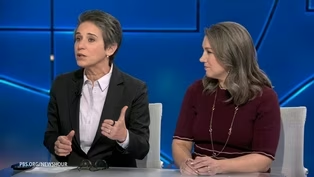
AMNA NAWAZ: Lawmakers on both sides of the aisle search for answers on how the military carried out strikes on alleged Venezuelan drug boats, and a special election in Tennessee could serve as a bellwether for the midterms.
To discuss that and more, we turn now to our Politics Monday duo.
That is Amy Walter of The Cook Political Report With Amy Walter and Tamara Keith of NPR.
Great to see you both.
TAMARA KEITH, National Public Radio: Good to be here.
AMNA NAWAZ: As we reported earlier, we know President Trump meeting with his national security team to talk about the pressure campaign on Venezuela.
And you both saw today, as Nick reported earlier, both Democratic and Republican lawmakers expressing concerns about that now confirmed second strike on a drug boat even as there were survivors in the water.
Tam, you heard the White House say earlier that the commander who ordered that strike was well within his authority.
Is that explanation enough to quiet the concerns of lawmakers?
TAMARA KEITH: I don't think it is, in part because we're also getting other further explanations now coming from defense officials who are speaking off the record on background.
There's just a lot of movement here, a lot going on, and there are a lot of questions.
There's also a political challenge for the White House, because other than saying these are drug terror -- narco-terrorists, the White House hasn't really built a strong public case for this.
Typically, if the United States is getting involved in a military operation, the level of troop buildup and other members of the military that are now in that region, that level of buildup, you would expect a concerted public campaign to build support.
And that really hasn't happened.
The support isn't clearly there.
And you also have cracks in the MAGA coalition, because you had people like Congresswoman Marjorie Taylor Greene, most notably, saying, hey, you said no foreign wars, you said no regime change.
What exactly are you doing?
AMNA NAWAZ: Amy, we're seeing those cracks in the party.
Is that crack filtering down to the base as well?
AMY WALTER, The Cook Political Report: Well, what's interesting, speaking to this point about not making the public case, there was a CBS poll out, I think it was last week, and 76 percent of Americans said, we don't really know what the Trump administration is doing here.
They'd like to have more information.
Now, overall, if you ask people do you think it's a good idea to call these terrorists, these people who are in these boats or delivering drugs, terrorists and then we, the United States military, can target those boats, a majority of people agree with that, so the actual -- that actual piece.
But what they don't have, what the public doesn't feel is that they have adequate information about what the administration is actually trying to do writ large and why they're doing it.
As for the cracks, I mean, I just think the fact that you have Democrats and Republicans in the Senate and in the House saying we need to investigate this is a sign of more pushback from a Congress that has really allowed the president to move forward on a whole lot of things that normally have congressional oversight.
So it's really the first chance that we're getting to see a bipartisan push against some of the president's actions.
AMNA NAWAZ: We will see how far that push does move ahead.
But I do want to ask you about the other news about the acting U.S.
attorney in New Jersey.
That's Alina Habba, who's President Trump's former attorney.
After months of back-and-forth over the validity of her appointment, a federal appeals court today upheld the lower court ruling disqualifying her from that role.
All that comes in the context of this, a Politico report that says President Trump set a record in his first year for the most nominees withdrawn from the Senate, largely due to vetting issues and pushback from lawmakers.
Tam, he's withdrawn 57 nominations.
That's nearly double what Joe Biden did in his first year and more than double his rate in his first term.
What do you take away from all this?
TAMARA KEITH: Yes.
And the remarkable thing is that, as Amy says, this is a Congress that hasn't, at least right publicly... pushed back very much on this president.
One thing that stands out to me about the president withdrawing nominations, yes, some of that is coming from congressional pushback, but some of it is also, you had for instance, the NASA administrator, the nominee for NASA administrator, Trump -- he was about to get Senate approval.
Trump withdrew that nomination because he was mad at Elon Musk and somebody said, oh, this guy made donations to Democrats and said -- Trump said, well, he's not loyal enough.
Then, months later, he renominates him.
So there's been just a ton of churn in that area, but you haven't seen the sort of Cabinet-level turnover or staff turnover that you saw in the first Trump term, in part because the president has surrounded himself with loyalists.
AMY WALTER: Right.
And those loyalists, we thought we might have seen more pushback from Congress on some of those picks that were controversial.
We didn't see that on the Cabinet level.
On the judicial level, we have seen some of it.
Now, some of it is really partisan, but it's notable there was a Bloomberg law analysis that found of all the U.S.
attorneys that the president has appointed, the ones that have the most, as they describe it, unorthodox backgrounds, so people who we could say may be not qualified as much for a job like this are almost exclusively in places that are blue areas or Democratic-leaning areas.
And so what we saw in New Jersey was a perfect example of this.
These are also places where the president has maybe some specific people in mind that he wanted to see prosecuted.
Obviously, we saw that with Jim Comey in Virginia, who was another U.S.
attorney who there are questions about whether she is able to legally keep her job, and this case in New Jersey, similarly about - - well, actually, New York with Letitia James.
AMNA NAWAZ: Right.
AMY WALTER: Yes.
Yes.
AMNA NAWAZ: Let's look ahead to tomorrow now.
I do want to get both of your takes on this, because voters in one Tennessee congressional district are going to head to the polls to vote for a new member of the House.
Amy, I want to start with you on this, because this is a district President Trump won very strongly just last year.
AMY WALTER: Yes.
AMNA NAWAZ: But a recent Emerson poll shows the Republican candidate in the race ahead by just two points.
What's going on in this race?
Why is it so close?
AMY WALTER: This shouldn't be close at all.
You're exactly right.
And, to me, it's just the continuation of a trend we have seen throughout most of this year, which is, these districts that Trump won overwhelmingly in the previous election now are coming in a little bit less overwhelming for the Republican candidate.
It tells us that the president's overall approval rating, while it's a big problem for Republicans in districts that he won by a small margin, it's also becoming a problem in districts that he won by larger margins.
And I expect -- and The Cook Political Report still rates this as a seat that Republicans should hold on to.
But the fact that Republicans are having to spend money here or having to put effort into this should be a warning sign for any Republican even in a district that Trump carried by a pretty healthy margin in the last election.
It's also notable that the ads that are running in this congressional district run by Republicans -- again, this is district Trump won.
They should be saying things like, hey, don't you want this candidate to come and put Donald Trump's agenda through?
Don't you love Donald Trump?
They don't really mention Donald Trump.
TAMARA KEITH: That's what the primary was about, but not the general election.
AMY WALTER: Yes, not the general election.
AMNA NAWAZ: Well, Tam, pick up on that, though.
Speaking of Republican efforts, Speaker Mike Johnson was there today.
We have seen Kamala Harris there in recent weeks as well.
President Trump posted online about this race, telling people don't take this race for granted.
He's remotely taking part in a tele-rally.
What does all of this tell you about how Republicans are looking at the race?
TAMARA KEITH: Yes, don't take this race for granted is President Trump's message because he has determined, as he said after the elections in Virginia and New Jersey, if I'm not on the ballot, Republicans just don't show up.
So this is him sort of projecting, hey, might keep a little arm's distance, little distance there.
The remarkable thing is, in his first term, he was doing political travel immediately after Election Day all through that first year.
He was campaigning in special elections.
He was on the road.
He has not been doing domestic political travel.
He just hasn't.
He hasn't been out there selling his agenda and he hasn't really used his political capital for candidates in these special elections and other elections.
And you saw that with Virginia and New Jersey.
He didn't travel there.
It's not even that far to go to Virginia.
And he isn't traveling for this race either.
AMNA NAWAZ: Amy, fair to say this is a bellwether for the midterms?
AMY WALTER: I think it's a bellwether in the sense that, if Republicans are having to fight to defend seats like this, that sets up for a very, very difficult midterm election.
AMNA NAWAZ: And we shall see.
Amy Walter, Tamara Keith, great to see you both.
Thank you.
AMY WALTER: You're welcome.
TAMARA KEITH: You're welcome.
GEOFF BENNETT: Tomorrow, the U.S.
Supreme Court will hear arguments in a case involving a group of faith-based pregnancy centers in New Jersey.
The organization is hoping to block the state's attorney general from investigating whether they misled women into believing the centers offered abortions.
The case highlights an effort to crack down on these so-called crisis pregnancy centers.
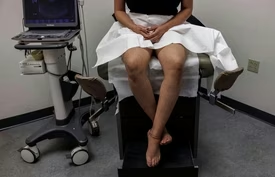
For our series The Next Frontier, special correspondent Sarah Varney reports, these organizations are a growing part of the anti-abortion movement in a post-Roe America.
HANA MILLER, Minnesota Native: And I was terrified.
I mean, like, no 18-year-old wants to find themselves in that position.
SARAH VARNEY: Four years ago, Hana Miller, then a freshman at Brandeis University outside of Boston, became pregnant.
After searching for abortion care on the Internet, the Minnesota native called one of the first clinics to pop up.
HANA MILLER: They were really trying to, like, beat around the bush, really trying to just get me there.
SARAH VARNEY: What happens when you went inside?
HANA MILLER: It looked exactly like any doctor's office, down to a woman in scrubs.
WOMAN: Hello.
SARAH VARNEY: But partway through the appointment, Hana realized she had come to the wrong place.
Instead of an abortion clinic, Hana was sitting in a crisis pregnancy center.
Known as CPCs, these mostly faith-based nonprofits offer resources to pregnant women to steer them away from abortion.
But reproductive rights advocates in the medical community have criticized CPCs for using deceptive and at times unsafe practices.
HANA MILLER: They told me that I was eight weeks pregnant at a time when I was six weeks pregnant.
SARAH VARNEY: Did anything she said change your mind?
HANA MILLER: No.
It made me kind of more resolved in my decision.
But it changed fundamentally the way that I felt about it.
It felt like something I needed to be ashamed of.
SARAH VARNEY: These centers are part of a larger strategy, says Carrie Baker, in the next frontier of the anti-abortion movement.
CARRIE BAKER, Smith College: When people think of the anti-abortion movement, they think of the push to try to make abortion illegal.
And they haven't focused as much on the ground game, which is what CPCs are.
SARAH VARNEY: Baker teaches gender, law and public policy at Smith College.
She says after many abortion clinics were forced to close post-Roe, the conservative Christian movement has prioritized replacing them.
MAN: Don't murder an innocent child.
SARAH VARNEY: As of last year, there were more than 2,600 crisis pregnancy centers and only 765 abortion clinics in communities across the U.S.
Many of these centers, which typically provide free diapers, pregnancy tests and anti-abortion counseling, offer health care services and medical advice without a license.
CARRIE BAKER: As these clinics get more and more things like ultrasounds and appear more and more medical and encourage people to rely on what they're saying, they're more of a danger.
I wouldn't call them medical providers.
I would call them political organizations who are often not revealing their political agenda, at least initially.
SARAH VARNEY: Baker points to cases where patients were misdiagnosed, delaying needed medical care, or were misled about the safety of abortion.
And because nearly all of the centers are not licensed medical clinics, and, because of that, not subject to federal health care privacy laws, critics worry about what they are doing with patient information.
CARRIE BAKER: There's a fair amount of evidence that anti-abortion crisis pregnancy centers are collecting information about people, and they're creating a mass database of young pregnant women or people that may not yet be pregnant, but might become pregnant.
My concern about CPCs is that they are actually surveilling women for criminal prosecution.
SARAH VARNEY: This year, the crisis pregnancy center industry is expected to bring in more than $2.5 billion.
From 2017 to 2023, nearly $430 million in federal dollars were awarded to more than 650 CPCs across the country through teen pregnancy prevention, welfare, and other federal programs.
And though a majority of funding for CPCs is from churches and private donors, an increasing amount is coming from state taxpayer dollars.
BRIAN WESTBROOK, Executive Director and Founder, Coalition Life: We stand here today because Planned Parenthood and their allies want to destroy life and not protect it.
SARAH VARNEY: At the center of the abortion fight today, Missouri is home to more than 90 CPCs.
BRIAN WESTBROOK: We want them to be the best darn mom they possibly can be, and that's where we come in.
SARAH VARNEY: Brian Westbrook is executive director of Coalition Life.
The anti-abortion group runs a crisis pregnancy center in the St.
Louis suburbs.
They send out protesters for so-called sidewalk counseling to abortion clinics in and out of the state.
BRIAN WESTBROOK: We never believed that any mother wakes up in the morning saying, yes, I really want an abortion.
I don't think anyone ever wakes up thinking they're excited to do that.
And so what we want to do is we want to coach them.
Then they can kind of pause, think about it, make a logical decision of, yes, maybe I shouldn't go through with this abortion.
SARAH VARNEY: Westbrook says they served around 1,100 women last year and on average helped four to five people per day.
BRIAN WESTBROOK: Our goal is to create a family unit that the child would be in a good spot to go into, to be born into.
SARAH VARNEY: The center offers pregnancy and STI testing, ultrasounds and pregnancy coaching.
Westbrook says that work is made possible because of private donors.
In Missouri, residents receive a 70 percent tax credit when they donate to groups like Coalition Life.
Last year, the state approved $11 million in these tax credits.
That's on top of the state's long-running Alternatives to Abortion program, which received more than $8 million in 2024.
BRIAN WESTBROOK: It certainly does help.
It helps our donors for sure.
They become a little bit more generous.
But I try to stay away from government funding as much as we possibly can.
For some pregnancy centers, that's fantastic for them.
For us, we want to be able to operate as independently as humanly possible.
And we know that a lot of government funding comes with a lot of strings.
SARAH VARNEY: Missouri is not alone.
From 2021 to 2024, anti-abortion centers in at least 21 states received funding through grants, state programs, budget allocations or tax credits.
Carrie Baker says, even in states where abortion is legal, crisis pregnancy centers are hard to hold accountable.
CARRIE BAKER: Just like a church can say whatever it wants on a Sunday morning, they're like, we're like a church.
We can say whatever we want.
We don't charge for our services, so we can't be regulated.
We don't have to reveal any information.
SARAH VARNEY: But that may be changing in Massachusetts.
Last year, a CPC in Worcester settled a lawsuit that alleged a nurse failed to diagnose an ectopic pregnancy.
That's when a fertilized egg implants outside of the uterus, a condition that is dangerous if left untreated.
The woman survived, but needed emergency surgery for massive internal bleeding.
NARRATOR: Whether you need pregnancy care or abortion care, avoid anti-abortion centers.
SARAH VARNEY: That summer, Governor Maura Healey, a Democrat, launched a $1 million education campaign to discourage residents from going to CPCs.
STATE SEN.
BECCA RAUSCH (D-MA): In order to get at anti-abortion centers, at this very real problem and threat to the health and safety of a lot of people, we have to do it in a way that does not run afoul of the First Amendment.
That's hard to do.
SARAH VARNEY: Democratic State Senator Becca Rausch authored a bill requiring a licensed health care professional to supervise any ultrasound related to a pregnancy.
It was signed into law last year.
STATE SEN.
BECCA RAUSCH: Because of search engines and algorithms and money, a lot of times, the first places that pop up are these anti-abortion centers.
But if they can't provide any ultrasound services because it's illegal in Massachusetts for them to do so because they lack a license and the appropriate training to do so safely and accurately, then that doesn't happen at the get-go.
SARAH VARNEY: But some groups are pushing back.
Your Options Medical, which runs centers in Eastern Massachusetts, is suing the state, saying its education campaign violates the group's free speech and equal protection rights.
HANA MILLER: This experience, for all intents and purposes, it did not have the effect that they wanted it to in so many ways.
SARAH VARNEY: Weeks after her CPC appointment, Hana was able to get abortion care at a licensed clinic near Boston.
She says the ordeal inspired her to study reproductive health and policy.
HANA MILLER: Class of 2025, we made it.
SARAH VARNEY: This may, she graduated with a degree in public health.
HANA MILLER: I felt incredible shame, incredible guilt.
I was so embarrassed.
And I felt stupid.
Like, how could I not have seen this sooner?
And I have thought about this for a long time, and I have kind of come out saying, you should not feel that.
They should feel that.
SARAH VARNEY: Hana hopes talking about her experience will help others avoid the same pain in the future.
For "PBS News Hour," I'm Sarah Varney in Massachusetts.
AMNA NAWAZ: And we will be back shortly.
But, first, take a moment to hear from your local PBS station.
GEOFF BENNETT: It's a chance to offer your support, which helps to keep programs like this one on the air.
AMNA NAWAZ: For those stations staying with us, we bring you now an encore report on this Cyber Monday.
Many of the products Americans will buy today and over the holiday season are made overseas.
That's despite rising prices from tariffs.
GEOFF BENNETT: So, why is it so difficult to manufacture affordable goods here in the U.S.?
Economics correspondent Paul Solman reports.
DONALD TRUMP, President of the United States: So we're going to have made in the USA like we haven't had before in a long time.
MAN: More consumers are searching for made-in-the-USA labels.
PAUL SOLMAN: The economic battle cry these days.
WORKERS: Made in America!
MAN: Buy made in America.
PAUL SOLMAN: Sounds great.
DONALD TRUMP: The days of making our parts all over the world because we have wonderful partners, no, it's America first now.
PAUL SOLMAN: And even before President Trump began announcing tariffs to bring back American manufacturing, in Huntsville, Alabama, Destin Sandlin was already on the case.
DESTIN SANDLIN, Host, "Smarter Every Day": Is it possible to make something in America and be competitive in the marketplace?
PAUL SOLMAN: Sandlin is a rocket scientist and engineer who used to test missiles for the military.
He now hosts the wildly popular "Smarter Every Day" series on YouTube, more than 11 million subscribers.
He's explored everything from why humans don't die at birth, to how to survive an underwater helicopter crash, to what happens to a baseball when it goes past the speed of sound.
How do you come up with topics?
DESTIN SANDLIN: That's just whatever I'm interested in.
That's the only requirement.
PAUL SOLMAN: His off-the-wall latest experiment, to manufacture a product, every single part of which is made in the USA.
DESTIN SANDLIN: Could we even do it?
Could we make the tools necessary to make things in America?
Not long after, Sandlin met Alabama businessman John Youngblood, who wanted to make a barbecue grill scrubber using chain mail, instead of the standard bristles, which: JOHN YOUNGBLOOD, Owner, JJGeorge: Those metal bristles, like a wire brush... will break off and people are swallowing them.
PAUL SOLMAN: Really?
JOHN YOUNGBLOOD: And then you're going to the doctor.
If you ask any E.R.
doctor, everybody's seen it.
PAUL SOLMAN: Sandlin saw his opportunity.
JOHN YOUNGBLOOD: Destin asked me straight up, he's like, hey, would you be willing to go in with me on this product and we can make it all here in the U.S.?
And I was like, absolutely.
PAUL SOLMAN: But it was.
And so, in 2021, the pair set out.
CHRIS ROBSON, The Robson Company, Inc.
: So I guided them how to mold and how to make molds.
PAUL SOLMAN: They lucked out at first, finding tool and diemaker Chris Robson, about to turn 70.
CHRIS ROBSON: So, when they finished the molds, we checked them out, made sure everything was going to work for us.
PAUL SOLMAN: And they started making some of the scrubbers first parts.
But, says Sandlin: DESTIN SANDLIN: Manufacturing capacity in America has been gutted.
If Chris had decided to retire before I needed that mold made, we would not have been able to make an injection mold in my area.
PAUL SOLMAN: Or who knows where, given the state of manufacturing in the U.S.
CHRIS ROBSON: Tool and die trade is suffering greatly by the fact that we're losing tool and diemakers.
Most of them are about my age.
We don't have any younger people stepping up to take the place of the people that are retiring.
PAUL SOLMAN: And when they look for the simplest part, a plain old steel bolt that would also be made in America: JOHN YOUNGBLOOD: This little stainless steel bolt right here is a one-inch bolt.
DESTIN SANDLIN: I talked to a bolt manufacturer, and he said, yes, we can't get the material for that.
We can't even buy the steel to make the bolt for that cost.
So, good luck.
Also, I think what you're doing is great young man in Alabama, but I don't think you're going to get there.
PAUL SOLMAN: Eventually, they found a bolt maker in Massachusetts.
JOHN YOUNGBLOOD: We could buy that bolt for a nickel made overseas and we pay 38 cents a piece for these bolts.
PAUL SOLMAN: As for the scrubbers steel handle... And how many parts do you make here, would you guess?
WESTON COLEMAN, T&C Stamping, Inc.
: Tens of millions.
PAUL SOLMAN: Enter Weston Coleman at T&C Stamping, in Athens, Alabama.
WESTON COLEMAN: So the first station, we actually bend of the handle down.
We just make sure this handle is wrapped fully around on the end.
PAUL SOLMAN: But doing the work in America costs way more than, say, in China.
WESTON COLEMAN: For every dollar that we would quote a bill for, they're quoting it for 25 cents.
PAUL SOLMAN: Though, long term, Coleman says, offshoring has its own costs even before adding possible tariffs.
WESTON COLEMAN: There's hidden costs.
There's maintenance costs.
There's going to be quality issues, and quality costs money, especially if it's a long-term part.
PAUL SOLMAN: In short, another example of manufacturing myopia in America, but, so far, all parts made in America, including the molded knob that holds the scrubber to the handle, or so they thought.
DESTIN SANDLIN: This was originally supposed to be made in America, but the box came in, and they said made in Costa Rica.
JOHN YOUNGBLOOD: That's right.
That's right.
We thought they were made in Mississippi.
PAUL SOLMAN: They were not.
DESTIN SANDLIN: One of the things we're realizing is, the only things we can verify are made in America are the things that we 100 percent control the supply chain of, because we manufactured it or watched it being manufactured.
Wouldn't you say that?
OK, four years on, the scrubber is for sale online for $75, a little less at a local Alabama grill store.
JASON PEASLEE, Southern Hearth and Grills: So we have been in business since 1982.
PAUL SOLMAN: But given the sky high costs of made in America, will anyone buy it?
Are they selling or?
JASON PEASLEE: Yes.
I wouldn't say necessarily like hotcakes because grill brushes are not necessarily the hottest commodity right now, but they are selling.
PAUL SOLMAN: So this is how much?
JASON PEASLEE: Sixty dollars.
PAUL SOLMAN: And what's the competition?
JASON PEASLEE: The probably closest thing on this would be this triple row brush from Napoleon.
PAUL SOLMAN: And how much is this?
JASON PEASLEE: Twenty-one.
PAUL SOLMAN: Thrice the price, but worth it says salesman Jason Peaslee.
Is it a selling point that this is just made in America?
JASON PEASLEE: Absolutely.
PAUL SOLMAN: But four long years, a lofty price tag because of made in America, and yet still not everything is.
DESTIN SANDLIN: We're not going to turn around American manufacturing with a grill scrubber being made in Alabama.
It's not going to happen.
But we might excite somebody in Nebraska.
And I think that's important, because I think the future is for people who make things.
PAUL SOLMAN: I think everybody in the audience would be sympathetic to what you're saying.
But I think they'd also be skeptical that we could turn things around.
DESTIN SANDLIN: It's never going to happen if you don't try.
So someone has to be stubborn enough to try it and see what happens.
PAUL SOLMAN: Stubbornness, a product still very much made in America.
For the "PBS News Hour," Paul Solman in Huntsville, Alabama.
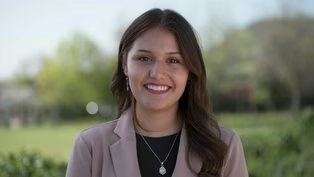
AMNA NAWAZ: In this season of gathering around the table, we hear from self-proclaimed proud ag youth Anixia Davila from Salinas Valley, California, known as the Salad Bowl of the World.
GEOFF BENNETT: Davila has led her high school chapter of Future Farmers of America, which has more than a million students participating nationwide.
Tonight, she shares her Brief But Spectacular take on what she's learned about leadership, responsibility, and community through farming.
ANIXIA DAVILA, Future Farmers of America: The poem I'm reciting is lineage by Margaret Walker.
"My grandmothers were strong.
They followed plows and bent to toil.
My grandmothers are full of memories, smelling of soap and onions and wet clay with veins rolling roughly over quick hands.
They have many clean words to say.
My grandmothers were strong.
Why am I not as they?"
My grandmothers were both from Mexico and they migrated here to America and they're very much my role models.
My father and my brother both work in the agriculture industry in the Salinas Valley.
The Salinas Valley is sometimes referred to as the Salad Bowl of the world.
Gonzales is a small little community town.
It's surrounded by fields.
We're also kind of split by the freeway, so sometimes they're also called like a little gas station stop.
Entering my freshman year, I chose to take ag biology instead of regular biology because I was introduced to the FFA program, which is Future Farmers of America.
Once your food reaches a table, I mean, it's gone through so many processes in order for you to be able to safely consume it.
There's so many different jobs in the agriculture industry that you don't necessarily think of off the bat.
Like, there's plant science.
There's animal science.
There's the dairy farmers.
I raise livestock for FFA, and I'm currently raising a market goat called Grover.
And he is such a silly little goat.
We have a farm at our school.
And so I go and I feed him in the morning and then in the afternoons.
Probably, after this, I will go and feed him again.
Being an ag youth is definitely empowering.
Agriculture in general is just so diverse.
It's definitely a battle that we face to educate people that the agriculture industry isn't just a farmer in a field.
My name is Anixia Davila, and this is my Brief But Spectacular take on representing ag youth.
GEOFF BENNETT: Well she is delightful.
And you can watch more Brief But Spectacular videos online at PBS.org/NewsHour/Brief.
AMNA NAWAZ: And that is the "News Hour" for tonight.
I'm Amna Nawaz.
GEOFF BENNETT: And I'm Geoff Bennett.
For all of us here at the "News Hour," thanks for spending part of your evening with us.
A Brief But Spectacular take on community through farming
Video has Closed Captions
Clip: 12/1/2025 | 2m 40s | A Brief But Spectacular take on leadership and community through farming (2m 40s)
Crisis pregnancy centers' role in the anti-abortion movement
Video has Closed Captions
Clip: 12/1/2025 | 9m 30s | Rise of crisis pregnancy centers highlights shift in anti-abortion movement (9m 30s)
Tamara Keith and Amy Walter on reaction to boat strikes
Video has Closed Captions
Clip: 12/1/2025 | 9m 15s | Tamara Keith and Amy Walter on the political reaction to Trump's boat strikes (9m 15s)
'That 2nd strike was a violation,' ex-military lawyer says
Video has Closed Captions
Clip: 12/1/2025 | 6m 15s | 'That 2nd strike was a violation of the laws of war,' former senior military lawyer says (6m 15s)
Trump administration declines to mark World AIDS Day
Video has Closed Captions
Clip: 12/1/2025 | 7m 45s | Trump declines to mark World AIDS Day as funding cuts threaten HIV-prevention efforts (7m 45s)
White House confirms U.S. fired twice at alleged drug boat
Video has Closed Captions
Clip: 12/1/2025 | 3m 57s | White House says U.S. fired twice at alleged drug boat, raising bipartisan legal concerns (3m 57s)
Providing Support for PBS.org
Learn Moreabout PBS online sponsorship
- News and Public Affairs

FRONTLINE is investigative journalism that questions, explains and changes our world.

- News and Public Affairs

Amanpour and Company features conversations with leaders and decision makers.












Support for PBS provided by:
Major corporate funding for the PBS News Hour is provided by BDO, BNSF, Consumer Cellular, American Cruise Lines, and Raymond James. Funding for the PBS NewsHour Weekend is provided by...