
February 18, 2026 - PBS News Hour full episode
2/18/2026 | 57m 46sVideo has Closed Captions
February 18, 2026 - PBS News Hour full episode
February 18, 2026 - PBS News Hour full episode
Problems playing video? | Closed Captioning Feedback
Problems playing video? | Closed Captioning Feedback
Major corporate funding for the PBS News Hour is provided by BDO, BNSF, Consumer Cellular, American Cruise Lines, and Raymond James. Funding for the PBS NewsHour Weekend is provided by...
Support provided by:

February 18, 2026 - PBS News Hour full episode
2/18/2026 | 57m 46sVideo has Closed Captions
February 18, 2026 - PBS News Hour full episode
Problems playing video? | Closed Captioning Feedback
How to Watch PBS News Hour
PBS News Hour is available to stream on pbs.org and the free PBS App, available on iPhone, Apple TV, Android TV, Android smartphones, Amazon Fire TV, Amazon Fire Tablet, Roku, Samsung Smart TV, and Vizio.
Providing Support for PBS.org
Learn Moreabout PBS online sponsorshipAMNA NAWAZ: Good evening.
I'm Amna Nawaz.
GEOFF BENNETT: Good evening.
I'm Geoff Bennett.
AMNA NAWAZ: And I'm Amna Nawaz.
On the "News Hour" tonight: Meta CEO Mark Zuckerberg takes the stand in a landmark trial on the addictive nature of social media.
We hear from a parent about the risks to kids.
MAURINE MOLAK, Co-Founder, Parents for Safe Online Spaces: These social media companies are designing them in a way that are addicting our children and they're operating with complete impunity.
GEOFF BENNETT: The U.S.
says it will further reduce its troop presence in Syria after fighting ISIS there for the last decade.
AMNA NAWAZ: And the immigration crackdown in the Twin Cities creates long-term uncertainties for the area's teachers and students.
GAEL, Student: I'm trying to overcome.
I'm trying to just go on without it, but the more it hits me, the more I get sad and scared.
(BREAK) AMNA NAWAZ: Welcome to the "News Hour."
Meta CEO Mark Zuckerberg took the stand in a Los Angeles federal court today to defend his company and its platform Instagram against allegations it was deliberately designed to be addictive to children and teens.
It's the first time he's testified about child safety in front of a jury.
The trial focuses on a now 20-year-old woman known by her initials, KGM, who says she became addicted to social media as a young girl and that excessive use exacerbated her depression, anxiety and suicidal thoughts.
GEOFF BENNETT: At issue is whether tech companies, despite knowing it would cause psychological harm, intentionally design their social media platforms to hook young users with addictive features like infinite scroll, personally tailored algorithms and push notifications.
YouTube is also included in the lawsuit.
TikTok and Snapchat chose to settle before the trial started.
The outcome will have big implications for some 1,600 similar cases across the country and could lead to monetary damages or force major changes to the platforms themselves.
For more we're joined now by NPR tech correspondent Bobby Allyn.
Bobby, it's always good to see you.
So what is the central legal question in this case and what stands out about the strategy the plaintiffs are pursuing here?
BOBBY ALLYN, Business and Technology Reporter, NPR: The central question is, are these tech companies legally culpable for hooking young people to social media apps?
And what that essentially will mean is, will they have to pay billions of dollars in monetary damages?
Will they have to make sweeping reforms to Instagram, to YouTube?
And what did they know about the harms to young people?
What did they do to conceal it to the public?
And, very importantly, Geoff, was this deliberate?
GEOFF BENNETT: As Amna mentioned, the Meta CEO,Mark Zuckerberg, he testified under oath.
What was the atmosphere in the courtroom?
You were there.
And what did he say?
BOBBY ALLYN: Yes, so Zuckerberg took the witness stand.
And you could tell he was getting kind of testy.
He often responded by saying things like, "I think you're mischaracterizing me," or "That's not what I said at all," or "I think you're taking this document out of context."
Zuckerberg was trying vociferously to demonstrate that the lawyers in the case were basically trying to lawyer him, right, to try to catch him in a gotcha moment.
But, meanwhile, what the plaintiff's lawyers were really focused on was trying to really illustrate that Zuckerberg himself was interested in recruiting and retaining children as young as 11 years old to Facebook and Instagram and keeping them on the platform for as long as possible with all of these very sticky features like likes and push notifications and beauty filters, was something that Zuckerberg himself ordered.
GEOFF BENNETT: Well, how challenging will it be for the plaintiffs to prove that these platforms were intentionally addictive?
BOBBY ALLYN: It's going to be a really uphill battle, because it's one thing that social media apps have fueled people's feelings of depression, body dysmorphia, suicide ideation, all of these other mental health issues, right, to sort of exacerbate that.
It's another to cause it.
And what experts say is adolescent mental health issues have a lot of sort of very complex root causes.
And this case is going to hinge on what degree the jury believes the companies themselves caused the mental distress that so many of these young people have experienced.
And we have one person here who's now in her 20s who says she got addicted to TikTok and Instagram and YouTube very young, but there are 1,600 other plaintiffs who have consolidated into this giant legal case against these tech giants.
So the verdict here from this jury is going to have a really, really far-reaching impact on all of these other cases that are awaiting the outcome.
GEOFF BENNETT: In the 30 seconds we have left, Bobby, for decades, as you all know, tech companies have relied on Section 230.
It's this federal law that shields these platforms from liability for user-generated content.
How does that play into all of this?
BOBBY ALLYN: Exactly.
So people say social media addiction, isn't that kind of an old issue?
We have been debating that for decades.
The reason why we haven't had a big trial until now is because of Section 230, which is a sort of impenetrable fortress for Silicon Valley.
Any time you try to sue Meta or Google or TikTok, they invoke Section 230.
The lawsuit goes away.
What's novel here, Geoff, is the legal approach.
They are attacking Meta and Google by saying this is a defective product, similar to how tobacco was a defective product.
In the '90s, there was a huge landmark lawsuit saying that they specifically targeted and misled young people to get addicted to their product.
That is what is being compared in this case, that this is the big tobacco comparison, but in the social media era.
GEOFF BENNETT: Bobby Allyn, thanks for sharing your reporting and insights with us.
BOBBY ALLYN: Thank you, Geoff.
GEOFF BENNETT: Our Ali Rogin has more on this now from the perspective of a parent.
ALI ROGIN: Geoff, Maurine Molak lost her son, David, back in 2016 when he died by suicide.
She is not a plaintiff in this case, but she is the co-founder of Parents for Safe Online Spaces, a coalition of families who have lost children to online harms and are bringing similar lawsuits.
Maurine, thank you so much for joining us.
First of all, tell me about your son David.
MAURINE MOLAK, Co-Founder, Parents for Safe Online Spaces: Thanks for having me, Ali.
David was the youngest of three boys.
And he -- we grew up in a Christian home.
We went to church on Sunday.
He was an Eagle Scout and a basketball player.
And after a serious basketball injury, David, while he was rehabbing, turned to social media and online gaming.
And over a period of about eight, nine months, we started to see a real change in his behavior.
He was showing all the signs of a behavioral addiction.
And we were seeking out mental health supports.
And that's when he became the target of cyber-bullying by a group of classmates at his home.
And it was the final match on a huge bonfire that just exploded in our home, and David lost hope and took his own life.
ALI ROGIN: And now, today, lawyers for the plaintiffs in the social media case are arguing that this is about the ABCs, which stands for addicting children's -- addicting the brains of children, intentionally doing so.
Would you say that that has been your experience, that that is what happens to children?
And do you draw a line between David's use of social media and his death?
MAURINE MOLAK: I absolutely do believe that it played a major role, if not the catalyst of what made him take his life or to feel like that there was no way out of the situation.
In my particular situation, David's behavior was, he would get angry and aggress when we would try to get him to stop using his devices.
He was sneaking around using them when he wasn't supposed to.
He was lying about completing his schoolwork.
And then there towards the end, he started stealing from us in order to purchase virtual assets to increase his player power through some of these gaming platforms.
Even after David was medically cleared to go back and play basketball, he no longer had the desire to and he preferred to sit behind a screen.
And that's when we knew we were in this very serious situation with him.
And parents that I have been working with for the last four years or so have been crying out that these social media companies are designing them in a way that is addicting our children, and they are operating with complete impunity.
ALI ROGIN: I'd like to read from you -- to you the statement from Meta today, the parent company of Facebook and Instagram -- quote -- "We strongly disagree with these allegations and are confident the evidence will show our longstanding commitment to supporting young people.
For over a decade.
We have listened to parents to make meaningful changes, like introducing teen accounts with built-in protections and providing parents with tools to manage their teens experience."
How do you respond?
MAURINE MOLAK: Well, first of all, of course they're going to say that because they are on trial right now.
I would just say that we have been working with whistle-blowers for many years, and we know that the internal documents, we're going to see the evidence.
We're going to see new evidence that's going to be released this week that's going to show that what Meta claims is not actually the truth.
And so all of the internal documents that are going to show that even their only internal research is going to show that they were addicting kids, they knew what was happening, and they didn't do enough to stop it.
ALI ROGIN: Maurine, you were in the hearing room with Mark Zuckerberg when he testified before the Senate in 2024.
I'd like to ask you what that was like.
And how do you think parents who are in the courtroom with him today are feeling?
MAURINE MOLAK: Well, it was a very surreal moment to be that close to Mark Zuckerberg, knowing that David was harmed on his platform Instagram.
And the apology was a forced apology.
It was a very shallow apology.
But what he's done since then, actions speak much louder than words.
ALI ROGIN: Are you hoping for any recourse as a result of this particular trial?
MAURINE MOLAK: I think we're going to see the court of public opinion.
I think parents will be vindicated, I think, these families who have been talking about this and not knowing what happened what to do in order to protect their kids online.
This is not a parent problem.
So I think that what we're going to see is actual change is going to come out of these -- this trial.
This is not the only trial we're going to see.
There's many more to come.
ALI ROGIN: Maurine Molak, co-founder of Parents for Safe Online Spaces, thank you so much.
MAURINE MOLAK: Thank you, Ali.
AMNA NAWAZ: Another major news story today, this one oversees.
Today, a senior administration official told "PBS News Hour" the U.S.
will reduce the number of U.S.
troops who've been fighting ISIS in Syria.
The statement comes after a major shift in U.S.
policy in the country, removing support from Kurdish forces, who fight ISIS alongside American troops, to support Syria's new president, Ahmed al-Sharaa.
Meanwhile, next door in Iran, the country appears to be bracing for a U.S.
strike.
Nick Schifrin is following all of this, and he joins us now.
So, Nick, let's start with Syria.
What's the U.S.
saying about Syria?
NICK SCHIFRIN: Amna, official, that senior administration official telling me tonight that -- quote -- "The U.S.
presence at scale is no longer required in Syria, given the Syrian government's willingness to take primary responsibility for combating the terrorist threat within its borders."
But a military official tells me this is not a withdrawal of the 1,000 or so troops that have been stationed in Syria.
Instead, it's what this official calls a consolidation.
The U.S.
has already announced it would close two bases in Syria, and the official tells me the final number and location of U.S.
troops is dependent on how capable the Syrian government is to fight ISIS.
For the last decade, though, those U.S.
troops fought ISIS alongside the mostly Kurdish Syrian defense forces, who controlled most of the northeast, and together they liberated the area from ISIS.
But, as you said, the U.S.
is now all in with Ahmed al-Sharaa.
And, recently, central government forces overran Kurdish positions, and the U.S.
withdrew support for the Kurds.
And this past weekend at the Munich Security Conference, I cut up with Mazloum Abdi.
He is the commander in chief of the Syrian Democratic Forces.
And he warns that any U.S.
withdrawal would threaten the political agreement that he made with the central government and the fight against ISIS.
GEN.
MAZLOUM ABDI, Commander, Syrian Democratic Forces (through translator): I believe withdrawing American troops at this critical moment is not a good idea, as it will inevitably present inherent challenges, especially in the ongoing fight against terrorism.
There will be severe negative consequences.
I believe that the presence of the United States is very crucial for implementing existing agreements, achieving stability in Syria, and for the commitment of all parties to the agreements to continue, at the same time for us to continue the fight against ISIS.
NICK SCHIFRIN: But, tonight, a U.S.
military official insists no decision made to go to zero, Amna, and the U.S.
will continue to partner with the Syrian government against ISIS.
AMNA NAWAZ: Another major story you have been tracking now, the U.S.
and Iranian officials met yesterday to continue negotiations over that country's nuclear program.
What have we learned about how that negotiation went?
NICK SCHIFRIN: An Iranian official and a regional official both confirmed to me tonight that Iran has made this offer, a pause in domestic enrichment of uranium to produce nuclear fuel through the end of the first Trump administration, entering into some kind of regional consortium for enrichment in the future, and, three, exporting or diluting the highly enriched uranium -- that's one step away from weapons-grade -- that the U.S.
bombed last summer.
In exchange, Iran would ask for sanctions relief and open up to U.S.
investment.
Officials tell me the U.S.
has made a counteroffer and continues to insist that Iran permanently give up any ability to enrich uranium domestically.
And, today, we heard from White House spokesperson Karoline Leavitt hinting at that ongoing impasse.
KAROLINE LEAVITT, White House Press Secretary: There was a little bit of progress made, but we're still very far apart on some issues.
I believe the Iranians are expected to come back to us with some more detail in the next couple of weeks, and so the president will continue to watch how this plays out.
NICK SCHIFRIN: Leavitt today insisted the president's priority is a deal, but, Amna, the U.S.
has deployed what the president calls an armada to the region, including the U.S.'
largest aircraft carrier and strike group, dozens of additional fighter jets.
Former officials, analysts telling me the U.S.
is capable of delivering a strong blow against Iran, but will find it difficult to defend itself and allies from a big Iranian response.
AMNA NAWAZ: What do those former officials and analysts tell you about the chance of a deal?
NICK SCHIFRIN: Exactly what Secretary of State Marco Rubio has said in the last couple of days.
It is very difficult, because the U.S.
demands are larger than what Iran is willing to concede.
Iran will simply not give up that right for domestic enrichment, says former State Department official and current distinguished diplomatic fellow at the Middle East Institute Alan Eyre.
ALAN EYRE, Middle East Institute: What they see is, any capitulation in the face of pressure will invite further aggression.
What they're doing now is, they're getting ready to take a hit.
Satellite imagery is showing this.
Open press reporting is showing this.
I'm sure intelligence is reporting this.
While they're continuing negotiations with the U.S., they fully expect these negotiations not to result in a deal, and they're preparing themselves for a massive U.S.
military attack.
NICK SCHIFRIN: And those preparations, Amna, include steps like deploying troops across the country, dispersing decision-making authority, and fortifying nuclear sites, all signs, again, that analysts believe Iran is preparing for a U.S.
strike.
AMNA NAWAZ: Nick Schifrin tracking two major stories overseas.
Nick, thank you.
NICK SCHIFRIN: Thank you.
AMNA NAWAZ: We start the day's other headlines, meanwhile, in Northern California.
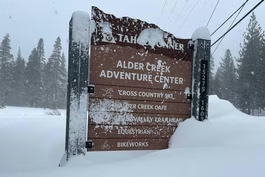
At least eight people are dead following an avalanche that tore through the Sierra Nevada, and, tonight, search-and-rescue teams are scouring the mountain wilderness for one remaining body.
Despite an urgent search-and-rescue effort overnight, tragedy in the Northern California mountains.
Of the nine missing backcountry skiers caught in an avalanche yesterday morning, nearly all of them have been found dead.
It is the deadliest avalanche to occur in the United States in more than four decades.
At a press conference this afternoon, the Nevada County sheriff said the final missing person likely perished too.
SHANNAN MOON, Nevada County, California, Sheriff: We did have a conversation with the families of the folks that are still outstanding and let them know that our mission has went from a rescue to a recovery.
It's a difficult conversation to have with loved ones, so I please ask for your patience.
AMNA NAWAZ: The group of 15 skiers in all, including four guides, were wrapping up a three-day guided backcountry tour and heading back to the trailhead when the avalanche struck at Frog Lake in the Castle Peak area northwest of Lake Tahoe.
The dispatch calls came in late yesterday morning.
EMERGENCY DISPATCH: Medical for an avalanche in the area of Castle Peak, reported as nine to 10 people buried, three others attempting to dig them out.
AMNA NAWAZ: Six skiers who were initially rescued huddled under a tarp for close to 12 hours before rescuers could reach them.
ETHAN GREENE, Director, Colorado Avalanche Information Center: When someone's buried in an avalanche, time is of the essence.
You really need to get that person out of the snow and back onto the snow surface as fast as possible.
AMNA NAWAZ: Ethan Greene is the director of the Colorado Avalanche Information Center.
ETHAN GREENE: Events like this one are quite unusual, where you have this many people involved in an accident.
And it sounds like the avalanche conditions in this area were both quite dangerous and also fairly well described and predicted by the Sierra Avalanche Center.
AMNA NAWAZ: A powerful winter storm has buried parts of California in several feet of snow since Sunday.
And gale-force winds caused whiteout conditions that slowed rescue efforts.
MAN: We're walking along the same track here.
AMNA NAWAZ: Video posted by the tour company Blackbird Mountain Guides over the weekend appeared to show that they were aware of the risk of avalanches.
The snowstorm had been in the forecast for nearly a week.
And there have been other harrowing avalanches overseas.
This one struck a moving train yesterday near the Swiss town of Zermatt.
And another avalanche likely derailed this train near the Swiss town of Goppenstein, causing several injuries.
But elsewhere across Europe, avalanches have taken dozens of lives this winter, including 10 in the Italian mountains just in the last week alone.
Also today, the current head of the National Institutes of Health is adding a new role as acting head of the CDC.
Dr.
Jay Bhattacharya's appointment is just the latest in a series of shakeups across the nation's health agencies.
He will serve until President Trump picks a permanent director, which requires Senate confirmation.
The former Stanford professor was a vocal critic of COVID era lockdowns.
Public health experts say he will face challenges running the agencies simultaneously.
They have both been hobbled by funding and staffing cuts and they're based in different cities, with the NIH in Bethesda, Maryland, and the CDC in Atlanta, Georgia.
We have an update now for you on a story that we brought you just last night.
The Food and Drug Administration reversed its decision today to consider whether to approve a new flu shot from Moderna that uses mRNA technology.
This comes a week after the FDA rejected the company's initial application, saying its research design was flawed.
Moderna is now seeking full approval for the vaccine's use in adults aged 50 to 64 and what's called accelerated approval for those 65 and older.
The company says the FDA set an August deadline for approval.
Moderna hopes to make the vaccine available later this year.
Retail billionaire Les Wexner told lawmakers today he was -- quote -- "duped by a world-class con man" as he faced questions about his association with Jeffrey Epstein.
The former Victoria's Secret boss appears in the Epstein files more than 1,000 times.
The two met in the 1980s.
Epstein later managed Wexner's personal fortune before the two had a falling out.
At a deposition in Ohio, Wexner denied wrongdoing and indeed has never been charged with any crimes related to Epstein.
But Democrats on the House Oversight Committee say Wexner enabled Epstein's crimes.
REP.
ROBERT GARCIA (D-CA): There would be no Epstein island.
There would be no Epstein plane.
There would be no money to traffic women and girls.
Mr.
Epstein would not be the wealthy man he was without the support of Les Wexner.
AMNA NAWAZ: The Epstein fallout is also playing out overseas, with prosecutors in Paris opening two new investigations into sex abuse crimes and financial wrongdoing.
Epstein owned apartments there, and officials are calling for possible victims to come forward.
More than a dozen climate and health groups are suing the Environmental Protection Agency over its axing of a rule that declared greenhouse gases a threat to public health.
The lawsuit names the EPA and its administrator, Lee Zeldin, as defendants.
Last week, the agency eliminated what's known as the Endangerment Finding, saying it hurts business.
The finding has been the legal basis for us climate regulations since 2009.
The head of one of the groups involved in the suit said the move is -- quote -- "rooted in falsehoods" and called it -- quote -- "a complete dereliction of the agency's mission to protect people's health."
Ukrainian and Russian officials are describing the latest round of U.S.-brokered talks as difficult with no breakthrough reported today.
A second day of negotiations in Geneva, Switzerland, ended without any resolution on issues like Ukraine's role in NATO, the size of its army and Russia's territorial demands.
After speaking with his delegation, Ukrainian President Volodymyr Zelenskyy described the negotiations as not easy, but he said both sides agreed to further talks.
And the head of his team said today's negotiations were, in his words, intensive and substantive.
RUSTEM UMEROV, Head of Ukrainian Delegation: There's progress, but no details can be disclosed at this stage.
The next step is to achieve the necessary level of consensus to submit the developed decisions for consideration by the presidents.
AMNA NAWAZ: Meanwhile, Russia continued its bombardment of Ukraine overnight and into today, including in the southern city of Mykolaiv.
Local media says a number of homes were hit by Russian drones, but no injuries were reported.
The region has frequently come under attack during the war, with damage to its infrastructure and power lines.
On Wall Street today, stocks ended higher, thanks largely to gains in A.I.
giant Nvidia.
The Dow Jones industrial average added nearly 130 points on the day.
The Nasdaq tacked on 175 points.
The S&P 500 also closed in positive territory.
And at the Winter Olympics today in Italy, Team USA locked in a few more medals.
And a warning, there are spoilers ahead.
Skiing star Mikaela Shiffrin snapped an eight-year Olympic medal drought by winning gold in the alpine slalom.
The men's cross-country team added to its historic run with a silver in the two-man relay.
And snowboarder Jake Canter won bronze in slopestyle, defying doctors who told him he should never snowboard again after a traumatic brain injury nine years ago.
Looking now at the total medal count, the U.S.
remains in third place with 24 medals, behind Norway and host country Italy.
Also today, a wolf dog surprised and delighted spectators by joining a ski race and crossing the finish line.
It's believed that 2-year-old Nazgul was on a walk with his owner and got loose.
And while he surely is a good boy, Nazgul is not in medal contention.
Still to come on the "News Hour": a massive sewage spill in the D.C.
region's Potomac River becomes a political flash point; a look at two Texas primaries that could be bellwethers for the upcoming midterms; and actor Ethan Hawke discusses his Oscar-nominated performance in "Blue Moon."
GEOFF BENNETT: Last week, White House border czar Tom Homan announced the end of the sweeping immigration crackdown in Minnesota.
Despite some signs of a slowdown in enforcement, parts of the state continue to see a presence of federal agents.
That's as beleaguered Twin Cities communities are grappling with what comes next.
And, as special correspondent Fred de Sam Lazaro reports, area schools may face the longest road back to normal.
FRED DE SAM LAZARO: Many of the sites at Valley View Elementary are entirely familiar, young students shuffling single file through the halls, vocabulary lessons in colorful classrooms, and footraces at recess when the temperature climbs above freezing.
But all around, there are reminders of just how unusual the past several weeks have been, an entryway filled with donated food, a parking lot where community volunteers pick up students for parents unable to venture out, and classrooms that have seen up to one-fifth fewer students than normal.
JASON KUHLMAN, Principal, Valley View Elementary: I think we try to minimize it, but I think the trauma is already there.
FRED DE SAM LAZARO: Jason Kuhlman is the principal at Valley View.
Four of his students were detained during Operation Metro Surge.
And he says there's been a near constant presence of ICE in neighborhoods around the school.
JASON KUHLMAN: I think the hardest thing is the helplessness.
We can't stop an abduction.
We can't stop ICE taking people.
What we have to do is pick up the pieces.
FRED DE SAM LAZARO: Valley View, a majority-Hispanic school in the immigrant heavy Minneapolis suburb of Columbia Heights, began offering a virtual option in late January for families too scared to send their kids in person.
About 70 students are still learning remotely.
JASON KUHLMAN: Our kids start looking and they start seeing those empty chairs and it's consistent, and you see our staff start getting anxious because they know what happened.
And that's where it hits.
FRED DE SAM LAZARO: One of those empty chairs belongs to 5-year-old Liam Conejo Ramos.
His story gained international attention last month when he and his father were detained by federal agents on their way home from school.
A judge ordered their release, but Liam hasn't returned to Valley View yet.
Despite his family's active asylum case, the Trump administration is pressing for their deportation.
OLIVIA, Student: It's not fair to others because, like, when he was taken, his parent -- his mom would have been very, very sad.
FRED DE SAM LAZARO: When asked about Liam's case, a Department of Homeland Security spokesperson told the "News Hour" -- quote -- "These are regular removal proceedings.
He will receive full due process."
Despite the announcement that the immigration crackdown is ending, Kuhlman says there's mounting uncertainty from Minnesota schools.
JASON KUHLMAN: Parents need a little time to believe that and trust that and see it with their own eyes.
It scares us.
I mean, we're always looking at the future.
I'm always keeping an eye on my enrollment.
We're having families self-deport.
They're going, no, it's not worth it.
It's not worth being taken to detention centers and sitting there for that long.
They're opting just to leave.
That's the impact that we don't know yet.
FRED DE SAM LAZARO: Since school funding is tied to attendance, a drop in student population could mean a loss of money just when educators need it most.
But even more pressing, Kuhlman says, is the lasting impact on Valley View's students.
GAEL, Student: Sometimes, ICE take away people, and sometimes people shoot other people while they're trying to protest to stop ICE.
It feels like it's not nice.
FRED DE SAM LAZARO: And how does that make you feel?
GAEL: Bad.
I feel scared.
I'm trying to overcome.
I'm trying to just go on without it, but the more it hits me, the more I get sad and scared.
FRED DE SAM LAZARO: DHS told the "News Hour" - - quote -- "The Trump administration will not tie the hands of our brave law enforcement and instead trust them to use common sense.
ICE is not going to schools to arrest children.
We are protecting children."
Nicole Herje, Valley View's social worker, says her students see things differently.
NICOLE HERJE, Social Worker, Valley View Elementary: I'm worried about kids playing soccer this summer and the ref blowing the whistle, and that will be a trigger that ICE is nearby.
I mean, we're talking months, years before they will be at a place where they can tell the difference between what is a real trauma trigger and what is actually safe.
FRED DE SAM LAZARO: In the past, Herje would meet with a handful of students every day.
Now she says it's entire classes or more.
NICOLE HERJE: I think Columbia Heights is in a public health crisis right now.
It's this cycle that has started now of dependents and these families that are really relying on the school for everything.
And it's going to take a long time for them to come out of this.
And this is to no fault of their own that they're in this situation.
ZOEY SCHAUST, Second Grade Teacher, Valley View Elementary: I just worry that, in time, there will still be a need and it will just be us, and we're only teachers.
FRED DE SAM LAZARO: Staff members across Valley View have seen their roles expand in recent weeks, from coordinating food deliveries for some 150 families to making sure students get to and from school safely.
For second grade teachers Zoey Schaust, who helps wrangle kids for pickup, the new realities come with new stressors.
ZOEY SCHAUST: I have my papers and I had those attached to my teacher badge at the beginning of the school year.
I now carry around my passport attached to my teacher badge.
And I know I'm not the only one.
FRED DE SAM LAZARO: So you fear personally for your own safety when it comes to an encounter with ICE?
ZOEY SCHAUST: Yes, I don't think my teacher badge will protect me.
FRED DE SAM LAZARO: Rene Argueta, is Valley View's homeschool liaison.
He packs meals and transports kids who live too close to take the bus.
But Argueta, a green card holder, is also wary of potential run-ins with ICE.
Just moments before we spoke, reports of federal agents nearby came over his walkie-talkie.
RENE ARGUETA, Homeschool Liaison, Valley View Elementary: I know how much I can do.
I know that today, with the situation, I don't cross those doors, just because, even though I can go outside, and I will definitely do it, I try not to put myself in a situation where I will put myself or my family in danger.
But, yes, there is a concern.
But it's a risk that we're willing to take.
ELIZA FULTZ, First Grade Teacher, Valley View Elementary: We will be waiting up here.
FRED DE SAM LAZARO: First grade teacher Eliza Fultz helps with pickup time too.
ELIZA FULTZ: I have a student who, up until the last couple weeks, was focused and attentive and motivated.
He was in one home that became very targeted and very unsafe for him to be in.
And his family, in an emergency, had to dramatically evacuate.
Yesterday, he was asking me: "Can you go back to my old house and look for my bike?
I miss my bike."
So I'm going tomorrow to look for his bike, yes.
FRED DE SAM LAZARO: It's not part of the job description that you signed up for, I suspect.
ELIZA FULTZ: It's not part of the job description in one way.
But people keep saying that.
And I'm like, of course, my student who's sad and is experiencing grief and trauma in all these ways that he doesn't know how to process, of course, I'm going to help him look for his bicycle.
Of course, I'm going to show up in every way I possibly can.
Like, it's not a question.
FRED DE SAM LAZARO: On the day we visited, Fultz read from the picture book "All Are Welcome."
She asked her students to write their own messages, echoing the book's themes.
ELIZA FULTZ: One of them said: "This is our country."
And, obviously, that brought tears to my eyes.
What a beautiful statement of courage and resilience.
These kids are brilliant, and they're beautiful, and they're smart, and they're funny, and this is their home.
FRED DE SAM LAZARO: For the "PBS News Hour," I'm Fred de Sam Lazaro in Columbia Heights, Minnesota.
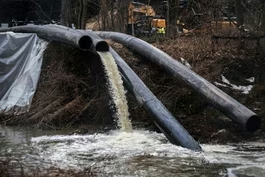
AMNA NAWAZ: An historic sewage spill along the Potomac River and the struggle to contain it are raising alarms after a major sewer line collapsed late last month, sending over 240 million gallons of waste into the water.
For nearly a week, raw sewage flowed directly into the river, before it could be diverted to a treatment facility.
Yet reports of intermittent spills have continued into February, and repairs are expected to take more than a month.
Public health experts say it could be one of the largest sewage spills in American history.
For more, I'm joined by Hedrick Belin.
He's president of the Potomac Conservancy.
Thanks for being here.
HEDRICK BELIN, President, Potomac Conservancy: Appreciate the opportunity.
AMNA NAWAZ: So let's just start with the obvious question here.
How polluted is this water after all of that sewage spilled for as long as it did?
What do we know?
HEDRICK BELIN: Well, it was certainly unprecedented, in terms of the amount of sewage going into the Potomac River, which is our nation's river, over just a week.
And water quality sampling efforts have shown astronomical levels of pollution, well, well above the EPA guidelines for what is safe for humans to touch.
And so there's a lot of work that needs to be done to address this, both in terms of the river health, but also the remediation that's going to be needed to ultimately restore the area to a place where people can splash around safely.
AMNA NAWAZ: Before we get to people in the water, what are some of the bigger environmental concerns?
What are you looking at?
HEDRICK BELIN: Well, I think at a macro level, the good news is, over decades, the Potomac River's gotten a lot better.
We come out with a river report card every couple of years, and the Potomac's clearly making a comeback.
But, unfortunately, we saw, when we released it, for example, pollution levels going down, fish populations doing better, and more people out recreating, but this amount of pollution is going to certainly change that equation.
But it also raises another interesting point, which is, this is a 54-mile-long pipe full of sewage that starts out near Dulles Airport.
And where else is the pipe susceptible to breaking?
AMNA NAWAZ: That's a big question you think we still don't have answers to.
HEDRICK BELIN: We don't have answers to that just yet.
AMNA NAWAZ: So one of the biggest questions we have heard from people in terms of the impact is on drinking water.
Do we know if this is having an impact on people's drinking water in the region?
HEDRICK BELIN: Well, the good news is, this happened just downstream of the -- where two big straws go in to take in water, drinking water.
And about five million people in the D.C.
metro area get their drinking water at home and here from the Potomac.
So we were fortunate that it happened downstream of those drinking water intakes, but it's still going to be problematic for months to come.
AMNA NAWAZ: And in terms of what we know about the spill, what does all of that mean for the risk of people going into the water?
Sounds like you don't recommend right now.
HEDRICK BELIN: No, you should stay away.
AMNA NAWAZ: For how long?
HEDRICK BELIN: Yes, you should stay away.
And for how long is unknown.
There's - - we're going to need to see continued water quality testing every day, we believe for another six months.
AMNA NAWAZ: Six months.
HEDRICK BELIN: Because even when the pollution levels are down where it's safe, the risk -- it's such a active situation that the risk for additional pollution going in, additional sewage, raw sewage, from our bathrooms going into the river remain.
AMNA NAWAZ: So the pipeline here, as you mentioned, it serves Washington, D.C., but also Maryland and Virginia counties in both of those neighboring states as well.
When you talk about the cleanup and the testing that's to come, where's the accountability?
Who is responsible for all of that?
HEDRICK BELIN: Ultimately, D.C.
Water, which is a local utility, is the owner of the pipe, but Loudoun County, Fairfax County, Montgomery County all contributors.
AMNA NAWAZ: Virginia and Maryland.
HEDRICK BELIN: So, Virginia and Maryland all contribute.
They also are on the board of D.C.
Water.
Because it is such a spill into a river, the EPA needs to be involved as well.
So we have got local, state and federal entities that, frankly, we think need to display greater leadership, given the situation.
AMNA NAWAZ: Greater leadership at the federal level or at local, state as well?
HEDRICK BELIN: All three.
We're hearing from lots of concerned citizens that they aren't getting answers to what's going on, they don't understand what they should or shouldn't be doing.
And certainly they're concerned about accountability and ultimately action.
I mean, this needs to be fixed.
It needs to be fixed as soon as possible.
And we need to take steps through an independent investigation looking at root causes to make some systemic changes to make sure something like this doesn't happen again, not just here, but certainly in other cities around the country.
AMNA NAWAZ: Given the scale and the scope, is this something local and state governments can handle on their own?
Because we have seen already President Trump really put the blame on local authorities, saying this is a Maryland and Virginia problem, they should fix it.
If the EPA doesn't get involved here, can this be handled?
HEDRICK BELIN: Yes, well, I think we need the EPA because of the multistate nature that you talked about.
They play an important role.
They also play an important role with the Clean Water Act.
But the states and the localities certainly will be the ones that will end up providing a majority of the money, I suspect, in part because there's been a lot of reduction of federal funds being available for these kinds of situations.
AMNA NAWAZ: We have used words like historic and unprecedented.
For context here,are there other comparable spills you have seen in comparable waterways in other parts of the country that you can look at and people can take a timeline away from?
HEDRICK BELIN: Yes, not this kind of thing.
And, again, it's raw sewage.
It's not jet fuel.
It's not some other toxic chemical.
But it does point to nationally this is clearly a wake-up call, because these pipes were put in the 1960s, this pipe.
There's plenty of pipes that were put in, in infrastructure in the '70s, '80s, and '90s.
And what we're seeing is, if you're delaying the maintenance and investment, you're going to have a failure like this.
So we need -- both for public health, but also for recreational purposes,we need some answers that we can share with the rest of the country to make sure other cities that all have sewage pipes don't experience such a catastrophic failure.
AMNA NAWAZ: Lots of questions still.
We hope there's answers soon.
Hedrick Belin, president of the Potomac Conservancy, thank you for being here.
HEDRICK BELIN: Appreciate it.
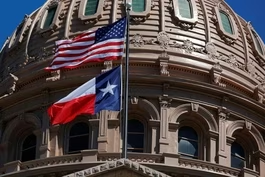
GEOFF BENNETT: Early voting is under way in Texas, a key state this year in the battle for control of the U.S.
House and Senate.
One of the leading Democrats in the Senate primary in the state, State Rep.
James Talarico, announced that his campaign raised $2.5 million in the last day after late-night host Steven Colbert said CBS blocked him from airing an interview from Talarico on his broadcast, which was later shared on YouTube.
Talarico is one of a handful of Democrats running to flip the state's Senate seat blue this fall, as longtime Republican Senator John Cornyn faces a challenging primary to remain the Republican candidate on the ballot.
For more on the political battle gearing up in the Lone Star State, we're joined now by Ashley Lopez.
She covers politics for NPR.
Thanks for being here.
ASHLEY LOPEZ, Political Correspondent, NPR: Yes, thanks for having me.
GEOFF BENNETT: So, as we mentioned, James Talarico has raised millions in this race.
He's still facing this primary challenge from Democratic Congresswoman Jasmine Crockett.
How is this contest shaping up and what does it reveal about the direction of the Democratic Party in Texas?
ASHLEY LOPEZ: The race initially was not quite as contentious.
This wasn't -- these weren't two candidates who are very dissimilar.
There's not a lot to fight about sort of substantively.
But I think, as more money is pouring in, Democrats are looking at the Republican side, that primary, how that's shaping up.
And I think they smell some blood in the water.
And so there's a lot more attention.
It's getting more contentious.
And I mean, like I said, substantively speaking, these two candidates are pretty similar.
There's not a lot of big differences there.
But, stylistically, Congresswoman Jasmine Crockett is more of a fire brand.
She seems to be very willing to take on Republicans in Congress, at least rhetorically, in a way that other Democrats aren't.
And James Talarico, who's a Statehouse member in Texas, he is trying to strike a more kind of conciliatory tone.
And so it is going to be very interesting to see what Democratic voters sort of prefer here.
GEOFF BENNETT: Let's talk about the Republicans, because, as you said, Democrats smell blood in the water for Cornyn.
John Cornyn has represented Texas in the U.S.
Senate for some 20 years.
He's now facing a primary challenge.
How real is the threat to his political future?
ASHLEY LOPEZ: I mean, if we take polling seriously, it's a pretty serious concern for him.
And this is very rare.
I should say like, it's been 14 years since a U.S.
senator has lost their primary race.
This does not happen often.
Incumbency power is very powerful.
This doesn't happen all the time.
This is another case where the candidates substantively on policy are not very different.
Ken Paxton, the attorney general in Texas, would like to position Cornyn as less of a MAGA candidate.
But if you look at his voting record, Cornyn votes with the president quite a bit.
And I think that's something his campaign says too.
But Ken Paxton is a little more stylistically like the president.
He has had a lot of legal trouble at his time as the attorney general.
So I think there's a lot of similarities there.
But that creates a situation where, is he as good of a general election candidate come November, with all the legal baggage that Ken Paxton has had in the past 10 years?
Is that going to be a liability for him?
GEOFF BENNETT: And this is also the first election since Texas' mid-cycle redistricting.
So what effect is that going to have on the House races across the state?
ASHLEY LOPEZ: There's a lot of open questions.
I think they were drawn basically to create five more safe seats for Republicans.
But Republicans did that basically by looking at particularly Latino turnout, Latino voting.
Latino voters in nature are swing voters.
I think that that's a less of a good bet than Republicans would think from what I'm seeing right now.
So we will see.
It could be that Republicans gained those five seats or maybe four, but you have to remember Texas redistricting caused other states to redistrict like California.
And so that might be a wash anyway.
GEOFF BENNETT: Yes.
Well, another reason why we're focused on Texas is because this is the first major primary contest of the year in what is expected to be a volatile political cycle.
What early signals are you watching for?
ASHLEY LOPEZ: Texas is an interesting -- it's an interesting case because the candidates are so similar.
I don't think it's going to tell us substantively what policies, what messaging works.
But I think it will tell us how fired up Democratic voters are.
Primaries by nature motivate base voters.
And this is a part of the Democratic Party that is really upset right now.
Base voters are telling Democratic leaders they're unhappy with the people that they have in power.
They're unhappy with the way Democrats have been handling the second term of the Trump administration.
And so I'm going to be curious to hear what voters are telling lawmakers now and politicians through primary elections.
GEOFF BENNETT: Every cycle, it seems, the question is asked, is this the year that Texas turns blue?
I'm not going to ask you to speculate.
Based on your reporting, what are Democrats telling you?
ASHLEY LOPEZ: There's like this narrative that Democrats have in Texas, which is demographics are destiny there.
As the state becomes more ethnically and racially diverse, by sheer numbers, Democrats will do better.
And that has not panned out for many, many cycles.
Texas is a state with uniparty control for now 30 years-plus.
That is a hard hurdle to clear.
The big wild card in all of this is if John Cornyn loses his primary race, because incumbent power is very powerful in general elections for Senate races.
And if he loses that and there is not an incumbent running against a Democrat, this is a different dynamic than we have seen in Texas in a long time.
GEOFF BENNETT: Ashley Lopez, political correspondent for NPR, thanks for being here.
ASHLEY LOPEZ: Yes, thank you.
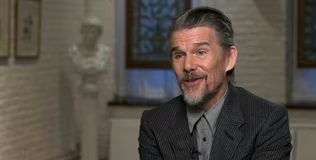
AMNA NAWAZ: Ethan Hawke has been acting since he was a teenager.
Now at 55, he has his first Oscar nomination for best actor for his role in the film "Blue Moon."
Senior arts correspondent Jeffrey Brown sat down with Hawke recently in New York for our arts and culture series, Canvas.
ETHAN HAWKE, Actor: OK, best line in "Casablanca."
BOBBY CANNAVALE, Actor: Nobody ever loved me that much.
ETHAN HAWKE: Nobody ever loved me that much.
Isn't that magnificent?
JEFFREY BROWN: In the movie, "Blue Moon" sat almost entirely on one night at Broadway's famous Sardi's Restaurant, a nearly unrecognizable Ethan Hawke plays Lorenz "Larry" Hart, one of the most brilliant lyricists in musical theater history.
But now at a party not celebrating him, he knows his time has passed.
And there's little left but to drink, talk, and talk some more, often with the bartender played by Bobby Cannavale.
ETHAN HAWKE: And, really, who's ever been loved enough?
Who's ever been loved half enough?
Would you get me a shot?
JEFFREY BROWN: You talk and talk.
ETHAN HAWKE: And I talk and talk and talk.
JEFFREY BROWN: Yes.
ETHAN HAWKE: I had this feeling about the performance that he walks into this opening night party the way a human being walks in front of a firing squad.
The only way to stop it is to talk.
JEFFREY BROWN: So you had a lot of lines to learn, for one thing.
ETHAN HAWKE: That's true too.
JEFFREY BROWN: The real Lorenz Hart was part of the Rodgers and Hart team that wrote such indelible songs as "My Funny Valentine, "A Lady is a Tramp," and, yes, "Blue Moon."
BOBBY CANNAVALE: You're unique.
ETHAN HAWKE: Sounds like you're writing my obituary.
JEFFREY BROWN: But the film captures the moment in 1943 when Rodgers, played by Andrew Scott, has had it with Hart's drinking and unreliability and teamed up with Oscar Hammerstein for the new musical "Oklahoma," the start of an even more renowned partnership, leaving Hart behind.
ETHAN HAWKE: From the moment we enter crying to the moment we leave dying, it'll just cover your face as you wail and cry and scream.
JEFFREY BROWN: Ethan Hawke first made his name as a teenager in the 1989 film "Dead Poets Society" with Robin Williams, and has built a career in film, including the "Beyond" series and "Boyhood," both for the director Richard Linklater, on stage here on Broadway in Sam Shepard's "True West" with Paul Dano, and on TV, currently on FX's "The Lowdown."
ETHAN HAWKE: I love it.
JEFFREY BROWN: In "Blue Moon," he's once again teamed up with Linklater and playing a man nearly a foot shorter than himself, here with Margaret Qualley.
Do I see Ethan Hawke?
Or you're disappearing into that character?
ETHAN HAWKE: You have to start by getting rid of everything that you identify as you, places of extreme confidence, the way I like to gesture all the time, the way that I like to speak.
You start getting extremely simple about it and then it can become additive.
JEFFREY BROWN: Is that a challenge?
Is it also fun?
ETHAN HAWKE: It's fun?
Have you ever skied to slope that's too difficult for you,and you get to the bottom of the hill and you think, ah, that was fun?
It wasn't fun while you were doing it.
It's fun because you survived.
JEFFREY BROWN: Right.
Right.
ETHAN HAWKE: And when you're doing independent film, there's just no room for error, you know?
JEFFREY BROWN: Yes.
You mean time-wise, production-wise, money-wise?
ETHAN HAWKE: Yes.
We prepped this movie for about 10 years, and we had 15 days to shoot it.
JEFFREY BROWN: Really?
ETHAN HAWKE: So... JEFFREY BROWN: So it has to work.
ETHAN HAWKE: You can't have an off-day, or this movie won't work.
JEFFREY BROWN: Yes.
For Hawke, this is also a kind of love letter to a place and time.
This film really is in old New York.
ETHAN HAWKE: It is.
JEFFREY BROWN: You like that?
ETHAN HAWKE: It's -- you know, I'm in love with this city.
And I'm in love with its history.
JEFFREY BROWN: Hawke clearly loves both the art and craft of acting and other actors.
In 2022, he directed a documentary series called "The Last Movie Stars" about Paul Newman and Joanne Woodward and told me of a lesson he applied to his portrayal of Hart.
ETHAN HAWKE: Newman used to talk about this thing I love, the correlation of opposites.
And he was also really thinking about Brando, that Brando was so extremely masculine and so feminine at the same time.
And it creates this duality where you're kind of, like, which way is the scale going to tip?
Like, who is this person?
You can't take your eyes off them.
And Larry Hart was full of opposites.
He's the most diminutive person in the room and he's the biggest person in the room.
JEFFREY BROWN: Personality-wise, yes.
ETHAN HAWKE: Yes.
He hates himself and he's arrogant.
He's gay and he's in love with a woman.
I mean, everything that I had to play, I had the -- I could play the opposite too.
JEFFREY BROWN: This is a person, in fact, who's a theater artist, right, who's known enormous success and is now finding himself irrelevant.
Now, I have to ask you, how much you feel it resonates with anything you have experienced?
ETHAN HAWKE: You can't be in the arts and not feel the vicissitudes of life, the power of hot spotlight when you're in "Dead Poets Society" and everybody loves it and everything's amazing.
It makes ordinary temperature feel extremely cold.
JEFFREY BROWN: Right.
And you felt that?
You felt that cold?
ETHAN HAWKE: I felt certain I was washed up, I mean, certain I was washed up at least three different periods I could point to where -- now, funnily enough, with the benefit of hindsight, those start to be the best times of my life, in hindsight, because when everybody's patting you on your back, it's not a great time for growth.
When everybody thinks you're an idiot, often, strangely, you kind of wake up in the morning like, I'm not an idiot, and I'm going to show that.
JEFFREY BROWN: Do you feel good about where you're at now?
ETHAN HAWKE: Well, I'd be absolutely foolish if I didn't.
I mean, I'm -- A, I'm alive.
I have four kids and a wife who loves me.
And I get to do work I believe in.
And the older I get, the more the work that I'm putting out into the world is work that it's connected to me, that I care about.
I care about this movie that I'm talking to you about today.
It's not a job to me.
It's tied up in my friendships.
It's about New York theater.
It's about people I love.
It's about music that I love.
I don't mind asking -- I have no shame in asking somebody if they'd like to see the movie.
I think it'd be 90 minutes well spent, you know?
And that's something I'm proud of.
JEFFREY BROWN: That feels good?
ETHAN HAWKE: Yes, that feels really good.
And then there's the point of where you're like, if you had told me when I started, when I was 18, that I would be being interviewed by you when I was 55 years old, I would think that I had made it.
I would feel pretty good about that.
(CROSSTALK) JEFFREY BROWN: ... combination?
ETHAN HAWKE: Yes, I would feel pretty good about that.
"The Heart Is Quicker Than the Eye," it's not a great song, but it's a good title.
And it's true.
JEFFREY BROWN: Ethan Hawke as Larry Hart vies for his Oscar on March 15.
For the "PBS News Hour," I'm Jeffrey Brown in New York.
GEOFF BENNETT: And that's the "News Hour" for tonight.
I'm Geoff Bennett.
AMNA NAWAZ: And I'm Amna Nawaz.
On behalf of the entire "News Hour" team, thank you for joining us.
Avalanche in Northern California kills at least 8 skiers
Video has Closed Captions
Avalanche in Northern California kills at least 8 skiers (2m 58s)
Ethan Hawke on his Oscar-nominated role in 'Blue Moon'
Video has Closed Captions
Ethan Hawke on his Oscar-nominated performance in 'Blue Moon' (7m 37s)

Minnesota students face fallout of immigration crackdown
Video has Closed Captions
Minnesota schools and students struggle with fallout of immigration crackdown (8m 12s)

Mother says social media built to addict children
Video has Closed Captions
After son’s suicide, mother says social media platforms are built to addict children (4m 59s)

News Wrap: Bhattacharya to serve as acting head of CDC
Video has Closed Captions
News Wrap: Bhattacharya to serve as acting head of CDC (5m 49s)
Sewage spill in Potomac becomes a political flashpoint
Video has Closed Captions
Massive sewage spill in Potomac River becomes a political flashpoint (6m 22s)

U.S. cuts forces in Syria as new leader fights terror threat
Video has Closed Captions
U.S. cuts forces in Syria as its new government fights terror threat (5m 8s)
What the Texas primaries could reveal about the midterms
Video has Closed Captions
What the Texas primaries could reveal about the midterms (5m 53s)
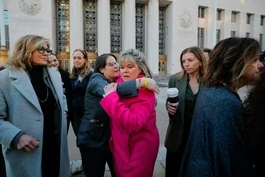
Zuckerberg takes stand in social media addiction trial
Video has Closed Captions
Zuckerberg takes stand in a landmark trial on youth social media addiction (5m 5s)
Providing Support for PBS.org
Learn Moreabout PBS online sponsorship
- News and Public Affairs

FRONTLINE is investigative journalism that questions, explains and changes our world.

- News and Public Affairs

Amanpour and Company features conversations with leaders and decision makers.












Support for PBS provided by:
Major corporate funding for the PBS News Hour is provided by BDO, BNSF, Consumer Cellular, American Cruise Lines, and Raymond James. Funding for the PBS NewsHour Weekend is provided by...