Here and Now
Here & Now for March 27, 2026
Season 2400 Episode 2437 | 26m 47sVideo has Closed Captions
Watch the entire episode of Here & Now for March 27.
Watch the entire episode of Here & Now for March 27.
Problems playing video? | Closed Captioning Feedback
Problems playing video? | Closed Captioning Feedback
Here and Now is a local public television program presented by PBS Wisconsin
Here and Now
Here & Now for March 27, 2026
Season 2400 Episode 2437 | 26m 47sVideo has Closed Captions
Watch the entire episode of Here & Now for March 27.
Problems playing video? | Closed Captioning Feedback
How to Watch Here and Now
Here and Now is available to stream on pbs.org and the free PBS App, available on iPhone, Apple TV, Android TV, Android smartphones, Amazon Fire TV, Amazon Fire Tablet, Roku, Samsung Smart TV, and Vizio.
Providing Support for PBS.org
Learn Moreabout PBS online sponsorshipPBS Wisconsin Original Production.
>> A postponed Supreme Court debate doesn't forfeit voters.
Only chance to see the candidates square off.
[MUSIC] still in session, the state legislature is not leaving residents hanging on property tax relief.
[MUSIC] I'm Frederica Freyberg tonight on "Here& Now" the state Supreme Court election approaches inside Wisconsin politics.
That's the table for you to get to know the candidates.
And Zac Schultz reports on how each candidate would respond to requests to recuse themselves on cases.
As property taxes increase while public schools vie for more funding, communities are informing the public how much is diverted to private schools.
And with millions of dollars now released by the state to address PFAs, we check back with the town of Stella to see how it could be put to use.
[MUSIC] It's "Here& Now" for March 27th.
>> Funding for Here and Now is provided by the Focus Fund for Journalism and Friends of PBS Wisconsin.
>> The morning before, the only statewide debate between candidates for Wisconsin Supreme Court this week, one of them had to pull out.
Liberal candidate Chris Taylor went to the hospital for kidney stones, according to her campaign.
Conservative Maria Lazar wished her a speedy recovery.
Now the debate has been rescheduled for next Thursday night, which puts it just five days before the April 7th spring election.
Meanwhile, the latest Marquette Law School poll found voters still don't know who they'll vote for.
Among registered voters, 53% remain undecided, with 23% supporting Chris Taylor and 17% choosing Maria Lazar and 7% saying they won't vote.
The state Supreme Court election is the focus of this week's new Inside Wisconsin Politics, with Wisconsin Public Radio reporter Shawn Johnson and Rich Kremer and PBS Wisconsin “Here& Now” reporter Zac Schultz.
>> The Wisconsin Supreme Court race is coming up, and polling shows a majority of you say you don't know enough about the candidates.
Let's fix that.
This is inside Wisconsin politics.
I'm Shawn Johnson here with my colleagues, Zac Schultz and Rich Kremer.
Hey, guys.
>> Hello.
Hey.
>> So this is not something we're just making up here.
There has been polling on this race, and the leading vote getter in that poll was a majority of people saying they don't know who they're going to support.
That is so different than in 2023 and 2025, when we in Wisconsin were the Super Bowls of election for our Supreme Court races.
So, Zac, what is the difference this year?
>> Well, the simple difference is this isn't for the majority.
The Liberals will have a four person majority for the next session no matter what.
If Chris Taylor wins, it goes to five two.
If Chris.
If Maria Lazar wins, it stays at 4 to 3.
But that simply is the difference between $100 million in campaign and the attention of the world on this very important swing state, and the court's decisions on election laws versus a snooze fest, even in the state for people that normally tune in for these elections, are still trying to figure out, oh, when is that coming up?
>> And that's not hyperbole either.
That $100 million is a real number from last election, when we shattered the 2023 record not just for Wisconsin, but for national judicial races.
Rich.
The 2025 race was the first one you'd covered really closely.
What was a day in the life like on that one, and how does it compare to what you've observed in this Supreme Court race?
>> I mean, it's like night and day.
I covered a Republican, former Republican Attorney General Brad Schimel, spent a day with him on the campaign trail.
And, you know, first off, the bat, he took money directly from the Republican Party of Wisconsin.
Also, I was at a campaign event at the Republican Party in La Crosse, where Brad Schimel framed the race as a fight between good and evil.
And he also used an analogy of driving the serpent out of the Garden of Eden.
So the.
The language used by Schimel is very different than what we've seen from Judge Lazar.
She's promoting that she is the independent candidate compared to Chris Taylor, who she attacks as being an activist and former Democratic lawmaker.
But she just hasn't made the same kind of statements that I've heard that Schimel did last year.
>> It's almost like an old fashioned Supreme Court race in Wisconsin, Zac.
>> It harkens back to a day where things weren't as heated that your your TV wasn't filled with ads nonstop in the lead up to it, where you really did have to pay attention to learn who these people were.
Now it's still Republican Democrat, you know, they may use the labels conservative, liberal, but Chris Taylor is a former legislative Democrat but now independent judge.
But her connections to the Wisconsin Democratic Party to the Republican Party covered go deep.
I've attended multiple events with her.
She's been speaking at GOP rallies with the next speaker's Eric Toney running for attorney general.
So it's not like either of these are running down independent lanes.
They're still following that traditional the new path.
If you want to become on the Supreme Court, you keep the political parties at arm's length in your name, but you take all the money under the table.
You take all their effort for grassroots, because that really matters when when it comes to getting people out to vote, those turnout operations, those dollar operations still belong to the parties.
There is no independent structure for anyone to remain independent and actually win a campaign.
>> Zac, what should people know about Chris Taylor's background and what led her to this point?
>> She's got heavy partizan activity in her background and she doesn't deny that.
But like every judge or justice, she wouldn't be former Justice Prosser served as the Assembly speaker for Republicans.
And back in the day when they could say, well, I'm a conservative justice, not a conservative politician with Chris Taylor in this modern environment, I don't know if it really matters because the candidates are so tied to the parties anyway that her background doesn't seem to have any baggage.
And we saw with Brad Schimel Rich, as you were talking about last year, he's a former Republican attorney general for Wisconsin, and he did not shy away from those Republican connections.
But you see a difference with Lazar and how she's handled herself.
>> Yes, she's she's leaning on her, you know, her experience in the courtroom, but also, you know, her political ads kind of let you know where she stands on certain things, or at least where her campaign does.
So there's plenty of signals out there.
>> You know, some of these candidates, when they run for Supreme Court, they come from the law.
And maybe you're hearing about them for the first time or getting introduced to them for the first time.
But, you know, Chris Taylor and Maria Lazar, as you both mentioned, have been around for a little while.
I remember Maria Lazar defending Republican drawn legislative maps in 2012 alongside co-counsel Dan Kelly, who former Supreme Court justice and who ran in a couple races in lost.
I remember Chris Taylor very well for her role in the minority on the Legislature's Budget Committee, where if you have that position, you are expected to be able to talk and defend every position and and attack the majority's position aggressively.
And so she did that.
Well, she wasn't just a backbencher legislator.
She was the person who was on that front line of attack.
And, you know, since we've since she's become a judge, that's changed.
And she has indicated and her friends have indicated, look, she knows this is a different role on the court, but it is striking a very big change for her to go from that, you know, attack, attack, attack Democratic legislator to a judge going to see things differently.
Rich, there was another finding in the Marquette poll that we recently covered that, you know, it's hard to say where people stand on the candidates when more than half of voters say they don't know.
But what we did see, what you saw.
There's a lot of tells in there about which side is more enthusiastic right now at this moment in time.
>> Yeah.
Big time.
There was a big disparity in terms of who's excited to vote in the April 7th election.
So some numbers I'll run off here.
People saying that there are certain to vote on April 7th.
Democrats are up 18 points over Republicans.
How important the election is to the outcome or how important is the election outcome to you?
That was a 19 point spread in Democrats favor as well.
So there's all kinds of metrics.
And not to mention that President Trump had his lowest net negative approval rating in Marquette poll history.
So those are all some headwinds for conservative candidates.
>> For the full episode, look for Inside Wisconsin Politics at and PBS, Wisconsin Dot, YouTube, and wherever you get your podcasts.
With more on the statewide race.
Elections for Wisconsin Supreme Court have become more expensive and more partizan than ever before.
And while justices on the court are technically independent, they are easily sorted into liberal and conservative groups that can create an appearance of bias in the eyes of some people, and has led to an increase in the number of requests for justices to recuse themselves from a case "Here& Now".
Senior political reporter Zac Schultz has more.
>> So that's when I say yes, those maps are rigged.
>> In 2023, Janet Protasiewicz ushered in a new era in Wisconsin Supreme Court elections by openly talking about her values.
While on the campaign trail, she called legislative maps passed by Republicans and adopted by the Supreme Court rigged.
Since then, multiple lawsuits filed against those maps have come before the court, and each time lawyers representing the Republicans have asked Protasiewicz to recuse herself, resting part of their case on this very interview she conducted with us each time she said no, concluding the presumption of impartiality stands.
I therefore deny the motion for my recusal.
>> Recusal is important in the sense that it is part of this big picture notion that people are entitled to unbiased adjudicators.
>> Rob Yablon is a professor at the UW Law School.
Most judicial recusals come from a judge who's already weighed in on a case, or who has a financial or personal relationship with one of the parties, but that doesn't include campaign contributions or statements from the campaign trail.
>> The expectation is that under the current rules, that judges and justices won't step aside because of their discussions of issues or values on the campaign trail, or because of money they've received.
>> Under the Wisconsin Supreme Court's own guidelines.
Each justice decides for themselves if they should recuse.
We asked the candidates in this Supreme Court election about their recusal standards.
>> I follow the rules set by the U.S.
Supreme Court as well as by the state of Wisconsin.
I've had to look at different circumstances and decide when and how to recuse.
And I always look at not only is it objectively, but subjectively biased.
So if there's an appearance of impropriety, then I will take a step back.
>> I'm instructed by my ethical obligations to look at each case on a case by case basis and make sure that I can be fair and impartial.
And that's what I do every day.
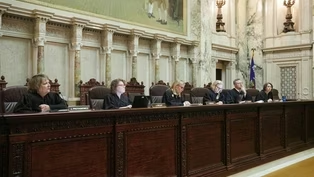
>> Two current cases have shown a new tactic in recusal requests.
Former Supreme Court Justice Mike Gableman and lawyer Jim Troupis have each attempted to remove enough justices through recusal to change the makeup of the court that would hear their case in 2020.
Troupis represented the Trump campaign as they attempted to throw out more than 200,000 votes in Dane and Milwaukee counties.
In oral arguments, he sparred with Justice Jill Karofsky.
>> And what you want is you want us to overturn this election so that your king can stay in power.
And that is so un-American.
>> Troupis lost that case, but at the same time, he was the lawyer behind Wisconsin's false elector scheme, an effort to send an alternate slate of electoral votes to Washington, DC on January 6th.
For that, he's been charged by the Wisconsin attorney general with forgery, and Troupis claims all the judges in Dane County are biased and should recuse.
His motions were rejected, and while appealing to the Wisconsin Supreme Court, he asked Justices Jill Karofsky and Rebecca Dallet to recuse based on their comments in the Trump v Biden case.
>> My investigation is just that an investigation into the extent to which elections in Wisconsin have been conducted in compliance with the law.
>> Meanwhile, Gableman was hired to investigate Republican claims of fraud during the 2020 election.
His investigation found no fraud, but it was determined he violated the open records law repeatedly.
>> And under my firm belief that this judge has abandoned his role as a neutral magistrate and is acting as an advocate.
>> And when in Dane County Court, he insulted the judge and opposing counsel.
A report by the Office of Lawyer Regulation found ten violations committed by Gableman, and he recommended he lose his law license for three years.
Final action belongs to the Supreme Court, and Gableman has asked three different members to recuse themselves.
Justices Protasiewicz and Karofsky said no.
While Justice Crawford did recuse not because of Gableman's request, but because she was a Dane County judge during his court case.
>> My strong sense is that the volume of recusal requests that we've seen over the past year or two are more than we've ever seen before in Wisconsin, and the nature of those requests really tends to be quite political.
>> Yablon says.
Whether the recusal requests get justices to sit out the case or not, the request itself is a message to the public.
>> Maybe the goal is actually to try to change the composition of the court in a way that you think will help you, but at the very least, it is an attempt maybe to raise some doubts about whether we should give credence to the legal decision that this body is issuing.
>> Reporting from Madison.
I'm Zac Schultz for "Here& Now".
>> Harkening back to the Marquette poll, when asked which is more important, a majority of registered voters at 58%, say they are more concerned about property taxes, while 41% are more concerned about funding for K-12 public schools.
This is voter sentiment as residents recoil over hikes in property taxes that largely go to fund schools, and the April 7th ballots will see more than 70 school referendum questions seeking additional funding from taxpayers.
The squeeze is the result of an increase in per pupil revenue limits, without accompanying state funding and underfunded costs of special education, but some districts want residents to see what else is contributing to the cost.
Private voucher schools green Bay is the first municipality in the state to show those costs on residents property tax bills.
Mayor Eric Genrich was the tie breaking vote to show that line item on the bills.
And mayor, thanks very much for being here.
>> Of course.
Thanks so much for having me.
>> So there's a lot to unpack here with all of this, but what has been the reaction in green Bay of people's property tax bills this year?
>> Well, you know, I think we're feeling the crunch like everyone is across the state of Wisconsin, not just with property taxes, but just the cost of living generally.
And I think that's why we're seeing some of those answers that you were highlighting through the Marquette Law Poll.
People are really struggling with the cost of living these days, and property taxes are a pretty big number, and they're really tangible and people see those annually.
And so we're certainly feeling that feedback as well.
You know what we've advocated for both for public education, but more specifically with municipal government funding, is more assistance from the state of Wisconsin.
We've made some progress in that regard with some reforms made to to the shared revenue program, but we'd love a more diversified revenue stream with local sales tax options being available to, to pull down those property taxes, which are, you know, they're just out of line when you compare the state of Wisconsin to a lot of other states across the country.
>> I see that green Bay schools will not go to referendum on April 7th, but is looking at a deficit and will seek one in November.
Why is this the same all over Wisconsin?
>> Well, I think you referenced, you know, the school funding formula really is broken in the state of Wisconsin and has been broken for some time.
Green Bay Area Public Schools is also involved in a lawsuit that Law Forward is bringing forward with some other school districts across the state to essentially make that case to our our, our courts and ultimately probably to our state Supreme Court to say that, you know, we have a our kids and our residents have a constitutional right to a sound basic education in the state of Wisconsin.
And, and we don't feel as though I don't feel.
And I think a lot of people don't feel that the state is meeting its obligation in that regard.
>> How well do these explanations resonate with your taxpayers?
>> I think people appreciate it.
You know, nobody ever really likes paying a property tax bill, but they want to know where those funds are going.
And so when this was brought forward to our common council, that really was the winning argument.
It's something that our public school district has been calling for for several years.
Our previous council shot it down.
This council moved it forward and allowed us to work with the Department of Revenue, with our county treasurer to figure out exactly, you know, how we could place this information on the bill.
But, you know, for green Bay area taxpayers, $14 million is going for this purpose, just under 10 million for the City of Green Bay proper.
So that's a big number.
You break it down to the average homeowner, you know, $300,000 home.
I think that's about $270 going for for this, this voucher program.
>> So again, I was going to back up and suggest that what you're talking about there is the line item of the voucher schools on on the property tax bill.
And again in your mind, why is that important to delineate?
>> Well, again, this was something that our school district felt very strongly about for, for some time.
They brought it to our common council.
And we just felt like transparency is really the best answer here.
I think a lot of people assume public dollars are going to public schools.
When you show this to them, it tends to to raise some questions.
But even if you're an advocate of of private voucher schools, you know, I think this enables one to, to make that argument, you know, the system that we have in place is the one that voucher advocates have asked for at the state of Wisconsin.
And so if they're not comfortable with it, you know, they should bring forward an alternate way of funding education in the state of Wisconsin.
And and I know that, you know, public school advocates have been doing that for some time.
And we're certainly looking forward to seeing how that lawsuit moves forward and how the legislature responds to this debate in the next session.
>> Meanwhile, it looks like green Bay schools will be even worse off deficit wise in the 2728 school year when your last referendum money runs out.
What kind of cost cutting measures have your schools had to undergo?
Do you know, significant?
>> You know, just over the last few years, numerous schools have been closed in the district.
Now, some of that is related to demographic change that we're seeing in cities across the state of Wisconsin and nation are are really seeing.
But the way that that vouchers are funded, you know, exacerbates this funding crunch for our districts.
And so even more hard questions are going to have to be asked, not just in this budget cycle, but as you said, in years to come where that deficit gets even larger and worse.
>> And it's my understanding that the caps on the voucher program come off soon, correct?
>> Yeah.
I mean, that's my understanding too.
You know, obviously not a not a state policy maker these days, but that's my recollection as well that in 26, 27, you know, that that number actually, you know, gets removed.
So we've already seen, I think, a 900% increase in the levy growth that that is devoted to voucher school spending here in the district over the last ten years.
So you can, you know, if we continue on that trajectory, it's really just not sustainable.
>> All right.
Well, we will be watching the referendum results as they come in on April 7th and be looking toward green Bay as well.
Mayor, thanks very much.
>> Thanks for having me.
>> Now that 125 million state dollars are coming to the rescue for communities across Wisconsin, poisoned by the forever chemicals PFAs, the question is, when will the money come and how much will go where those questions are front of mind.
In the town of Stella, population about 650, with some of the highest concentrations of PFAs in the country.
Town Chair William Casey Crump is here, and thanks very much for being here.
>> Thank you for having me.
>> So what was your reaction when you learned the funds would finally be released?
>> It was it was a relief, to be honest.
It's been, you know, two years or three years roughly, I think, since those funds were originally talked about.
And to have the Senate and the governor finally come to an agreement and get that stuff signed off on and get it out is, is the first of of many steps yet to come, I think.
>> Yeah.
Because what do you know about how much Stella will receive?
>> That's the great unknown.
I talked to DNR yesterday as a matter of fact.
And and we're going to they're still trying to figure out exactly who's going to control the money, how it's going to be distributed.
They're not even sure themselves exactly.
You know, whether it's going to be municipalities like Stella that end up getting some of the money or, or our residents, I should say not not necessarily municipality or it's going to be public water works that get the money.
You know, we've got Wausau, we've got Tomahawk and some and Rhinelander Yvonne that have well, issues for their township, for their towns.
Whereas out here in Starks we're individual wells.
And so each homeowner is responsible for that.
And so it's very important, hopefully, that there will be some of that money that will go directly to those residents.
>> Because would that be priority one for the funds?
And Stella Private Wells.
>> I would love to see it become priority one.
Either that or treatment systems.
The way it is right now is the DNR did have some funds that they made available for people to have their wells.
Redrilled the problem is when those Re drills were done, they still had PFAs in their water, which made their water undrinkable.
Some of them came up, still had PFAs, but it was below the level.
So the second area secondary treatment on that is to put in a water treatment system in your home.
It's, it's we don't want or I, I, I feel like we don't want a kitchen faucet treatment.
We want a whole house treatment system.
Because if you're only getting your drinking water from your kitchen sink, it's very hard to brush teeth.
It's very hard to, you know, take showers.
It's it makes it much more difficult.
So that's why a whole house system would be important.
And those are expensive.
So again, money for that would be a blessing.
>> Why not jump right to the whole house system instead of going through drilling new wells or deeper wells?
>> Well, I think that if they can get clean water and they can get a, a well that works, that's a much longer term solution.
And also it's, it's not it's not going to be any more of a great cost on the residents.
The whole home treatments require filters.
Those filters run 300 to $500.
They recommend you change those quarterly.
There's two filters.
So that's $1,000 each time they have to change the filter.
So that's roughly 4000 a year.
That's very, very rough on our on our families out here.
We're not a rich community.
We're not vacation homes.
We're farmers.
We're ranchers.
We're small, you know, we're we're blue collar people.
>> So we've reported on this, but what is the known source of the PFAs in your community?
>> Well, it's definitely there is a lot of information that points to the paper mills, the sludge from the paper mills.
And I'm not sure if you know how that works.
And I won't go into great detail on that.
But when they wash the paper, all of that water gets collected.
All the stuff that comes off the paper gets collected.
And it was looked at back in the 60s and 70s as a very, very high nutrient rich fertilizer.
So they spread it on the fields out here for years and years and years.
The property that I own, they spread it clear back into mid 70s, I think up until probably the time we bought the land.
And so paper mill has been a big part of that.
And the paper mill here made microwave popcorn bags.
Those bags are lined, were lined with PFAs to keep them from leaking, to keep the butter and the oil inside it from leaking out.
And that's where the majority of the PFAs came from when they were treating those microwave popcorn bags.
That's what we've been told.
That's what the history shows.
And that, of course, is what the DNR pointed to in their announcement of a linked source.
But the paper mill Ahlstrom, who is like the third owner, I think since I've lived here in the last 20 years, they have stepped forward and they are providing some drinking water to families that are have concerns.
The problem with that is it's not a solution.
>> Well, we will keep watching the situation there and we appreciate your time.
>> You betcha.
Thank you.
>> For more on this and other issues facing Wisconsin, visit our website at PBS Wisconsin and then click on the news tab.
That's our program for tonight.
I'm Frederica Freyberg.
[MUSIC] >> Funding for Here and now is provided by the fund for Journalism and Friends of PBS Wisconsin.
 New
NewHere & Now opening for March 27, 2026
Video has Closed Captions
Clip: S2400 Ep2437 | 1m 20s | The introduction to the March 27, 2026 episode of Here & Now. (1m 20s)
 New
NewInside Wisconsin Politics: The 2026 State Supreme Court Race
Video has Closed Captions
Clip: S2400 Ep2437 | 7m 49s | Inside Wisconsin Politics on the 2026 state Supreme Court race and voter awareness. (7m 49s)
 New
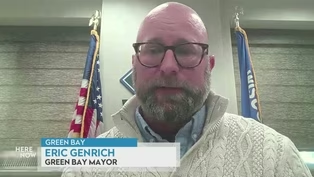
NewMayor Eric Genrich on Property Tax Bills and School Vouchers
Video has Closed Captions
Clip: S2400 Ep2437 | 6m 32s | Eric Genrich on why Green Bay itemizes private school voucher costs on property tax bills. (6m 32s)
 New
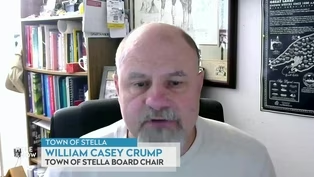
NewWilliam Casey Crump on State Funds to Address PFAS Pollution
Video has Closed Captions
Clip: S2400 Ep2437 | 4m 58s | William Casey Crump on the town of Stella remediating PFAS-contaminated water supplies. (4m 58s)
 New
NewWisconsin's 2026 Supreme Court Race and the Issue of Recusal
Video has Closed Captions
Clip: S2400 Ep2437 | 5m 24s | Candidates in Wisconsin's 2026 Supreme Court race share how they consider recusal. (5m 24s)
 New
NewIn Focus with Dr. Tamika L. Johnson: Traumas Teachers Endure
Video has Closed Captions
Clip: S2400 Ep2437 | 45m 37s | Dr. Tamika L. Johnson on teaching amid loss of life, angry parents and food insecurity. (45m 37s)
Providing Support for PBS.org
Learn Moreabout PBS online sponsorship
- News and Public Affairs

Top journalists deliver compelling original analysis of the hour's headlines.

- News and Public Affairs

FRONTLINE is investigative journalism that questions, explains and changes our world.











Support for PBS provided by:
Here and Now is a local public television program presented by PBS Wisconsin