
Here and Now
Hopes and Tensions over Renewable Energy in Rural Wisconsin
Clip: Season 2500 Episode 2510 | 7m 59sVideo has Closed Captions
Supporters and opponents of wind and solar in rural communities wrangle over projects.
Supporters and opponents of large-scale wind and solar energy development in rural communities wrangle over projects as the state's demand for electricity to grow significantly in the coming years.
Problems playing video? | Closed Captioning Feedback
Problems playing video? | Closed Captioning Feedback
Here and Now is a local public television program presented by PBS Wisconsin
Here and Now
Hopes and Tensions over Renewable Energy in Rural Wisconsin
Clip: Season 2500 Episode 2510 | 7m 59sVideo has Closed Captions
Supporters and opponents of large-scale wind and solar energy development in rural communities wrangle over projects as the state's demand for electricity to grow significantly in the coming years.
Problems playing video? | Closed Captioning Feedback
Where to Watch Here and Now
Here and Now is available to stream on pbs.org and the PBS app.
Providing Support for PBS.org
Learn Moreabout PBS online sponsorship>> As to the rising cost of energy, many people want to see an even bigger turn to renewable sources.
Solar panel fields and wind turbines have been cropping up next to and on top of Wisconsin farms for a couple of decades now.
But as reporter Steven Potter explains, not everyone is on board.
>> Chicken Tom >> Wilcox has farmed the same plots of land around his home in Clark County for more than 20 years.
>> Agriculture is good land use.
>> He's admittedly old fashioned with how he goes about it.
>> You got to understand, I farm like it's 1950.
>> He uses older equipment to harvest his hay and soybeans, and he mixes his own corn feed for beef, cattle, chickens and turkeys.
And he prefers it that way.
>> It's not that we're making a lot of money on these animals.
It's the lifestyle.
that he feels threatens the work of farmers across Wisconsin.
That's the increase of renewable energy projects such as wind and solar power.
He says that the acreage used for such projects is just too valuable.
>> At some point, we're going to have to decide, you know, do we want to use up all this tillable land?
And I personally, I don't.
We need to preserve.
>> Our our valuable farmland in the state of Wisconsin and really everywhere.
these developments.
Wilcox leads the volunteer group known as Farmland First.
They attend community meetings, fairs and parades, and reach out to public officials to stop developments that have been proposed.
He says most of his fellow rural Wisconsin residents don't want wind turbines and solar panel fields near them.
>> If you go anywhere around here to a public forum, you wind up being like a 90/10 split and the residents really don't want this.
And usually the people that are for it are going to get paid.
>> Farmland first is actively opposing two projects nearby.
>> It's basically a city of farms, and there's too many people here for this kind of project.
>> On the other side of this energy debate, several utility companies and clean energy organizations are pushing to have more solar and wind projects, saying we need them.
>> It can be controversial, for sure.
>> Alex Beld is with Renew Wisconsin.
They say renewable energy projects make economic sense.
>> The wind keeps blowing, the sun keeps shining.
Those energy sources aren't usually impacted by things like tariffs or, you know, global conflict.
>> Proponents also say the benefits go beyond just money.
>> Even if there wasn't, at this point, a great economic argument to be made for renewables, there's a huge environmental, health and to be made.
>> Beld says his group understands there's resistance.
>> There are people who don't want to see the landscape change or see farmland get used for something else.
>> But he says the needs outweigh the costs.
>> The goal is to, yeah, completely transform our our economy and our energy system so that it's all running on clean energy.
>> For the utility companies, renewable energy projects are big business.
>> The renewables are a great way for us to make big and positive impacts in our communities.
>> Ben Lipari is in charge of commercial operations for Alliant Energy, one of the biggest public utility companies in the state.
>> We have our wind portfolio that's growing.
We have our solar portfolio.
That's established and one of the largest operating solar portfolios in the Upper Midwest.
>> He says Alliant strives for a mixed menu of energy production.
natural gas and coal to support the around the clock energy needs.
And then, as we've been committed for a number of years now, we think that there's a critical role for renewables that don't have fuel costs and are able to complement some of those traditional energy sources.
>> Lipari also points to local funding generated by taxing power per megawatt.
That utility companies are required to pay.
>> Let me start with solar.
Over the last few years, we've brought 12 utility scale projects online throughout the state.
That's enough power to support over 350,000 residential homes and businesses in those communities.
That's providing critical shared revenues to support community projects over the life of those projects.
That's going to support communities upwards of $150 million.
are more than 20 large utility scale solar panel fields, and for wind power, there are more than a dozen projects generating electricity for utility use.
Steil Lipari acknowledges that not in my backyard.
Opposition.
>> You have certain folks in the community that would rather you cite the project somewhere else.
We spend a lot of time with those community members.
We want to hear their concerns.
>> Residents can make their voice heard about these projects.
>> Throughout the entire review process.
There are many opportunities for public participation.
>> Meghan Sovey-Lashua is with the Public Service Commission of Wisconsin.
The agency that regulates utilities in the state.
She says approving any new energy project is a very deliberate, drawn out process.
Over six months, the agency conducts reviews, holds public hearings.
>> And then there'll be an open meeting where the commission then deliberates.
After reviewing that very full record of evidence.
And then the commission makes its decision.
>> One major factor that the PSC considers with new power generation applications is the state's growing need for more energy.
In the SCS draft of their new strategic Energy assessment for 2026 to 2032.
The demand for power jumps more than 40%, and more than 70% of that increase is due to three active data center developments.
>> If there's a construction project that a utility needs to build to serve a data center, that would come before the commission.
But the commission has no authority over data centers.
>> The report also predicts a significant change in the types of energy production over the next six years.
In all, coal power will decline 28%.
Natural gas will increase 14%, wind will increase 6% and solar will increase 11%.
Such growth in wind and solar will require more landowners to share and least land.
>> Three, four, five, six seven eight.
>> That's a decision that Kathy Haas made more than 20 years ago.
>> I determined number two, and there is 41 in the project.
she has leased land for one wind turbine to the Cedar Ridge Wind Farm project in the town of Empire.
The least payments she and her neighbors receive has made a difference.
>> It's helped a lot of farmers, you know, some of the smaller ones, to be able to hang on to their farms.
needed is minimal.
>> The wind turbine project, it's able.
You can farm right up to it.
All you gave up was just this small piece of land to be able to develop this project and add electricity to the grid.
>> Haas says.
There was opposition to the project early on, but that's faded.
>> Once they realize that these were going to help keep our taxes down.
You know, then it was a little bit, you know, just so that everybody was going to benefit somehow.
Everybody's pretty much got used to them up there.
>> Still, for farmers like Tom Wilcox, his opposition is steadfast and represents what he sees is worth protecting.
>> You asked earlier if there's good places for this.
Yeah.
Places where crops don't grow and people don't grow.
>> Reporting from Clark County.
I'm Steven Potter for Here and Now.
>> For more on this and other issues facing Wisconsin.
Visit our
 New
NewHere & Now opening for September 4, 2026
Video has Closed Captions
Clip: S2500 Ep2510 | 1m 4s | The introduction to the September 4, 2026 episode of Here & Now. (1m 4s)
 New
NewLaura Dresser on the State of Working in Wisconsin in 2026
Video has Closed Captions
Clip: S2500 Ep2510 | 4m 8s | Laura Dresser on the State of Working Wisconsin 2026 report on job trends and inflation. (4m 8s)
 New
NewOjibwe Tribal Group Condemns Line 5 Spill as 'Sloppy Work'
Video has Closed Captions
Clip: S2500 Ep2510 | 58s | The Great Lakes Indian Fish & Wildlife Commission denounced Enbridge over a Line 5 spill. (58s)
 New
NewPhilip Rocco on Noncitizen Voting Claims and Mail-In Ballots
Video has Closed Captions
Clip: S2500 Ep2510 | 6m 46s | Philip Rocco on moves to manage mailing ballots by alleging noncitizen voter fraud. (6m 46s)
 New
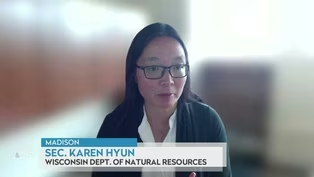
NewSec. Karen Hyun on a Natural Gas Leak in Line 5 in Wisconsin
Video has Closed Captions
Clip: S2500 Ep2510 | 5m 19s | Karen Hyun on Line 5 leaking natural gas in Iron County following a vehicle collision. (5m 19s)
Providing Support for PBS.org
Learn Moreabout PBS online sponsorship New Episode
- News and Public Affairs

Top journalists deliver compelling original analysis of the hour's headlines.
 New Episode
- News and Public Affairs

Today's top journalists discuss Washington's current political events and public affairs.
 New Episode
 New Episode
 New Episode
 New Episode
 New Episode


 New Episode
 New Episode
 New Episode
Support for PBS provided by:
Here and Now is a local public television program presented by PBS Wisconsin