
June 12, 2026 - PBS News Hour full episode
6/12/2026 | 57m 46sVideo has Closed Captions
June 12, 2026 - PBS News Hour full episode
June 12, 2026 - PBS News Hour full episode
Problems playing video? | Closed Captioning Feedback
Problems playing video? | Closed Captioning Feedback
Major corporate funding for the PBS News Hour is provided by BDO, BNSF, Consumer Cellular, American Cruise Lines, and Raymond James. Funding for the PBS NewsHour Weekend is provided by...
June 12, 2026 - PBS News Hour full episode
6/12/2026 | 57m 46sVideo has Closed Captions
June 12, 2026 - PBS News Hour full episode
Problems playing video? | Closed Captioning Feedback
How to Watch PBS News Hour
PBS News Hour is available to stream on pbs.org and the free PBS App, available on iPhone, Apple TV, Android TV, Android smartphones, Amazon Fire TV, Amazon Fire Tablet, Roku, Samsung Smart TV, LG TV, and Vizio.
Providing Support for PBS.org
Learn Moreabout PBS online sponsorshipGEOFF BENNETT: Good evening.
I'm Geoff Bennett.
AMNA NAWAZ: And I'm Amna Nawaz.
On the "NewsHour" tonight: An agreement with Iran seems to be on the horizon, but uncertainty remains about what's actually in the deal and whether it will lead to the end of the war.
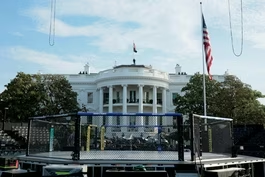
GEOFF BENNETT: The White House South Lawn is set for Sunday night's cage fight, an event decades in the making for President Trump and the UFC.
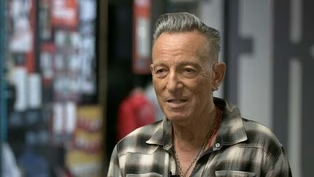
AMNA NAWAZ: And Bruce Springsteen reflects on 60 years of performance and protest ahead of the opening of his new American Music Center.
BRUCE SPRINGSTEEN, Musician: I believe that culture has impact.
I believe that culture shapes the nation.
Culture shapes our politics.
(BREAK) AMNA NAWAZ: Welcome to the "News Hour."
The U.S.
and Iran both say they are inching closer to a deal today to end the war that the U.S.
and Israel started with Iran nearly four months ago.
GEOFF BENNETT: But as with previous announcements, from the U.S.
side in particular, there was little in the way of detail on timing and execution of any agreement and major differences in the public pronouncements of what exactly is in this so-called memorandum of understanding.
Our White House correspondent, Liz Landers, has been reporting on this all day and is here to update us.
So, Liz, you were on a briefing call today with a senior White House official.
What is the White House saying is in this deal?
LIZ LANDERS: Yes, this call was held because the administration says that they are tired of seeing misreporting and the back-and-forth that we have seen play out on social media about this.
So a senior U.S.
official laid out what the U.S.
is asking for right now and what these demands are from the U.S.
side.
First of all, they're demanding that the Strait of Hormuz be open and that this would lift the blockade, secondly, dismantling of the Iranian nuclear program and the U.S.
removes that enriched uranium material, that it will be destroyed on site and then taken out of the country.
That this would also guarantee for a long-term peace in the region, that Iran would no longer fund proxy groups that are violent towards other countries, and that Iran's territorial sovereignty would also be respected, and then, finally, enforceable inspection regimen with a long-term commitment.
Now, Geoff, in exchange for all of this, Iran would get sanctions relief, which has been crippling for that country for a number of years now.
This official said that, going forward, they would get rewarded for - - quote -- "acting like a normal country."
This official was optimistic that the U.S.
and Iran could reach this deal, saying they were about 80 to 85 percent of the way there.
They did not give a timeline on when this could be signed, but acknowledged that it could happen in Europe.
GEOFF BENNETT: Eighty to 85 percent of the way there.
What about the sticking points over Iran's nuclear program?
LIZ LANDERS: That remains a sticking point.
And this U.S.
official did acknowledge that, saying that they do believe that this is a direct line to those things, but said -- quote -- "They are committing indefinitely to not build or procure a nuclear weapon.
And then, you know, we're going to have to figure out exactly how we enforce that."
And, Geoff, we have heard a number of times from the president back and forth over the last few months about striking a deal.
We will see if this becomes the sticking point again.
GEOFF BENNETT: And, Liz, today, there have been conflicting messages from Iran about what they think is in the deal.
Bring us up to speed.
LIZ LANDERS: The Iranians posted on social media.
An Iranian media outlet said this morning that there was a 14-point draft memorandum.
They posted about this not.
Long afterwards, we heard from President Trump on his social media platform saying that there was a lot of false information that was floating around out there.
And not long after that, we heard from the Iranian foreign minister saying that the memorandum of understanding has never been closer, and then the president reposted that.
So, seeming like the Americans and Iranians were sort of getting on the same page here.
Now, though, this afternoon, we have heard from Iran's foreign minister, Araghchi, saying that the terms of the nuclear agreement have to come at a later stage after this first cease-fire is agreed to.
He said on Iranian state TV that the cease-fire must include Lebanon in part of this and that Israel must stop striking in that country, as Hezbollah and Israel have been exchanging strikes for weeks now.
Araghchi also said that the management of the Strait of Hormuz would not return to the prewar era, that the sovereignty of the Strait of Hormuz belonged to Iran and Oman, that Iranian frozen funds would be released.
This could also be a sticking point.
And that, most importantly, I think, downblending the highly enriched uranium stockpile.
That is very different than what we heard from the U.S.
official.
GEOFF BENNETT: Lots to track, to say the least.
Liz Landers, thanks, as always.
LIZ LANDERS: Of course.
AMNA NAWAZ: Now to parse the statements, the motivations, and the potential outcomes of this latest attempt to end the war, we're again joined by two of our Iran watchers.
Alan Eyre worked in the State Department and was a senior member of the Obama administration's negotiating team for the 2015 Iran nuclear deal.
He's now at the Middle East Institute.
And Miad Maleki was born and raised in Iran.
Until last year, he was the associate director for sanctioned Targeting in the U.S.
Treasury Department with a focus on Iran.
He's now a senior fellow at the Foundation for the Defense of Democracies.
And welcome back to you both.
Alan, I'll start with you.
You heard Liz report Iran and the U.S.
both saying they are close to an agreement.
What one side says is in the deal is not what the other side is saying.
And each blames the other for misrepresenting the deal.
What is going on here, in your view?
ALAN EYRE, Middle East Institute: Again, we're close to a deal.
We've been close to a deal many times, but close doesn't count; 85 percent is actually sort of terrifying, because the closer you get, the harder it is.
But it does seem both sides want a deal.
Both sides seem to realize that military escalation isn't really going to help either side.
So, in terms of what the deal contains, I think we have to wait until it's out.
But I'm fairly confident that the traditional red lines that Iran has posited will not be violated.
They're not going to dismantle their nuclear program.
They're not going to export all their HEU to the United States.
So we'll just have to wait and see.
But the most important fact is, it looks like there could well be an agreement to begin negotiations.
And that would be great news.
AMNA NAWAZ: Miad, what's your take on this?
Alan says close doesn't count.
Do you agree with that?
MIAD MALEKI, The Foundation for Defense of Democracies: I do.
I think here's the way that I'm looking at this.
And I'm sure you all remember during the JCPOA negotiations that we were having the same issue, that Iranians were presenting a different version of what was being negotiated or discussed than what here in D.C.
and in Washington and the U.S.
we were tracking as far as the talks.
Here are a couple of things that is very important for the Iranians as far as the text of the memorandum of understanding.
On the nuclear issue, they really want to make sure that what's being presented in the text, it's not a full-on Iran giving up its enrichment capability or no commitment to not ever being able to enrich uranium.
Listen, they have spent 900 or more billion dollars in this nuclear program.
They have been selling this to their population as a program that is going to produce electricity and gas and is going to deter foreign aggression, when, in fact, it brought the economy in Iran to where it is today and a nuclear program that is only producing less than 10 percent electricity for them.
So it is a sacred program.
They don't want to have a deal that presents it as completely being taken away from the regime.
And also on the frozen assets, I think that's another area that the Iranian regime wants that to be presented as a regime receiving these funds, or these funds being released to the regime.
On the U.S.
side, I think there's -- that's not the case.
And I think the U.S.
government only is ready to maybe restore Iran's access to these funds for humanitarian trade.
And that was the case under the Biden administration when these funds were moved to these Gulf tensions.
And that wouldn't be the releasing of funds to the regime.
And that wouldn't be a sanctions relief, because these funds are not really blocked.
They're restricted.
They can be used for non-sanctionable trade, which we did for humanitarian trade.
AMNA NAWAZ: So, Alan, I hear you saying earlier that you don't see Iran signing a deal that limits its nuclear ambitions in any way or offers any nuclear restrictions right now.
But how much of an issue is the potential for Israel's war in Lebanon to continue here?
We heard from the foreign minister in Iran, Araghchi, say that there has to be a cease-fire there.
That requires getting Bibi Netanyahu on board.
How do you see this playing out?
ALAN EYRE: Well, I must have misspoke, if you understood me to say that Iran would not accept constrictions.
They're totally willing to accept constrictions, the same constrictions they have always been willing to accept, which is, they will put limitations on their nuclear program in exchange for money, whether that's unblocking frozen assets, whether it's sanctions easing, whether it's reparations.
We will see if they're going to be able to do service charges or tolling on the Strait of Hormuz.
But you're right.
Another big spoiler here is, Iran continues to insist that the cease-fire be wide-ranging and include Lebanon.
Now, Prime Minister Netanyahu is taking a serious hit already domestically because he hasn't been able to achieve war goals that he wanted to achieve with Iran.
And if he's forced by the U.S.
administration to stand down on Lebanon and on Hezbollah leading up to an election for prime minister, that's toxic for him.
So look for Israel to be a real spoiler in terms of continuing to try to spark a military escalation with Iran.
AMNA NAWAZ: Miad, let's hear take on that and also this question of whether or not the U.S.
is better off now than it was before this war began?
Have U.S.
interests been advanced?
MIAD MALEKI: Well, just kind of reacting to what Alan said, I think one thing that is a fact about this regime is that the more the Islamic Republic fails domestically, and I would say the narrower its base of supporters become, the more it really turns outward, exporting its revolution, expanding its destabilizing influence, to really satisfy that ideological commitments that it can no longer fulfill at home, those promises that they have made to their core supporters.
And that is done through their proxy forces.
They really want to maintain Hezbollah's ability to deter Israel, to cause chaos and fear in Israel.
And it's important for them to do that.
And they can commit that it will never support proxy groups.
They have made those commitments before, but it's a covert operation, so they can do whatever they want behind closed doors in covert fashion.
So it is important, but I think at the same time they can make that commitment, yet go back to supporting Hezbollah, and that will continue to cause issues with Israel.
Now, on the kind of broader issue, whether we're better off now today, I think, again, it's the fact that the Iranian regime has been deterred militarily.
Economically, they're in very bad shape.
I have said this before.
Two, three years ago, they were setting up drones and missile facilities in our backyard in Venezuela.
Today, they're really facing significant issues domestically even keeping things together.
So the security threat has been deterred or been treated delayed for the time being, and I think that puts us in a much better position today.
AMNA NAWAZ: OK, Miad Maleki and Alan Eyre, always great to talk to you both.
Thank you so much.
ALAN EYRE: Thank you.
MIAD MALEKI: Thank you.
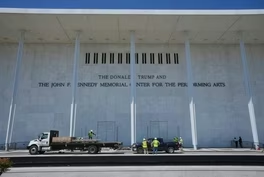
AMNA NAWAZ: In the day's other headlines: A federal judge says the Kennedy Center must continue its court-ordered removal of President Trump's name from the institution by today's deadline.
Scaffolding went up at the arts venue earlier today as crews prepared to remove the president's name from the exterior.
This afternoon, the Justice Department filed an emergency motion aimed at keeping it up.
The Kennedy Center has already removed Trump's name from its official Web site, among other places.
Also today, the Washington National Opera said it is suing the Kennedy Center over $17 million in donations that it says the center withheld after the two sides split earlier this year.
A Kennedy Center representative called the lawsuit's claims meritless.
A federal judge today extended a block on the Justice Department's proposed $1.8 billion anti-weaponization fund.
The ruling from a court in Virginia is the strongest step yet to hold the administration to its word that it won't try to resurrect the plan.
Earlier this month, acting Attorney General Todd Blanche told Congress the government is scrapping the fund.
But President Trump has hinted that he still supports its creation, which would give money to those who claim they have been unfairly prosecuted by the government, including people who were charged with crimes for the January 6 attack on the Capitol.
Across parts of Illinois and Indiana, residents and cleanup crews are picking up the pieces after tornadoes damaged hundreds of buildings and left hundreds of thousands without power.
WOMAN: There goes that house.
AMNA NAWAZ: Eyewitnesses saw at least 10 tornadoes touch down yesterday evening.
At least three of them leveled homes, trees and power lines south of Chicago.
In hard-hit Streator, Illinois, and Merrillville, entire neighborhoods lie in ruins.
There have been no reports of deaths or serious injuries.
In West Texas, police say the suspect in a shooting that left one person dead and at least 10 others injured is now deceased.
Eyewitness video caught the sounds of gunfire as 45-year-old Victor Mata Villarreal barricaded himself inside a building in Midland, Texas.
The shooting itself started hours earlier in another part of the city.
At a press conference today, Midland's mayor said robot and drone footage was used to confirm the suspect was dead and she paid tribute to those affected.
LORI BLONG, Mayor of Midland, Texas: Our thoughts and our prayers are with these families, with the community of Midland and with all of those that were involved today.
AMNA NAWAZ: Police did not immediately say how the suspect died or reveal any information on a possible motive.
An investigation is ongoing.
In Ohio, the FBI has reportedly raided the offices of a progressive voting rights organization.
That's according to multiple outlets and was first reported by MS NOW.
A board member of the Ohio organizing collaborative is cited as saying that agents also fanned out across the state, approaching group leaders and even volunteers.
They were told it was part of an investigation into the group's voter registration efforts.
The actions come as President Trump continues to suggest, without evidence, that voter fraud is rampant and the lead-up to the midterm elections.
The Justice Department signed off today on Paramount's $110 billion bid for Warner Bros.
Discovery.
A DOJ statement obtained by the "News Hour" says the deal is -- quote -- "not likely to result in harm to competition or American consumers" and offered no requirements or concessions for the deal to proceed.
It is a major step for Paramount CEO David Ellison, son of Trump ally Larry Ellison, in his bid to pick up media assets like CNN and HBO Max.
But the deal still faces challenges from various state attorneys general, including in California.
Elon Musk became the world's first trillionaire today, at least on paper, as his company SpaceX made its highly anticipated debut on Wall Street.
The rocket and A.I.
company stock closed the day nearly 20 percent above its IPO price of $135 a share.
That values SpaceX at more than $2 trillion and helps Musk himself set a new bar for personal wealth.
Elsewhere on Wall Street, stocks ended higher as oil prices cooled once again.
The Dow Jones industrial average added around 350 points.
The Nasdaq rose nearly 80 points, or about a third of 1 percent.
The S&P 500 also ended the week with a gain.
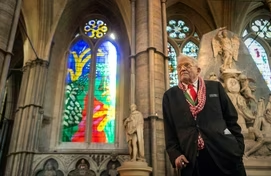
And British artist and painter David Hockney, one of the most celebrated art icons of the 20th and 21st centuries, died yesterday, just one month short of his 89th birthday.
Jeffrey Brown has a look at his life and legacy.
JEFFREY BROWN: A moment frozen in time, a bigger splash, an iconic David Hockney painting, vivid, alive, and deceptively simple, yet capturing a whole story.
Born in Bradford, England, in 1937, Hockney was an art star from his 20s, first as part of the London art scene.
DAVID HOCKNEY, Artist: I'm interested in ways of looking.
Of course, people will respond.
Everybody does look.
It's just a question of how hard.
JEFFREY BROWN: He was known for bucking art world trends, not just painting at a time when more conceptual art ruled, but painting the human figure.
His move to Los Angeles led to works that would come to define 1960s and '70s Southern California.
DAVID HOCKNEY: It was really three times better than I thought.
JEFFREY BROWN: And also openly portray gay life and subjects.
Coming from an England where homosexuality was still illegal, Hockney found in L.A.
both artistic inspiration and personal freedom.
For more than six decades, he helped redefine what painting could be, as his work was exhibited regularly worldwide.
He returned throughout his career to portraiture, painting friends, loved ones, and himself.
When we met at his L.A.
studio in 2018, he spoke of his fascination with the human face.
DAVID HOCKNEY: How can you see in them?
How can you really see a person?
I mean, I'm looking at you now, thinking of it.
And I think, well, how would I know if I'd got you really well, when I did not really know you?
JEFFREY BROWN: Hockney also embraced emerging technologies throughout his career, from photography to digital drawings on iPhones and iPads.
Yet he remained one of painting's most passionate defenders.
DAVID HOCKNEY: I know the arguments about painting is dead, but painting can't die, because photography is not good enough, actually.
It's not good enough.
JEFFREY BROWN: It's not good enough.
DAVID HOCKNEY: No, it's just a snap.
But, I mean, why not look longer?
And you will maybe see more.
JEFFREY BROWN: His death comes less than a year after the close of a major retrospective at the Louis Vuitton Foundation in Paris.
You clearly like the fact that you're doing something that has been done for a long, long time.
DAVID HOCKNEY: Well, what is new, really new?
Is there anything new under the sun?
I mean, I love painting, I love it.
I have lots more to do.
JEFFREY BROWN: And he did until the very end.
David Hockney died Thursday at his home in London.
He was 88 years old.
For the "PBS News Hour," I'm Jeffrey Brown.
AMNA NAWAZ: Still to come on the "News Hour": how children in Gaza are trying to continue their education amid the rubble; David Brooks and Jonathan Capehart weigh in on the week's news; and Bruce Springsteen grants a peek inside his new American Music Center.
GEOFF BENNETT: A federal judge today declined to block the White House from hosting cage fights on the South Lawn on President Trump's birthday, clearing the way for Sunday's event to move forward.
White House correspondent Liz Landers reports on how the event came together and on the decades-long relationship between Mr.
Trump and the UFC that helped bring a first-of-its-kind sporting spectacle to the White House.
LIZ LANDERS: Today, the Ultimate Fighting Championship is the premier mixed martial arts organization, a full contact sport that combines striking and grappling and is worth billions of dollars.
On Sunday, it takes center stage in American political life.
Yet this is a picture few could have imagined back in 1993, when the UFC began.
NARRATOR: Eight street-tough warriors wage combat in a battle where anything can happen and probably will.
LUKE THOMAS, Combat Sports Analyst: Basically, at this time, there's something called traditional martial arts.
They're all making a bunch of competing claims about what works in a fight, right?
And the idea was, though, that they all live in their own siloed universes.
What would happen if you just put those together and created a sort of set of open rules?
What would we discover?
LIZ LANDERS: That question, the lack of rules and the spectacle of violence, attracted attention, but also scrutiny, including from boxing fan and late Arizona Senator John McCain, who described the sport as human cock fighting and led efforts to ban it in most states and on TV.
The scrutiny and the UFC's state by state efforts at legalization also led to more rules and regulations, which Dana White now credits with saving the sport.
DANA WHITE, President, Ultimate Fighting Championship: I think that without senator John McCain, I probably wouldn't be sitting here having this conversation with you right now.
QUESTION: Tell me why.
DANA WHITE: because I think his stance on the UFC drove them toward -- and not only them, but us when we bought it, toward regulation and being regulated by the athletic commissions in each state.
LIZ LANDERS: Yet the UFC still struggled to stay on its feet.
In 2001, White, who had been a boxing enthusiast and fitness entrepreneur, led the purchase of the league for $2 million.
NARRATOR: Home tonight to the world's most prestigious mixed martial arts event.
LIZ LANDERS: That same year, casino owner and longtime fight fan Donald Trump opened the doors of his Taj Mahal Casino in New Jersey for a fight, a move White says was critical.
DANA WHITE: When the Trump brand was here and the UFC brand was down there, he saw it and said, I'd love to have this at my casino.
LUKE THOMAS: As being part of the casino business, he was sort of very visible in the boxing world in the late '80s and then the early '90s.
And, in fact, you will recall, he was the guy principally responsible for making the fight between Holyfield and Foreman possible at one of his casinos.
This was a Donald Trump-driven effort.
So he's kind of always been around the fight game.
DANA WHITE: And these guys don't realize the opportunity that they have right now.
LIZ LANDERS: But Thomas says it was "The Ultimate Fighter," a 2005 reality show on Spike TV that ultimately saved the UFC.
And despite Trump joining a short-lived rival to the UFC in 2008, White and Trump became close allies.
DANA WHITE: Donald was the first guy that recognized the potential that we saw in the UFC.
LIZ LANDERS: White endorsed Trump at the 2016, 2020 and 2024 Republican National Conventions.
DANA WHITE: I know Donald J. Trump is the best choice for president of the United States.
LIZ LANDERS: In 2024, White also successfully pushed Joe Rogan, the longtime MMA announcer whose podcast is enormously popular with young men, to endorse Trump.
Yet Luke Thomas says the most important thing White did for Trump was following the assault on the U.S.
Capitol on January 6, when he openly welcomed Trump at UFC events.
LUKE THOMAS: There is no mainstream actor anywhere that did as much to try and rehabilitate Donald Trump's image after January 6 as much as the Ultimate Fighting Championship.
You want to see how important that was to Donald Trump.
Look at what he is doing for them as part of this payback.
LIZ LANDERS: For his part, White has said he supports Trump on a personal level.
DANA WHITE: I mean, I'm not a political guy.
I'm not a political guy.
QUESTION: On -- speaking at the conventions.
You're at the triumphant victory party.
DANA WHITE: And what did I say?
What did I say when I was at those?
QUESTION: No, they were congratulatory.
They were personal, for sure.
They weren't policy-oriented speeches.
DANA WHITE: A hundred -- they were absolutely personal speeches.
They weren't political in any way, shape or form.
LIZ LANDERS: On Sunday, more than 4,000 spectators will attend the fight in person on the White House lawn, while tens of thousands more will watch in a nearby overflow area.
Alex Pereira is hoping to be the first MMA fighter to win in a third weight class.
The event will be streamed on Paramount+, which bought the TV rights to the UFC last year for over $7 billion.
The owner of Paramount Skydance, David Ellison, is a Trump ally, who just received sign-off from the Justice Department on his purchase of Warner Bros.
The company that now owns the UFC, TKO Group Holdings, is footing the over $60 million tab for the event.
Last month, President Trump disclosed that he'd purchased TKO stock.
In addition to the favors being exchanged, Thomas says Trump may be hoping the event boosts his image with the young men who make up the MMA fan base, but who have largely fallen off as supporters since his election.
And while the location of this event and its nature may feel unprecedented in our 250-year history, Thomas says it fits into a long, global tradition.
LUKE THOMAS: Why was the Thrilla in Manila in Manila?
It's because a dictator paid to put it there.
Why was the Rumble in the Jungle in Kinshasa, then Zaire?
It's because a dictator paid to put it there.
Some of the biggest fights in history are related to authoritarian strongmen who had an attachment to combat sports, either genuine or transactional, or some combination of the two trying to either make themselves look better or the country to look better or some combination of it.
LIZ LANDERS: For the "PBS News Hour," I'm Liz Landers.
AMNA NAWAZ: For nearly three years, children in Gaza have grown up surrounded by war, displacement, and loss.
Thousands of children have been killed in the Israeli strikes that followed the brutal Hamas assault on Israel on October 7 of 2023.
Even since the cease-fire struck last October between Israel and Hamas, Israeli attacks have killed some 229 children.
And, still, the children of Gaza yearned for the normalcy of school and the chance to keep learning.
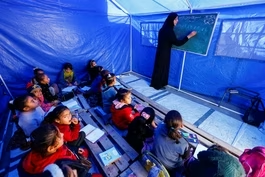
Now school is held in tents and damaged buildings and overcrowded shelters.
Ali Rogin takes a look at this youngest generation.
In Gaza City, a bright, solar-powered lamp illuminates 11-year-old Kadi's makeshift classroom.
KADI AL-HAMALAWI, 11-Year-Old Gazan (through translator): I study at night.
I charge a light in the sun and use it to study.
ALI ROGIN: The room is partly a shattered wall, partly a sheet of tarp that was never meant to shelter a family.
Surrounded by open windows that let in wind and rain, Kadi's family has been living here since their home was destroyed by an Israeli airstrike.
MIRHAT AL-HAMALAWI, Father of Kadi (through translator): The children have lost their innocence.
Every child in Gaza has lost their innocence.
ALI ROGIN: Kadi's father, Mirhat Al-Hamalawi, now says learning competes with survival.
MIRHAT AL-HAMALAWI (through translator): They have stopped thinking about games and toys because they are thinking about things that are far too much for their brains to comprehend.
They are thinking about how to secure water and food for their families.
The starvation we went through gave our children harsh lessons for decades to come.
ALI ROGIN: Those harsh lessons persist despite the October 2025 cease-fire, city streets that were once a playground now a graveyard.
For many of Gaza's youngest residents, attending funerals is now more common than attending class.
More than 21,000 children have been killed by Israeli strikes since the Hamas attack in October 2023, launching this ruinous war.
For those who remain, their classrooms often look nothing like a school.
INAM HILAL AL-BATREEQI, School Headmistress in Gaza City (through translator): We lack many basic educational resources.
Students often have to sit on the ground.
Even when we had floodings in Gaza, the ground was overflowing with water.
We had to tell our students to go home.
But in the event that we do have tables or chairs, students just sit on the chairs.
They don't care about the floodings.
ALI ROGIN: Even schools that have reopened struggle to withstand relentless Israeli strikes.
INAAM AL-WAHEEDI, School Director in Gaza City (through translator): A residential building near the school was targeted.
We made a quick decision to evacuate.
After about five minutes after the students left, the residential building was demolished and the school was also damaged.
ALI ROGIN: According to the United Nations, more than 97 percent of schools across the Gaza Strip have been damaged or destroyed.
And yet children keep coming, more than any school can hold.
INAAM AL-WAHEEDI (through translator): The number of students today is more than 100 who want to attend, but we just don't have the capacity.
ALI ROGIN: The United Nations says, with high demand and limited space, most children in Gaza are only able to attend a few hours of classes three days of the week.
But so many children in Gaza will never return to a classroom.
In Northern Gaza, 38-year-old Mahmoud Khalla digs with his bare hands in search of his whole world.
A December 2023 Israeli strike left him the sole survivor of his family.
The attack killed at least 39 people.
More than two years later, Khalla still returns to the site, sifting through the rubble that was once a residential building, determined to recover the remains of his wife, his children, and the families of his brothers and sisters.
MAHMOUD KHALLA, Displaced Gazan (through translator): We dig through the rubble with our own hands to find the martyrs.
It's exhausting for us, of course, but we will not stop until we recover all the bodies and bury them properly.
ALI ROGIN: For families like Mahmoud Khalla's the losses are impossible to measure.
And for the children growing up amid displacement, fear, and collapsing living conditions, aid groups say the trauma now stretches far beyond the battlefield.
Now worsening conditions have fueled rodent infestations that add yet another layer of issues for most Gazans facing displacement.
James Elder, spokesperson for the United Nations Children's Fund, says that, despite unimaginable conditions, many parents are still desperate to get their children back into the classroom, seeing education as one of the few remaining pieces of normal life.
JAMES ELDER, UNICEF Spokesperson: It was stunning to see children, having spent a collecting water, remembering they used to live at homes with taps, collecting water because water was so scarce, and then going to a soup kitchen and queuing up in this humiliating sense to try and get a bowl of food., and then, at nighttime, going back and maybe if they'd been able to find a solar panel of light, studying.
ALI ROGIN: In the meantime, a childhood in Gaza today is unlike any other, shaped by Israeli attacks, despite an often violated cease-fire, the search for food, and repeated displacement, yet, every night under the glow of a small light, flickers of hope.
KADI AL-HAMALAWI (through translator): I started helping my mother in the kitchen.
Days pass quickly.
I don't even have time to hang out with my friends.
When I come home late at night, I study because I want to travel, and I want Gaza to be safe again.
ALI ROGIN: Eleven-year-old Kadi still opening her textbooks, curious, inquisitive, and determined to learn of a world and forge her future beyond the rubble.
For the "PBS News Hour," I'm Ali Rogin.
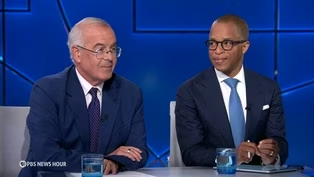
GEOFF BENNETT: Another political fight in Congress, a mixed martial arts fight at the White House, and a potential deal to end the fighting with Iran.
Time now for the analysis of Brooks and Capehart.
That's "The Atlantic"'s David Brooks and Jonathan Capehart of MS NOW.
It's always good to see you both.
GEOFF BENNETT: So, the White House says it's increasingly confident that a deal with Iran is within reach.
David, what should Americans make of the administration's stated confidence?
DAVID BROOKS: This is -- somebody counted.
This is the 40th time Donald Trump has said... GEOFF BENNETT: That's right.
DAVID BROOKS: ... we're very confident.
So 40 is a good biblical number, so maybe it's true.
It's too soon to really know how this all turns out, but I think you can say some things.
One, the Iranian military is degraded, so that's a plus.
Two, the Straits of Hormuz will be in worse shape before -- after this action than before.
Before, it was an open waterway.
Now it's an Iranian and Omanian lake.
Three, it seems extremely unlikely to me, despite what the administration is saying, that Iran is going to want to give up or is going to be willing to give up their nuclear power.
This has been a core of their whole regime for decades, or that they will give up supporting Hamas and Hezbollah.
This has been a core.
And so unless they're really in economic struggle, worse than we think, and they're going to be moved by that trouble, then I'm a little dubious.
I think we will end up significantly worse off than before the war.
One other final point.
All these bombs got dropped.
What actually pressures each side?
In each case, it was an economic sanction.
It was Iranians closing the strait and us imposing a blockade and sanctions before that.
So it was actually economic pressure that moved people, not all these bombs that got dropped, and that should be a lesson for leaders going forward.
GEOFF BENNETT: And, Jonathan, I mean, is there a broader lesson here about American foreign policy that, no matter who occupies the White House, presidents discover that the bargain with Iran is ultimately always the same?
It's constraints on its nuclear program in exchange for economic relief.
JONATHAN CAPEHART: And that's what we had as the United States with the JCPOA, which President Trump ripped up and is now trying to get a JCPOA-like agreement, February, March, April, May, June, four months into a war he started with Benjamin Netanyahu.
They got to the JCPOA not through two people zooming into a capital and then leaving and saying we have got a deal.
They got the JCPOA by hunkering down in Switzerland every day for years, Switzerland and other places, for years, across from their counterparts and interlocutors with other nations involved to hammer out that deal.
We have seen nothing like that whatsoever when it comes to bringing about a resolution to this current war with Iran.
GEOFF BENNETT: David, what's the bigger risk for President Trump, arriving in a deal that basically mirrors the Obama era Iran deal or failing to negotiate a deal after promising that he could do something better, find something better?
DAVID BROOKS: Well, I wasn't a fan of the Obama deal.
By the way, I think it's sunsetted too soon, so making it a little unreliable.
But the danger for President Trump is that we walk away with face covering, so we don't admit that we lost the war, but we lost the war, and everybody's in the region knows we lost the war, and everybody in America knows we lost the war, and everybody around the world knows we lost the war.
And that hurts American prestige and will hurt American interests long term.
GEOFF BENNETT: We have seen examples recently of Republicans breaking with President Trump, whether the anti-weaponization fund, to the fight over the FISA Section 702 - - this is a warrantless surveillance tool -- over his election of Bill Pulte as the acting director of national intelligence.
Are these isolated disputes, Jonathan, or are we starting to see a Republican Party that feels more comfortable challenging the president?
JONATHAN CAPEHART: I mean, yes and no.
I'm loath to say we have reached a pivot point, like this is the moment.
We don't know.
I think we will know as time goes on.
But as we get more of these things like this, like the rising up against Pulte, like bringing down the FISA law, that Republicans are finding their courage.
We should also keep in mind that a lot of them are finding their courage because they have been primaried and lost, they're retiring or their primaries have not happened yet.
And so they're keeping their powder dry.
But each time they take a stand against the president, I think, for once, claws back some congressional authority as a co-equal branch of government.
GEOFF BENNETT: One of the Republicans who was primaried and lost is John Cornyn.
And in an interview with The New York Times, he predicted that the two years after the November midterms will be the most miserable two years of President Trump's life.
He says: "He's going to have the most miserable two years of his life in the last two years of his term, I think, because I think November is going to be a disaster."
Historically, dissent inside the MAGAverse has been short-lived.
Do you see that changing?
DAVID BROOKS: A little.
I was thinking when I read that quote that it'll be miserable for him, but it won't be as miserable as for us.
DAVID BROOKS: I do think there is some sort of leakage here.
I wouldn't say it's a turnaround, but there's been some sort of leakage.
The Trump thing is just weird.
He's just -- he appoints Bill Pulte, who's clearly not even close, within a Pacific Ocean, of being qualified for this job.
And then he turns around, and to make the permanent acting, not acting, but the permanent director of DNI, Jay Clayton, who's totally like superstar level by Trump's standards.
So how does the same guy pick two people, one with such radically different qualifications?
The one thing I should add is that I don't like what the Democrats are doing here.
I understand you don't like Bill Pulte.
I understand you think he should not have been appointed.
And that, you're absolutely 100 percent correct.
But the FISA program works well.
We are now -- as Speaker Johnson made the point, we're now -- we got the World Cup here.
We got the Iranian thing going on.
We need all the intelligence I can get.
And that FISA program supplies, I'm told, half the president's daily intelligence brief.
That's a lot of information and valuable information.
It's a very well-working program.
And the Democrats are not repeal -- or not renewing it sort of in my view out of spite, but they're making us less safe.
GEOFF BENNETT: Jonathan?
JONATHAN CAPEHART: How this became the Democrats' fault is curious to me.
One -- a couple of things to keep in mind.
One, even though the law has expired, it was reauthorized by a FISA court in March of 26', this past March, which goes through March of 27.
So Congress has time to come back and reauthorize it, do whatever they need to do, because it's not just Democrats who have concerns about the law.
It's Republicans as well.
So I just don't think it's right to say it's all the Democrats' fault, especially when they're not even in the majority in either house.
GEOFF BENNETT: In the time that remains, David, do your Sunday night plans involved being at the White House for a UFC match, by chance?
JONATHAN CAPEHART: I asked him the same thing.
DAVID BROOKS: Well, I'm actually active participant.
(LAUGHTER) DAVID BROOKS: I'm going to be fighting with Jonathan.
It'll be fun.
It will be like... GEOFF BENNETT: That, I would like to see.
Could you imagine?
DAVID BROOKS: Yes.
Yes.
GEOFF BENNETT: But what do you make of this?
DAVID BROOKS: Well, I first thought of, like, who are the artists John F. Kennedy brought to the White House?
It was like W.H.
Auden, Robert Frost, Jerome Robbins, Leonard Bernstein.
And now we have got cage fighting.
Don't anybody say America's in cultural decline.
So I just... (LAUGHTER) DAVID BROOKS: Go ahead.
GEOFF BENNETT: Well, look, yes, to your point, presidents have traditionally sought validation from established cultural institutions and artists.
As I'm saying this, I'm looking at the what people have called the claw on the South Lawn.
President Trump has created this alternative cultural establishment around combat sports and podcasts and influencers and social media stars.
How significant is that shift?
And what does it suggest?
JONATHAN CAPEHART: Well, it's a significant shift because it's the president of the United States who's anointing it.
Whenever a president invites someone from the culture into the White House, it's giving the imprimatur of the president.
Excuse me.
President Obama brought in Lin-Manuel to do what then became "Hamilton."
So there -- you're talking about Auden.
And now you got Lin -- I cannot remember his name.
DAVID BROOKS: Lin-Manuel Miranda, yes.
JONATHAN CAPEHART: Miranda, because I'm so close to calling him Noriega.
And that is -- I know that is not right.
JONATHAN CAPEHART: But this, a cage fight on the South Lawn of the White House, the people's house, that also has corporate sponsorship that you can see inside the ring, this - - talk about degrading the culture.
This is degrading the White House, degrading the people's house.
And it's just unconscionable that this has happened.
GEOFF BENNETT: Part of me thinks, though, that there were people who said that about Obama when he had rappers in the East Room, right?
I mean, it's just -- are we just in a different time, a different... DAVID BROOKS: He wants us to be talking this way, because he's saying, look, you get looked down upon by people.
I believe in cage fighting just like you.
GEOFF BENNETT: Right.
Yes.
Final word.
JONATHAN CAPEHART: No, we are out of time.
And I'm -- we don't have enough time for me to thunder righteous indignation about all this.
GEOFF BENNETT: We will pick it up on your Substack.
JONATHAN CAPEHART: Yes.
GEOFF BENNETT: Jonathan Capehart, David Brooks.
Thank you both.
Thank you.
DAVID BROOKS: Thank you.
JONATHAN CAPEHART: Thanks, Geoff.
GEOFF BENNETT: Tomorrow, the Bruce Springsteen Center for American Music opens to the public on the campus of New Jersey's Monmouth University.
The new facility houses Springsteen's archives, while also telling the broader story of American music through artifacts and exhibits.
Ahead of the opening, I sat down with the Boss himself as part of our arts and culture series, Canvas.
What's it feel like to see your whole life, like, reflected in museum form?
It's like... BRUCE SPRINGSTEEN, Musician: Like you're dead.
(LAUGHTER) GEOFF BENNETT: Far from it.
Just days after wrapping a 20-day stadium tour with the E Street Band, Bruce Springsteen and I sat down surrounded by the artifacts of a more-than-six-decade career, much of it devoted to telling the stories of working people.
We're inside the new Bruce Springsteen Center for American Music, dedicated not just to one man's career, but to the traditions that shaped it.
This building houses your archives, but it's also dedicated to the broader story of American music.
Why was that important to you?
BRUCE SPRINGSTEEN: I always looked at myself as a small link in a very big chain.
I was a guy who kind of came along.
You pick the flag up for a while.
You run with it for a little while, and you hand it to the next guy.
So we wanted to make the place very inclusive.
GEOFF BENNETT: The top floor houses Springsteen's archives, which grew out of a fan-curated collection of memorabilia that eventually outgrew its home at the Asbury Park Public Library.
The bottom floor includes a gallery of artifacts from across the history of American music.
BOB SANTELLI, Executive Director: This is where we tell the story of American music in a condensed form.
GEOFF BENNETT: Bob Santelli is the center's executive director and an American music historian.
BOB SANTELLI: This is one of my favorite cases here, because of the power of the artifacts.
That's Louis Armstrong's trumpet.
That's Dizzy Gillespie's trumpet, John Coltrane's saxophone, and Ella Fitzgerald's concert dress.
We had to figure out how to encompass the story of American music in a rather small space, and yet make sure it was relevant, it was accurate, and reflective of what Bruce's music is all about.
GEOFF BENNETT: Where does Bruce Springsteen's contribution fit in that overall narrative?
BOB SANTELLI: His contributions are increasingly significant.
His place is right up there with all the greats, including Bob Dylan.
And so what we're trying to do here is, it's not a tribute to him.
Most importantly, what we do is we try to uncover the creative process.
GEOFF BENNETT: In addition to memorabilia, the center offers an intimate look at Springsteen's creative process through interactive exhibits, handwritten lyrics, and other rare materials from across his career.
BOB SANTELLI: He writes on $1.50 spiral bound notebooks that you can get in any drugstore.
GEOFF BENNETT: Handwritten lyrics to "Born in the USA," that's incredible.
BOB SANTELLI: Yes, and of course, fans see that as kind of Holy Grail stuff, you know?
GEOFF BENNETT: And there's only one word that's crossed out.
It's almost as if this was like downloaded and he just wrote it all out at once.
BOB SANTELLI: Exactly.
Right.
GEOFF BENNETT: Where do you see yourself fitting in that longer narrative, that longer arc of American music?
BRUCE SPRINGSTEEN: You know, I'm just a guy that came along at this particular moment and was interested in writing about the times that I lived through, grew up in, my family's life, how that connected to America in the second half of the 20th century.
And I wanted to be an artist to encompass their times, the times that they live in, and wrote about those things.
GEOFF BENNETT: For Springsteen, writing about his times has often meant examining the tension between America's ideals and its reality.
From songs like "Youngstown," a lament for the hollowing out of industrial America, to "American Skin (41 Shots)," his meditation on the 1999 police killing of Amadou Diallo, an unarmed immigrant in New York City.
He's also been one of the country's most politically engaged musicians, lending his voice to Democratic candidates for decades, performing at campaign rallies and get-out-the-vote events.
You said before that loving your country means telling the truth about it.
BRUCE SPRINGSTEEN: Sure.
GEOFF BENNETT: How has that guided your work?
BRUCE SPRINGSTEEN: Well, I believe in critical patriotism.
I believe that's the definition of a patriot, that you love your country so much that you are willing to look at it clearly, recognize its faults, encourage it to be a better place, and believe that you carry in your heart the country that is waiting.
GEOFF BENNETT: In recent years, the politics that long informed Springsteen's work has become more explicit.
In January, after federal immigration authorities in Minnesota killed two U.S.
citizens, Renee Good and Alex Pretti, Springsteen responded with a song.
BRUCE SPRINGSTEEN: Their bravery, their sacrifice, and their names will not be forgotten.
BRUCE SPRINGSTEEN: This is "Streets of Minneapolis."
It was very angry.
And usually I write songs that have a lot of political implications, but very often are not directly political.
BRUCE SPRINGSTEEN: So, in this case, I wrote a protest song.
I thought, gee, maybe this is a little broad, but then I had my buddy Tom Morello, guitarist from Rage Against the Machine.
And he says: "No, no, no."
He says: "Bruce, nuance is great, but sometimes you got to kick them in the teeth."
And so that was a moment when you had to kick him in the teeth.
BRUCE SPRINGSTEEN: It was a song written for a moment.
I wrote it, recorded it, released it in three days.
It's the song of its times.
JON LANDAU, Bruce Springsteen's Manager: Bruce is a synthesizer.
GEOFF BENNETT: Jon Landau is Bruce Springsteen's longtime manager.
JON LANDAU: He hears everything.
He reads everything.
And he's got some internal blender.
And he creates out of found material original work.
GEOFF BENNETT: When Landau first encountered Springsteen in the '70s, he was a music critic who famously wrote: "I saw rock 'n' roll future and its name is Bruce Springsteen."
Today, the two are still collaborators, their creative and professional partnership among the longest running in modern music.
JON LANDAU: The fact that the whole first floor is dedicated to setting a context for Bruce, which keeps this from becoming idolatry, and we're telling, yes, Bruce's story, but we're telling it as part of a narrative about American music, which the concerts are intended to do.
GEOFF BENNETT: To celebrate the opening, organizers brought together more than a dozen artists for two nights of performances tracing the story of American music.
KEN CASEY, Dropkick Murphys: Any time you get to share the stage with Bruce, if you get asked, you better be there.
GEOFF BENNETT: Ken Casey is the front man for Dropkick Murphys.
He says he sees Springsteen as part of a long tradition of artists who have used music to engage with the world around them.
KEN CASEY: You think about during the civil rights movement and the Vietnam War protests, like how -- what a big role music played in those.
And is music meeting the challenge now?
I'm not 100 percent sure it is, or I'd like to see music do more.
GEOFF BENNETT: Do protest songs, do they serve a different purpose today?
Do they carry the same power, the same weight?
BRUCE SPRINGSTEEN: I don't know.
I'm in the hearts and minds business.
You change people kind of one at a time, and I believe that culture has impact.
I believe that culture shapes the nation.
Culture shapes our politics.
So I have to -- whether they do or not, I have to act as they do.
GEOFF BENNETT: You play for audiences across the political spectrum.
People who love your music might not share your politics.
BRUCE SPRINGSTEEN: Right.
GEOFF BENNETT: How does that strike you?
BRUCE SPRINGSTEEN: That's what I like.
(LAUGHTER) BRUCE SPRINGSTEEN: That's fine.
I like a big tent.
If I'm playing up at the stadium here in Jersey, and there's 50,000 people, I don't think they're all Democrats or they're all progressives.
So I like playing to a big tent.
GEOFF BENNETT: For all the reflection that comes with the opening of a career-spanning museum, Springsteen insists he's far from finished.
You could have stopped a long time ago, and people would have said that was a complete career.
Why keep going?
What does it cost you, and what does it give you?
BRUCE SPRINGSTEEN: It's just my job, and it's my pleasure.
I don't even think about stopping.
If you created a body of work that's resonant, I don't see any immediate reason to -- there's never going to be an E Street farewell tour, I can tell you that.
GEOFF BENNETT: And while the center bears his name, Bruce Springsteen hopes its focus broadens with time, placing his work within the larger continuum of American music.
BRUCE SPRINGSTEEN: I feel like I'm simply a link in a big chain, you know?
And I would imagine, as time passes, all that's up here will end up in a little case, along with a lot of other great, fabulous musicians.
(LAUGHTER) GEOFF BENNETT: You think so?
BRUCE SPRINGSTEEN: Sure.
GEOFF BENNETT: Generations from now, if people walk through here, they want -- you want them to think that, oh, Bruce Springsteen was a link in a longer chain?
BRUCE SPRINGSTEEN: Yes.
GEOFF BENNETT: Really?
BRUCE SPRINGSTEEN: Yes.
GEOFF BENNETT: Well, I would say that and more.
(LAUGHTER) BRUCE SPRINGSTEEN: Thanks.
I appreciate it.
GEOFF BENNETT: Bruce Springsteen, a real pleasure.
BRUCE SPRINGSTEEN: Thank you.
My pleasure.
GEOFF BENNETT: Absolutely.
Later tonight, a special one hour edition of "Washington Week" here on PBS.
JEFFREY GOLDBERG, Moderator, "Washington Week With The Atlantic": Our country is about to turn 250 years old, and we wanted to do something a bit different in anticipation of this milestone.
We have been planning to host a cage match that would feature our favorite panelists duking it out in front of a live studio audience, but President Trump beat us to the punch, quite literally.
So we kept the live studio audience, and instead of gouging each other's eyes out in the shadow of the White House, we're going to talk about our history, the state of our democracy, and the successes, failures, and challenges of the American experiment.
AMNA NAWAZ: That is tonight right here on PBS.
Meanwhile, this weekend on "Horizons," host William Brangham explores the boom of data centers across the country and their environmental impact.
GEOFF BENNETT: And on "Compass Points," moderator Nick Schifrin speaks with the authors of a new book that explains how Iran's religious rulers failed to live up to the promises that propelled them to power during the 1979 Iranian Revolution.
You can watch both "Horizons" and "Compass Points" on our YouTube channel or wherever you get your podcasts and on your local PBS station.
Check your local listings.
And that is the "News Hour" for tonight.
I'm Geoff Bennett.
AMNA NAWAZ: And I'm Amna Nawaz.
On behalf of the entire "News Hour" team, thank you for joining us, and have a great weekend.
 New
NewBrooks and Capehart on tradeoffs of possible U.S.-Iran deal
Video has Closed Captions
Brooks and Capehart on the tradeoffs of a possible U.S.-Iran deal (9m 42s)
 New
NewGaza's students strive to learn despite shattered schools
Video has Closed Captions
How Gaza's students are still learning despite shattered schools and displacement (6m 19s)
 New
NewMideast experts assess potential U.S.-Iran agreement
Video has Closed Captions
'Close doesn't count': Mideast experts assess potential U.S.-Iran agreement (7m 6s)
 New
NewNews Wrap: Judge orders Trump's name from Kennedy Center
Video has Closed Captions
News Wrap: Judge says Kennedy Center must remove Trump's name by Friday deadline (8m 12s)
 New
NewRemembering painter David Hockney and his artistic legacy
Video has Closed Captions
Remembering revolutionary painter David Hockney and his artistic legacy (3m 15s)
 New
NewSpringsteen on critical patriotism and the power of protest
Video has Closed Captions
Bruce Springsteen on 'critical patriotism' and the power of protest music (9m 52s)
 New
NewUFC at White House spotlights Trump's partnership with White
Video has Closed Captions
White House UFC event spotlights Trump’s decades-long partnership with Dana White (6m 22s)
 New
NewWhat U.S. and Iran are demanding in latest peace proposal
Video has Closed Captions
What the U.S. and Iran are demanding in the latest peace proposal (3m 57s)
Providing Support for PBS.org
Learn Moreabout PBS online sponsorship New Episode
- News and Public Affairs

Today's top journalists discuss Washington's current political events and public affairs.

- News and Public Affairs

FRONTLINE is investigative journalism that questions, explains and changes our world.
 New Episode
 New Episode
 New Episode
 New Episode
 New Episode

 New Episode
 New Episode
 New Episode
 New Episode
Support for PBS provided by:
Major corporate funding for the PBS News Hour is provided by BDO, BNSF, Consumer Cellular, American Cruise Lines, and Raymond James. Funding for the PBS NewsHour Weekend is provided by...