
March 24, 2026 | Carolina Impact
Season 13 Episode 1319 | 26m 34sVideo has Closed Captions
From Inmate to Entrepreneur, Raise You Up Ministries, Senior Scholars at Queens, ArtPop St. Gallery
Programs help inmates launch businesses, rebuild life after release in Mecklenburg County; Raise You Up Ministries is a shopping mall on wheels helping those experiencing homelessness; A Charlotte organization keeps seniors sharp by creating community through learning; & Local arts organization ArtPop stands out from the crowd in NYC's Times Square.
Problems playing video? | Closed Captioning Feedback
Problems playing video? | Closed Captioning Feedback
Carolina Impact is a local public television program presented by PBS Charlotte
March 24, 2026 | Carolina Impact
Season 13 Episode 1319 | 26m 34sVideo has Closed Captions
Programs help inmates launch businesses, rebuild life after release in Mecklenburg County; Raise You Up Ministries is a shopping mall on wheels helping those experiencing homelessness; A Charlotte organization keeps seniors sharp by creating community through learning; & Local arts organization ArtPop stands out from the crowd in NYC's Times Square.
Problems playing video? | Closed Captioning Feedback
How to Watch Carolina Impact
Carolina Impact is available to stream on pbs.org and the free PBS App, available on iPhone, Apple TV, Android TV, Android smartphones, Amazon Fire TV, Amazon Fire Tablet, Roku, Samsung Smart TV, and Vizio.
Introducing PBS Charlotte Passport
Now you can stream more of your favorite PBS shows including Masterpiece, NOVA, Nature, Great British Baking Show and many more — online and in the PBS Video app.Providing Support for PBS.org
Learn Moreabout PBS online sponsorship- [Announcer] This is a production of PBS Charlotte.
(bright music) - Just ahead on "Carolina Impact."
From cell blocks to startups, see how one program turns incarceration into innovation, teaching inmates to think like entrepreneurs.
Then, help that moves; an RV on a mission, delivering hope and essentials directly to those in need.
And lifelong learning that's proving age is just a number, as local seniors stay sharp by staying connected.
"Carolina Impact" starts now.
(lively music) Good evening.
Thanks so much for joining us.
I'm Amy Burkett.
Crime is a conversation happening in neighborhoods across Mecklenburg County.
People want safer streets, communities, and real solutions that last longer than a headline.
Inside the Mecklenburg County Jail, a different kind of crime prevention effort is quietly taking shape.
One that doesn't start after release, but long before it.
Tonight, "Carolina Impact"'s Chris Clark looks at a program challenging inmates to rethink their future by building something of their own.
- I had $3 to my name, the outfit I was arrested on, no phone, no anything.
- [Chris] When Erin walked out of the Mecklenburg County Detention Center, she wasn't walking into a new life.
She was walking into uncertainty.
- I came into town.
Less than 24 hours later, I was in jail.
I was facing two felonies, two misdemeanors.
My addiction had taken me so deep that I didn't even talk to my family.
- [Chris] For more than 30 years, addiction controlled Erin's life, but inside the jail, she discovered something she didn't expect: opportunity.
- I looked on their kiosk and I saw programs.
I got accepted into the substance abuse pod.
- [Chris] Instead of leaving jail as soon as she could, Erin made a decision that surprised even her attorney.
- My attorney was like, "I can get your bond unsecured and we can get you out today."
And I'm like, "No, I need this.
I wanna stay and finish this program."
- [Chris] She stayed to complete a 42-day recovery program, but finishing the program was only the first step.
For many people leaving jail, the real challenge begins after release.
- Most of our residents want to work, but many of them are not ready to work.
- [Chris] Before someone can rebuild their life, the basics have to come first.
- Mental health services, housing, transportation, identification.
A person can't get employed legally without identification.
- [Chris] That's why the Mecklenburg County Sheriff's Office created the Post-Release Resource Center, a place where newly released individuals can begin rebuilding their foundation.
- It bridges the gap between incarceration and independence.
- [Chris] The center operates through partnerships with local agencies and a $40,000 grant from Lowe's.
- Workforce development is public safety.
Rehabilitation is public safety.
- Sheriff Gary McFadden says many of these programs were inspired by something he saw overseas.
- I went to Germany and Norway to study prison system.
Programs in those prisons was everything.
It was unusual the way that they had the programs.
People were free to move around.
People were working in kitchens, you know, libraries.
And so then I said, "Why can't we do this in the US?"
- [Chris] The goal was to rethink what incarceration could accomplish.
- People think that incarceration is for punishment, which it is at some point, but we are not in the business of punishment.
We are in the business of rehabilitation.
- [Chris] That philosophy also led to another program inside the jail itself, one focused on entrepreneurship.
- There's a whole bunch of guys in here that just wanna start their business.
Most of them was running things that wasn't legal at the time.
So they definitely were business owners, but they just didn't know how to properly do it.
- [Chris] The program is called The Next Great 50.
Participants develop business ideas, learn how to register an LLC, and prepare to launch companies once they return to the community.
At roughly $50,000 a year, the program serves about 50 detention center residents, and it's a fraction of the $73,000 it costs to house just one person in jail annually.
Some of those businesses are already up and running.
Mario Young turned a lifelong passion into a photography company.
- It's been kind of growing since my youth.
Always behind a camera somewhere, taking a picture or watching someone take a picture.
So I always been in the arena of just photography in general.
- [Chris] For him, the program turned an idea into something legitimate.
- If it wasn't for The Next Great 50, I'll probably be somewhere trying to pay someone for the information and not knowing if I'm getting scammed or being used or misused.
With The Next Great 50, I've gotten the opportunities to work with the universities here in Charlotte.
I've gotten the opportunities to work with banks such as TD Bank.
- [Chris] For the people going through these programs, success rarely happens overnight, and the road isn't always easy.
- When they're in recovery, they tend to give up when life keeps lifeing.
They want everybody to be like, "Oh, you're so wonderful," and it's not like that.
- [Chris] Recovery isn't about perfection.
It's about learning how to keep going, even when life gets hard.
- You have to make them greater by concentrating on gratitude.
The other day I looked out the window and I'm like, "I don't have to look for drugs."
- [Chris] Moments like that, she says, remind her just how far she's come.
Nationwide, about 44% of people released from jail return within a year.
In Mecklenburg County, that number is closer to 29%.
And officials say programs focused on recovery, job training, and entrepreneurship are helping drive that difference.
- I don't like the stigma of painting pictures that only a couple of us that come home can do it.
All of us can do it.
- [Chris] For Josh, the goal is bigger than any single success story.
It's proving that people given opportunity and support can rewrite the direction of their lives.
- How do you want that person to return?
Because they're going to return.
Now, do you want to not help them and then get the same result to where your tax dollars are still gonna go to housing them?
- How would you want me to prepare your neighbor?
Maybe not your neighbor, maybe your daughter's neighbor, maybe your son's neighbor, maybe your mother's neighbor.
But this person will be someone's neighbor.
- [Chris] Sheriff McFadden says he hopes the programs continue long after he is gone.
For Erin, the programs inside the jail and the support she found after release helped change the direction of her life.
What once felt like the end of her story became a brand new beginning.
- I wouldn't be as successful as I am.
I have hope now.
- [Chris] Programs like these don't erase the past, but they can change what comes next.
And in Mecklenburg County, the goal is simple: turn time served into second chances and former inmates into neighbors ready to succeed.
For "Carolina Impact," I'm Chris Clark.
- Thank you, Chris.
The program is still evolving, but organizers say success isn't measured only by businesses launched.
It's measured by lives redirected.
And for a community searching for ways to reduce crime, the impact may begin long before someone walks out of the jail.
Learning how to build a business can open a door to a second chance.
But for many in our community, the first step toward a fresh start is much more basic: food, clothing, hygiene, and someone who cares enough to show up.
Recent studies show over 3,000 people a month experience homelessness in Charlotte-Mecklenburg.
For the past 15 years, Mickey Coria has made it his mission to meet them where they are through his nonprofit, Raise You Up Ministries.
You may have even seen the RV rolling through town.
Mickey refers to it as a shopping mall on wheels.
As producer Russ Hunsinger shows us, it's about more than supplies.
It's about restoring dignity, building trust, and reminding people who feel invisible that they are seen.
(gentle music) - It's rough.
It is scary.
It is cold.
I've been homeless over 10 years off and on.
I can't sleep on these streets.
I can't take these streets.
I'm not getting any younger.
- [Mickey] We estimate we have, you know, 600 people per month, about 70,000 people per year.
- You want pasta?
- Raise You Up Ministries started organically.
Just a group of people caring for people experiencing homelessness.
What it does is really create relationships with people living on the streets and making their life a little bit easier.
Operational Hug happens twice a month, and what we do is come with the shopping mall on wheels.
Inside of that shopping mall, what we do is recreate a real shopping mall for people to go and shop like they do in retail.
They take anything they need.
We have an attendant for each person.
And then when they go to check out the clothing and anything else that they need, they don't have to pay anything.
- Mickey's vision was always to be able to go to where the neighbors are and not have them try to find a way to get to us.
So this works out really well.
- That's a plus.
That's a plus.
And they have nice, nice stuff.
I feel like a new man coming up out of here.
- [Mickey] I didn't want just to go to the street and hand out clothes.
I want it to feel dignified.
I want it to feel normal.
We create this beautiful space, they can actually go and shop and feel amazing.
(upbeat music) - And that's the idea of them being catered to.
You know, like if you were in a store at the mall, someone would ask you, "What can I get you?
Can I help you find your size?"
At one point before we had the RV, we just had the clothes.
I guess the best word is dumped on tables.
And you know, you're hauling through that and it takes away some of the humanity of it.
If you're just grabbing clothes for yourself, this way you're being served one by one.
I think it makes a big difference.
- [Mickey] We have a dressing room, yeah.
Because many times, you know, sometimes it's raining and people get wet.
They discard the old clothes and then they get a whole new outfit head to toe.
Can you imagine how they feel?
It is an incredible experience.
(uplifting music) - I appreciate, you know, other people that care enough to come out and actually, you know, feed us and take care of us.
Because you'd be amazed at how many whispers we hear behind our back.
- [Mickey] We provide first quality food, we provide haircuts.
♪ Happy birthday to you ♪ - [Mickey] We celebrate people's birthdays.
It's another thing that we do to accomplish the purpose of feeling normal again.
- A little unusual, but a great unusual feeling, 'cause I hadn't had a gift from, I don't know how long.
But it's a great feeling, you know what I mean?
- It's really warm and it is nice.
And today I got two sweat tops.
I got a blanket.
So if I have to sleep outside, I can cover up.
And I got some brand new shoes and a brand new bag to carry it in.
They gonna help me a lot.
I don't have to get anything else, just enough.
When you're homeless, you don't need that many things, but what you have is good quality.
It's going to last.
Thank you so much.
- [Mickey] I always remind them that homelessness is not the identity.
Homelessness is just a situation.
- Making them feel loved.
That's really important.
Making them be seen, known, and heard.
- Thank you, Mickey.
- [Mickey] We are the one blessed.
We think that people get blessed is true, but we are even more blessed 'cause we're able to see that.
We saw this lady Jackie, just changing their life and one day her life changed.
Literally for someone living on the street, receiving what she received, it was day and night.
And we get to witness that, in which you see the happiness and the love back to us.
That's amazing to us.
- Thank you, Russ.
Mickey is working to expand the ministry's outreach to create a mobile job skills training center, bringing the classroom to the people.
Mickey relies on volunteers to help.
If you are interested to get involved, you can head to our website at pbscharlotte.org to learn more.
Connection can change everything.
We just saw how community support can help someone through a season of instability.
But staying connected is just as important in another stage of life.
As we age, we all wanna feel like we belong, like we're part of something bigger than ourselves.
Yet for many seniors, retirement can sometimes mean less social interaction and fewer opportunities to stay mentally engaged.
For more than 50 years, one local organization has been working to make sure that doesn't happen.
"Carolina Impact"'s Dara Khaalid and videographer Russ Hunsinger show us how Senior Scholars at Queens is using the power of lifelong learning to keep minds sharp, friendships strong, and community alive.
(upbeat music) - [Dara] Have you ever been behind the scenes of a live TV production?
Well, we're going to show you what it's like today.
No, this isn't for PBS News or any of the other networks.
This is for the Charlotte organization, Senior Scholars at Queens.
- So I'm cutting between the cameras, I'm throwing in slides, I've got lower thirds.
- [Dara] Watching Alan Matthews and the rest of the AV team operate their equipment with precision sure feels like you might see it on primetime TV.
- Over here I've got all the cameras on a multi-view, so I'm picking the next shot, doing pan, tilt, and zoom on each camera.
- [Dara] From pressing the right glowing neon buttons on the keyboard to having the perfect audio levels, this is what it takes to broadcast their weekly meetings to members who aren't in the room.
There's an average of 70 to 90 who watch virtually.
- It keeps me on my toes with the tech.
No two Fridays have ever been alike.
They're all different.
- [Dara] For Alan, who's mostly retired from years spent in the media, working with the Senior Scholars AV team keeps his fire burning.
- I don't really look at it as work per se.
It's still fun.
(bright music) - [Dara] As a volunteer, he doesn't get a dime, but he's still dedicated to producing the best show he can.
- I care about my audience, and I wanna make a good product for my audience.
I want them to look at the content and not notice what I'm doing at all.
If they don't know what I'm doing, then I'm doing it right.
- [Dara] The AV team doesn't just have to make sure everything flows effortlessly for those viewing online.
There's a live crowd of members seated below the balcony and a speaker on stage that rely on good visuals too.
Every week, Senior Scholars invites a speaker to educate members on topics ranging from healthcare, history, science to global affairs.
Today's topic, UNC Charlotte's Dr.
Beth Whitaker explored the United States and Africa: history, change, and the road ahead.
- So for many years the United States sort of supported colonialism in Africa, in part because its allies in Europe were the colonizers in Africa, right?
Europe, the UK, and France being the most significant colonizers in terms of the largest territories.
- [Dara] Since 1973, Senior Scholars has been educating those 50 and older through discussions.
The nonprofit focuses on keeping minds sharp.
- I've learned a lot through this presentation.
- Curiosity.
It's good to foster that.
And Senior Scholars gives people the opportunity to really broaden their horizons and to learn new things.
You're never too old to learn.
(upbeat music) - [Dara] Research shows staying involved in meaningful activities that are cognitively demanding can improve your memory.
- I think it keeps our brains young, our minds young, our bodies healthier, just to engage with, you know, other thinking people.
Even the Zoom audience that can't attend in person, at least they have the opportunity to learn about new subjects and other things going on.
- [Dara] Cognition isn't the only area that Senior Scholars helps its members.
- You're also socializing in the process, and you see things in the Charlotte area that I never would've seen or even been aware of without Senior Scholars.
- [Dara] Social time doesn't just come before and after meetings.
The group also hits the road, exploring places like the Carolina Raptor Center, enjoying nature at the Wildacres Retreat, and trying new culinary adventures.
- It's fun to meet new people and make new friendships.
- [Dara] Which is why you'll never find Shannon Smith alone at Senior Scholars events.
The friendships she's made in just a few years make her feel right at home.
- People are very welcoming and warm, and they know others are trying to join and become part of their community.
And I've felt a lot of outreach and warmth.
- [Dara] Connections made here often lead to volunteer opportunities.
- Alright, that's a good one.
- [Dara] These days you can find Shannon at the Sullenberger Aviation Museum.
- A couple ladies came to give a little talk about it before it opened in June of 2024.
And they were describing it and talking about it and saying volunteers were needed.
So a couple of us stepped up.
Get ready.
Oh, there you go.
- [Dara] Shannon helps young people in the makerspace as they create paper rockets and launch into learning new things.
- Just watching them create and learn and grow on their own is a lot of fun.
And just to know that they're gonna grow up and run our world, let's give them a good start.
- She is just a delight to have.
You know we got peace of mind when Shannon is here because she can run this space with her eyes closed.
- Whoa!
- [Dara] As they teach, connect, and continue to grow, these Senior Scholars are proving that curiosity never retires and that a commitment to lifelong learning keeps minds sharp and spirits soaring.
- And hit ready when you're ready.
- [Dara] For "Carolina Impact," I'm Dara Khaalid.
- Thank you, Dara.
On Good Friday, the group plans to hold its meeting to discuss medical innovation at The Pearl.
From staying connected through learning to connecting through creativity.
Our final story tonight takes us into the heart of Charlotte's vibrant art scene.
There are more than 800 arts, culture, and humanities organizations here.
From major performing arts centers to museums to small grassroots cultural groups.
It's a rich creative landscape, but it also means a lot of competition for attention.
So how does one organization cut through the noise and truly stand out?
"Carolina Impact"'s Jason Terzis introduces us to a group that found a way to do just that.
- Well, for any creator, the goal is to get noticed.
Likes on Facebook posts, hearts on Instagram, subscribers on YouTube.
For traditional artists, that notoriety can come in the form of industry buzz and ultimately sales.
But for one Charlotte arts organization, the main goal for many is to make it to the crossroads of the world.
(lively music) For an artist, it just might be the pinnacle.
- I can't even explain to you how it feels to see your work like that.
- [Jason] Seeing your artwork, not on a wall, but in the middle of New York City's famed Times Square.
- And when I got off the train, I literally could see it.
The billboard is on 44th, but as I walked up the street, I could see it.
- [Jason] For Camisha McDaniel, it was the thrill of a lifetime.
- And you see your work, it was just like, "There it is!"
I was so dramatic.
- [Jason] So dramatic.
Camisha felt the urge to dance, and so she did.
(energetic music) - That's like a dream come true.
Like to have your work on a big screen like that.
- [Jason] Andrea Brinkley also experiencing the thrill of Times Square, seeing her colorful flower up in lights.
- When you see your art that big, it's quite moving.
(laughs) Yeah.
- [Jason] Exposure to vast audiences on big stages is a large part of what ArtPop Charlotte offers.
- Yeah, I think the most unique thing is definitely our billboards.
You know that local artists are featured on billboards.
Even though they're from Charlotte, they're featured on billboards all over the country.
- [Jason] So it only makes sense, I suppose, that the woman responsible for all of it used to work in billboard advertising sales.
- So I worked in the billboard industry for about 20 years.
- [Jason] While that sales job paid the bills, Wendy Hickey's passion has always been in the world of art.
- I was in the business of building brands like Budweiser, Coca-Cola, attorneys, car dealerships, those types of things, right?
And I thought someday that I'm going to help local artists.
And that's how the idea was born.
- She was like, "I think I wanna do this full time."
And I was like, "I think you should do this full time."
And I was like, "I think I wanna be an artist full time."
And she was like, "I think you should do it full time."
- The very first day that I moved to Charlotte, I went to the Arts and Science Council and to my employer, Adams Outdoor, and asked, "Could we start ArtPop in this community?"
- [Jason] Wendy's idea: when billboards aren't being used by paid advertisers, have ArtPop artists showcase their works for free.
- So you can go to Times Square, you can go to Korea, you can go to LA, you can go to San Francisco, and you'll see local Charlotte artists on billboards all over the country, sometimes all over the world.
- I see the ArtPop billboards whenever you drive down the streets.
I know quite a few artists that have actually been ArtPop artists and they've talked about how it's changed their careers as artists and taken them from being unknown to literally being on a billboard in Times Square.
- So the billboards is like, that's another level of marketing for artists in the Charlotte community.
- [Jason] And in the world of art, there's no exposure quite like free exposure.
- My first billboard was on Independence Boulevard for four months, but then somebody wanted to rent that space.
So then it moved to I-77, and then it moved to Brookshire Freeway, and then finally it moved to I-85.
So I had some lovely locations and it was really fun to go and see it.
- It is true, honest exposure, right?
The millions of people that pass by your billboards on the streets and get to see your name and look you up that I would've never had access to before is really impactful.
- [Jason] And when it's time for those billboards to be leased again, ArtPop then partners with local designers to creatively repurpose billboard materials, transforming it into fashion, over the years, preventing an estimated 13,000 square feet of vinyl from reaching landfills.
- We have an entire project management program where we connect local artists to paid opportunities.
We have an entire upcycling program where we upcycle our billboards that have retired.
And the new artists go up every year in September.
We do a fashion show and all of the fashion is made out of our billboards.
- [Jason] Another thing that makes ArtPop unique is the way in which they work with the artists themselves.
Each year a new group is selected to be part of that year's cohort.
- It'll be 24 artists, it'll be 19 adults and five high school seniors.
And historically we've always been 19 adults, one high school senior.
So a wonderful donor has made it possible for us to extend the program to five seniors this year.
And they'll also receive scholarships.
- So I was part of the cohort of 2025.
I was ArtPop 2025, and my billboard was all over Charlotte and including Times Square.
- [Jason] ArtPop is now hosting an exhibit in conjunction with Connect Labs Wexford in the innovation district with more than 30 pieces currently on display.
- There are artists of all disciplines, all ages, because we serve artists who are high school seniors all the way up to senior citizen artists.
So you're gonna see a little bit of everything here.
And this exhibit will be up for about two months.
- I think it's incredible.
The work is incredible.
I love seeing it in a space like this that you don't normally see art in.
So it's a beautiful experience for the people that work here, but also to be able to have a reception for them here, I just thought it was really nice.
- [Jason] Camisha McDaniel, the one who was dancing in Times Square, is back with another unique piece.
- With everything that's going on in the world, I wanna touch people in a different aspect.
I want to gear more towards the happiness.
- [Jason] And who knows, maybe Camisha's latest piece will wind up in Times Square, just like her last one.
- How incredible to see your work in Times Square.
How does ArtPop make that happen?
- Well, a combination of things, and beginning with those billboard partners, which are a huge help.
They also have individual donors, family foundations, and corporate sponsors.
ArtPop was also recognized by the National Endowment for the Arts, receiving a $40,000 grant specifically for their class of 2026.
And they're actually taking applications for that class now.
And all their events, like the one happening now at Connect Labs by Wexford, are free and open to the public.
So they just wanna get the community out, come see what the artists are creating, and those billboards, my goodness, what a huge thing for them.
- I mean, I love seeing them just all over our region, let alone being in Times Square.
- Absolutely.
- Another great story.
Thank you for sharing.
Well, that does it for us this evening.
Before we leave, I wanna say thank you to the Dream Center of Matthews for being in our audience tonight.
They were a great group and we're glad that they could spend some time with us, just like I'm glad you could spend some time with us.
We always appreciate your time and look forward to seeing you back here again next time on "Carolina Impact."
Good night, my friends.
(uplifting music) (uplifting music continues) (inspiring music) - [Announcer] A production of PBS Charlotte.
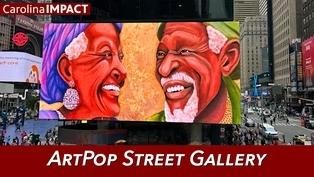
ArtPop Street Gallery | Carolina Impact
Video has Closed Captions
Clip: S13 Ep1319 | 6m 39s | Local arts organization ArtPop stands out from the crowd in NYC's Times Square. (6m 39s)
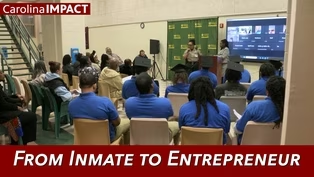
From Inmate to Entrepreneur | Carolina Impact
Video has Closed Captions
Clip: S13 Ep1319 | 6m 32s | Programs help inmates launch businesses, rebuild life after release in Mecklenburg County. (6m 32s)

March 24, 2026 Preview | Carolina Impact
Preview: S13 Ep1319 | 30s | From Inmate to Entrepreneur, Raise You Up Ministries, Senior Scholars at Queens, ArtPop St. Gallery (30s)
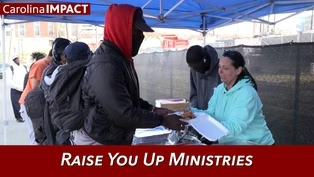
Raise You Up Ministries | Carolina Impact
Video has Closed Captions
Preview: S13 Ep1319 | 5m | Raise You Up Ministries shopping mall on wheels helping people experiencing homelessness. (5m)
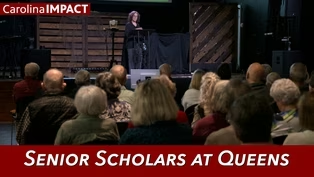
Senior Scholars at Queens | Carolina Impact
Video has Closed Captions
Clip: S13 Ep1319 | 6m 11s | A Charlotte organization keeps seniors sharp by creating community through learning. (6m 11s)
Providing Support for PBS.org
Learn Moreabout PBS online sponsorship
- News and Public Affairs

Top journalists deliver compelling original analysis of the hour's headlines.

- News and Public Affairs

FRONTLINE is investigative journalism that questions, explains and changes our world.












Support for PBS provided by:
Carolina Impact is a local public television program presented by PBS Charlotte