
May 22, 2026 - PBS News Hour full episode
5/22/2026 | 57m 46sVideo has Closed Captions
May 22, 2026 - PBS News Hour full episode
May 22, 2026 - PBS News Hour full episode
Problems playing video? | Closed Captioning Feedback
Problems playing video? | Closed Captioning Feedback
Major corporate funding for the PBS News Hour is provided by BDO, BNSF, Consumer Cellular, American Cruise Lines, and Raymond James. Funding for the PBS NewsHour Weekend is provided by...
May 22, 2026 - PBS News Hour full episode
5/22/2026 | 57m 46sVideo has Closed Captions
May 22, 2026 - PBS News Hour full episode
Problems playing video? | Closed Captioning Feedback
How to Watch PBS News Hour
PBS News Hour is available to stream on pbs.org and the free PBS App, available on iPhone, Apple TV, Android TV, Android smartphones, Amazon Fire TV, Amazon Fire Tablet, Roku, Samsung Smart TV, LG TV, and Vizio.
Providing Support for PBS.org
Learn Moreabout PBS online sponsorshipWILLIAM BRANGHAM: Good evening.
I'm William Brangham.
Amna Nawaz and Geoff Bennett are away.
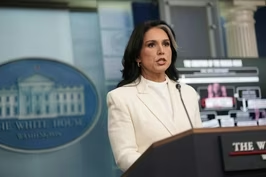
On the "News Hour" tonight: Director of National Intelligence Tulsi Gabbard resigns, the latest high-profile shakeup in the Trump administration.
We look at the many causes driving a decade-long decline in students' math and reading scores.
THOMAS KANE, Harvard University: The pandemic was just the mudslide that followed seven years of steady erosion in student achievement.
WILLIAM BRANGHAM: And so-called carbon credits meant to offset climate change often haven't lived up to their promise, though some groups are now trying to change that.
RITA HITE, President and CEO, American Forest Foundation: We want to make sure that we're not just paying landowners for things they would have already done, because, if that's the case, then you don't actually get additional carbon.
The atmosphere doesn't feel a difference.
(BREAK) WILLIAM BRANGHAM: Welcome to the "News Hour."
Director of National Intelligence Tulsi Gabbard, the highest-ranking intelligence official in the U.S.
government, resigned today.
She said her husband is suffering from a rare bone cancer that requires her full attention.
Foreign and defense correspondent Nick Schifrin and White House correspondent Liz Landers are both covering the story, and they join us now.
Nick, what did Gabbard say in her announcement, resignation announcement, today?
NICK SCHIFRIN: Well, as you said, William, Gabbard said that she's leaving because of her husband's illness.
And she released this resignation letter, which reads in part: "My husband, Abraham, has recently been diagnosed with an extremely rare form of bone cancer.
I must step away from public service to be by his side and fully support him through this battle."
In response, President Trump wrote that -- quote -- "Tulsi's done an incredible job, and we will miss her."
And the president announced that her principal deputy, Aaron Lukas, would become the acting director of national intelligence.
And so the president using kind words there, William.
And Tulsi Gabbard has executed some of his key intelligence community priorities.
A Gabbard aide sent me a list of her accomplishments, listing -- quote -- cutting what Gabbard called -- quote -- "agency bloat" by more than 40 percent, declassified, including high-profile cases like the JFK assassination, and exposing what the president calls the weaponization of the intelligence community.
But former intelligence and Trump officials tell me that Gabbard was largely cut out, she was frozen out of the policymaking process, and that, frankly, CIA Director John Ratcliffe has already been running the intelligence community.
WILLIAM BRANGHAM: Liz, you have been looking into one other part that Gabbard was involved in.
What can you tell us about that?
LIZ LANDERS: Gabbard took an unprecedented step and showed up in late January of this year in Fulton County, Georgia, at a raid that the FBI was conducting at the Fulton County election headquarters there.
The FBI took all of the 2020 physical ballots, their tabulator tapes, all of their ballot images, and their voter rolls at the time.
The FBI said that this was based on belief of probable cause of violation of retention and preservation of election records and also deprivation of a fair election.
The Fulton County Board of Commissioners sued almost immediately afterwards, saying that the federal government needed to turn over those ballots.
But this is all because the president keeps saying and lying about the results of the 2020 election.
We know he has put pressure on the secretary of state there in the past, and Gabbard defended her presence there.
She wrote a long letter at the time to Democrats on the Hill, and she said that national -- the national intelligence director maintains election security is a national security issue.
And she said that President Trump told her to go.
When she was down there, she facilitated a call between the president and FBI agents who conducted the raid, again, a very unusual move there.
And she said in that letter at the time that electronic voting systems in the United States have long been vulnerable to exploitation by bad actors that could change or manipulate the outcome of an election.
We are still waiting for evidence that those elections were manipulated.
WILLIAM BRANGHAM: Right, truly unprecedented.
Nick, can you go back to this relationship that she had with the president?
And how did it sour?
And what does that mean when it comes to a person in this office?
NICK SCHIFRIN: So, a former intelligence and Trump official tells me that it largely soured over the president's decisions over Iran starting last summer.
And right before the president authorized that attack on Iranian nuclear sites, last summer, she released this video: TULSI GABBARD, Former U.S.
Director of National Intelligence: Because, as we stand here today, closer to the brink of nuclear annihilation than ever before, political elite and warmongers are carelessly fomenting fear and tensions between nuclear powers.
NICK SCHIFRIN: So, a former official tells me that she never recovered from that.
The president didn't know about it beforehand, considered it an attempt to try and convince him not to bomb Iran.
And, of course, he did decide to bomb Iran on last summer, despite his promise beforehand not to get involved in Middle East wars, which, of course, was a position that she promoted quite publicly.
And then she was also considered against this year's war against Iran.
One of her key deputies resigned over it.
And so the former intelligence official tells me she was on her way out anyway.
She was likely going to have to resign even before her husband's illness.
William, as for your key question, how important is this?
Well, look, the role of the director of national intelligence has been debated since it was created some 20 years ago.
There have been bipartisan calls for reforms, including some of the cuts that Gabbard has implemented.
Some former officials tell me it's not an important job and the president does not consider it an important job.
But other officials say, look, the role that Congress created is important, was not supposed to be political, involved in the things that Liz just talked about, and that it does not help the intelligence community if this person is considered weak, considered politicized, or, frankly, has been frozen out by the president.
WILLIAM BRANGHAM: Nick Schifrin, Liz Landers, thank you both very much.
NICK SCHIFRIN: Thank you.
LIZ LANDERS: Of course.
WILLIAM BRANGHAM: I'm joined now by Larry Pfeiffer.
He had a three-decades-plus career in the U.S.
intelligence community, where he served as chief of staff to CIA Director Michael Hayden and was deeply involved in post-9/11 intelligence reform, including service within the Office of the Director of National Intelligence.
He's now director of the Hayden Center at George Mason University.
Mr.
Pfeiffer, thank you so much for being here.
I just wonder if you could give us your reaction to this resignation today.
LARRY PFEIFFER, Director, Michael V. Hayden Center: Well, I would not disagree with anything Nick said.
She was inexperienced to begin with.
She should never have been nominated for the job.
Once in the job, I don't think she ever fully understood the responsibilities that she had in managing this vast enterprise of 18 intelligence agencies, many of which reside in other Cabinet departments.
And when she began to lose favor with the president, her way of dealing with it was to lean heavily into responding to his desire to plumb into some of these conspiracy theories that were discredited surrounding some of our past presidential elections.
I'm very sad, of course, to hear about her husband's situation, and my heart is with them as they move forward there.
WILLIAM BRANGHAM: As Nick was describing, this office was created to sort of address the vulnerability that 9/11 revealed, that siloed intelligence had blinded us in some way to a terrorist threat looming.
But Gabbard often, as you were describing, seemed focused on other things.
How much of that do you believe was a reflection of her or a reflection of the office or a reflection of this president?
LARRY PFEIFFER: I would offer it was more a reflection of her and of the influence of the president, less so the specific position.
I mean, this position was created, as you said, in response to 9/11 as a way to try to break down some of the silos that existed within our national security structure.
But another key point was the framers of the law that created this were very concerned that the then-DCI, director of central intelligence, being dual-headed, as the head of the community as well as the head of CIA, that was just too large of a job for one person to do.
And I will tell you, having worked with General Hayden, who was the first CIA -- or sole CIA director without the community management responsibility, he was forever grateful he didn't have to worry about taking care of the community while also trying to run such a robust agency as CIA.
So I don't think she fully understood the grave responsibility she had in coordinating those various elements of the community towards a common goal.
WILLIAM BRANGHAM: I mean, it has been two decades now since this office was created, since 9/11.
Is it your understanding that the office itself is working as intended?
Are we safer because we have an ODNI?
LARRY PFEIFFER: So the DNI position in the ODNI was created by Intelligence Reform and Terrorism Prevention Act legislation, which was, like all legislation, a compromise.
It -- the DNI role was imperfect to start, but it has moved on for 20 years.
I think they have made great strides through the years in doing integration across the community and establishing standards for the community, so they're all speaking the same language, working on the same procedures.
They have played a very critical role in overseeing significant acquisitions.
I mean, this is a large enterprise.
They spend millions and millions of dollars.
They buy lots of very sensitive capabilities.
And it's important to have an enterprise that can oversee and manage that responsibly for the taxpayer.
So I think, yes, the DNI has done -- has made stride through the years.
Most of the strides they have made are around boring things like I just described.
Is it perfect?
No.
Any institution after 20 years is probably worthy of review.
My view is that, if you want to review the DNI, you want to review the structure of the intel community, how it's governed.
That's a serious discussion.
And that should be something that should be done in a bipartisan fashion.
It should involve people who have expertise in these disciplines, people who've held these positions, and no movement towards reform should be made without recommendations and discussion from such a body as I described.
WILLIAM BRANGHAM: All right, that is Larry Pfeiffer, director of the Hayden Center.
Larry, thank you so much for being here.
LARRY PFEIFFER: Thank you.
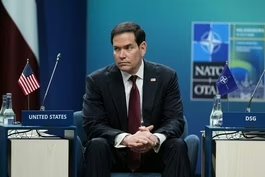
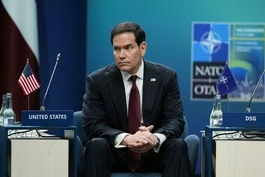
WILLIAM BRANGHAM: We start the day's other headlines in Sweden, where Secretary of State Marco Rubio met with NATO allies amid confusion over recent U.S.
statements on troop levels in Europe.
Rubio told the gathering of foreign ministers that the U.S.
remains committed to the military alliance, but that the presence of American forces depends on what the allies themselves contribute to NATO.
Yesterday, President Trump said the U.S.
would send an additional 5,000 troops to Poland, citing his ties to that country's new president.
But earlier this month, the president said he would withdraw 5,000 from Germany after Chancellor Friedrich Merz said Iran had -- quote -- "humiliated" the U.S.
Today, Rubio insisted that such decisions are -- quote -- "not political."
MARCO RUBIO, U.S.
Secretary of State: I think it's well understood in the alliance that the United States' troop presence in Europe is going to be adjusted.
This is not a decision that was made on the back of a napkin.
I mean, this has been an ongoing process.
WILLIAM BRANGHAM: This troop change-up comes amid a growing rift in the military alliance, with tensions simmering over the Iran war, the question of America's commitment to Ukraine, and the president's threats to seize Greenland.
Authorities in the Democratic Republic of Congo are banning funeral wakes and large gatherings to try and slow the Ebola outbreak there.
Health workers are struggling to keep up with rising cases amid public anger over the handling of the crisis.
Today in Geneva, the World Health Organization raised its assessment of the threat, saying it now poses a very high risk to the area.
Officials say there are now at least 750 suspected cases and more than 170 suspected deaths.
Neighboring Rwanda has shut border crossings to the DRC to prevent the spread of the virus, which is putting a strain on locals.
WEMA FURAHA, Resident of Goma, Democratic Republic of Congo (through translator): Our work is here at the border.
When it is closed, we are all stranded.
It is this work that sends our children to school, provides us with a home, gives us a livelihood.
WILLIAM BRANGHAM: And a hospital in Berlin released this image, the child of an American Ebola patient looking at their father through a window.
The hospital says the man is not critically ill, and his wife and four children have all tested negative.
A judge in Tennessee dismissed the human smuggling case against Kilmar Abrego Garcia today.
He was mistakenly deported to El Salvador last year, and then returned after the U.S.
Supreme Court ordered the Trump administration to do so.
Criminal charges stemming from a 2022 traffic stop followed, which the judge said today amounted to - - quote -- "selective or vindictive prosecution."
Thousands of Cubans gathered outside the U.S.
Embassy in Havana this morning to protest the Trump administration's indictment of former President Raul Castro.
They waved flags and chanted during the nearly hour-long pro-government demonstration.
Cuba's president and prime minister attended the rally, as did several others from Castro's own family.
The 94-year-old was indicted this week on murder charges over the downing of two civilian airplanes back in the 1990s.
Cuba's government says the charges are just a pretext for future U.S.
military action.
In Washington, the U.S.
Federal Reserve officially has a new chairman.
KEVIN WARSH, Federal Reserve Chairman: So help me God.
(APPLAUSE) WILLIAM BRANGHAM: Kevin Warsh was sworn in today by U.S.
Supreme Court Justice Clarence Thomas at the White House.
During the ceremony, President Trump said he wants Warsh to be, in his words, totally independent, despite his aggressive attempts to get the prior chair, Jerome Powell, to cut interest rates.
In his own remarks, Warsh pledged to -- quote - - lead a reform-oriented Federal Reserve."
KEVIN WARSH: Our mandate at the Fed is to promote price stability and maximum employment.
When we pursue those aims with wisdom and clarity, independence and resolve, inflation can be lower, growth stronger, real take-home pay higher, and America can be more prosperous.
WILLIAM BRANGHAM: Warsh steps into this role at a difficult time for the Fed.
Inflation is on the rise due to the war in Iran.
And officials at the Central Bank are now considering the possibility of raising interest rates, rather than cutting them, as the president would prefer.
On Wall Street today, stocks posted decent gains to close out the week.
The Dow Jones industrial average added nearly 300 points, or more than half-a-percent.
The Nasdaq rose about 50 points.
The S&P 500 closed out its eighth straight winning week.
Six-point-seven million viewers tuned in last night to watch Stephen Colbert's final episode of "The Late Show."
That's according to preliminary Nielsen data.
And it's about triple his usual audience this season.
Colbert was joined by Sir Paul McCartney, among others, as he signed off after 11 seasons and more than 1,800 episodes.
CBS announced it was ending the show last year, citing financial reasons.
President Trump had long criticized Colbert and called on CBS' new corporate owners to fire him.
And another CBS mainstay is coming to an end.
CBS News Radio is shutting down tonight after nearly a century on the air.
The storied service started in 1927 and gave rise to such icons as Douglas Edwards, Walter Cronkite, and Edward R. Murrow.
Together, they and their colleagues brought history into our homes.
EDWARD R. MURROW, Former CBS News Anchor: Murder had been done at Buchenwald.
WILLIAM BRANGHAM: From the liberation of the Nazi camps in Germany... DAN RATHER, Former CBS News Anchor: There are many people in Dallas who sincerely and literally still have a very difficult time believing what happened here today.
WILLIAM BRANGHAM: To the assassination of President John F. Kennedy.
ALLISON KEYES, CBS News: It looks like a nuclear war happened here.
You can't see the sky at all.
It's all gray smoke.
WILLIAM BRANGHAM: To the deadliest attack on American soil, 9/11.
The company announced the closure in March, blaming what it called challenging economic realities.
So, to borrow Mr.
Murrow's famous phrase, we wish everyone at CBS News Radio one final.
good night and good luck.
Still to come on the "News Hour": the sale of an ostensibly sustainable clothing company to a fast fashion giant sparks outcry; the effort to shore up trust in programs that claim to reduce carbon emissions; and David Brooks and Jonathan Capehart weigh in on the week's political headlines.
As the school year is coming to a close, a new analysis shines yet another harsh spotlight on what's being called a learning recession for America's students.
And it's a problem that started long before the pandemic.
That's according to the latest National Education Scorecard, which is an annual deep dive into data about kids in grades K-12.
The findings of this report are sobering.
Children had a steady decline in math and reading scores beginning all the way back to 2013, which happens to be when smartphones and social media really took off.
Compared to a decade ago, math scores today are down in 70 percent of school districts.
Reading scores are down in 83 percent.
Scores have climbed a bit since 2022, but nowhere close to making up all the lost ground.
In fact, eighth grade reading scores are now at their lowest level since 1990.
I spoke recently with Thomas Kane.
He's one of the authors of the scorecard and a professor at Harvard University.
I started by asking him, what stood out most about this latest report?
THOMAS KANE, Harvard University: So the pandemic was just the mudslide that followed seven years of steady erosion in student achievement.
It was as if -- when Congress dismantled test-based accountability at the end of the No Child Left Behind Act, it was as if they turned off the smoke alarms just at the time when social media was setting fire to students' learning time outside of school.
WILLIAM BRANGHAM: There are lots of known issues about K-12 education in America, but what problems are most pronounced, in your view, that contribute to this really grim report?
THOMAS KANE: So when I tell my kids that we used to be able to smoke on airplanes, they're incredulous.
THOMAS KANE: And I think when they tell their kids 20 years from now that we allowed unfettered access to cell phones inside schools and outside of schools, I think their kids are going to have the same reaction.
WILLIAM BRANGHAM: Really, it's that profound?
THOMAS KANE: But it's not just about cell phone bans.
So, actually, the early evidence on the effect of cell phone bans is that they are having modest effects on student achievement.
THOMAS KANE: The -- what that implies is that the mechanism by which social media are slowing student achievement gains, it's not just through distracting kids in class.
It's about how they're using time outside of school.
It's about sleep disruption.
It's about missing homework.
It's about just doing less reading in general.
And the states that are turning things around are turning things around by focusing on early literacy and encouraging, requiring more reading inside a school to counteract the fact that kids are doing less reading outside of school.
WILLIAM BRANGHAM: It's so interesting you bring that up.
We know, as you were mentioning, some states have been able to turn this around, Mississippi being one of them.
My colleague talked earlier with Dr.
Lance Evans.
He's the superintendent of the schools in Mississippi.
Here's how he said they approach reading and math.
LANCE EVANS, Mississippi Superintendent of Education: We have an array of coaches.
So we have literacy coaches.
We have math coaches.
We have literacy coaches in special education.
We have leadership coaches.
We have data coaches.
Let's just use the literacy coaches as a continued example, because the same methodology is used for our math coaches as our literacy coaches.
What we do is, we hire some number of coaches.
At this case, we have got about 85 of them.
Our literacy coaches are typically in our schools, some two days a week, some three days a week.
It just kind of depends on the proximity.
But it's not a thing where they're in there like once a month.
I mean, this is they are working hand in hand with teachers, with administrators.
WILLIAM BRANGHAM: That is a lot of coaches augmenting what teachers are doing.
How replicable is something like that?
THOMAS KANE: So the key, that is, to the Mississippi system is not just the coaches.
It's that the adults in the system are being held accountable for student results.
WILLIAM BRANGHAM: The adults meaning the parents or the administrators?
THOMAS KANE: It's the administrators.
It's the school district leaders.
It's even the state leaders.
Honestly, I think one of the challenges we face since the end of the No Child Left Behind Act is that we're not holding our leaders accountable to the results.
It's not just teachers and students that are being held accountable when we publish students' results.
It's the school district leaders.
It's the governors.
It's the state legislators.
They're all being held responsible for trying to help students catch up.
WILLIAM BRANGHAM: There were also declines shown in both wealthier districts and what we'd call poorer districts, implying that money isn't the sole issue either.
THOMAS KANE: So it's clearly money is not the sole issue.
It's part of the issue, honestly.
So the literacy coaches cost money.
The math coaches cost money.
Some are learning in high-dosage tutoring or another couple of strategies that districts have been using.
But it's about focusing on student outcomes and being honest with people about where students stand.
One of the striking things, William, is that we only sort of woke up to what's been happening recently.
This is a decline that started more than a decade ago.
And, honestly, the reason why it sort of slipped under the radar screen all this time is because we weren't holding folks accountable for student results.
And that, honestly, I think is going to be the first step, is when states and governors and state legislatures say, hey, look, this is -- we're going to be held accountable for what's happening with our students' achievement.
And we're going to expect local leaders to be accountable too.
WILLIAM BRANGHAM: You mentioned earlier that us getting away from testing might have been one of the contributing factors here.
But a lot of people look at the testing regimen and the teaching for the tests, that that wasn't great either.
What do you say to those people?
THOMAS KANE: So we looked at what happened prior to 2013, prior to the recent declines.
A lot of people don't realize, prior to 2013, there was a two great equivalent increase in fourth grade and eighth grade math achievement since 1990.
And the states that saw the biggest improvement during that time period, if you looked at the folks born in those states, they had higher earnings, higher educational attainment, lower teen motherhood, lower arrest rates.
WILLIAM BRANGHAM: Across-the-board benefits.
THOMAS KANE: So it's not just test scores.
Test scores are a leading indicator to future outcomes.
It's not the only thing that matters, but test scores clearly matter.
WILLIAM BRANGHAM: Does this suggest other solutions?
Does your report help schools say here are some other things that we could be doing?
THOMAS KANE: So one of the key things, probably the lowest-hanging fruit, is trying to lower student absenteeism.
Absenteeism is not the cause of the decline, but it is one of the things that is slowing the recovery.
WILLIAM BRANGHAM: How bad is it?
THOMAS KANE: So about 25 percent of students still are missing -- are chronically absent, so missing 10 percent of... WILLIAM BRANGHAM: A quarter of kids?
THOMAS KANE: Yes, so missing 10 percent of the school year or more.
THOMAS KANE: And that's up from before the pandemic.
And so one of the first things that we can do is just try to get that back down at least to the pre-pandemic levels.
WILLIAM BRANGHAM: Tom Kane, Harvard University, thank you so much for being here.
THOMAS KANE: Thank you.
WILLIAM BRANGHAM: A deal between two seemingly incompatible clothing brands has sparked controversy and it raises questions about the whole idea of what's known as sustainable fashion.
Our Liz Landers is back with more.
LIZ LANDERS: William, the Chinese fast fashion and low cost giant Shein is often called the largest polluter in the industry.
It's riddled with controversy surrounding labor violations, design theft and more.
Shein is now acquiring Everlane, a much-loved clothing brand known for what it called radical transparency.
The company had even gone so far as to tell consumers about the factory where its clothes were made and exactly what it cost to produce them.
For many customers, Everlane has been the face of a sustainable and ethical way to buy clothes online.
But that all may change with this deal.
For more, I'm joined now by Maxine Bedat, the founder and director of sustainable fashion think tank New Standard Institute.
Maxine, thank you for joining us.
MAXINE BEDAT, Founder and Director, New Standard Institute: It's great to be here.
LIZ LANDERS: So, earlier today, "Vogue" reported that Everlane CEO Alfred Chang addressed this merger and he said in a message to staff that -- quote -- "We will continue operating independently with our design standards, brand philosophy and values intact" and that this deal gives them the -- quote -- "stability and resources to make a larger impact."
Is that really possible?
Do you believe him?
MAXINE BEDAT: I'm not sure what those vague terms mean.
I think if there was some clarity on what that meant, it would -- there would be more of a nail to hang on there.
But without that, it's really unclear.
Shein is a company that is known for its speed.
It's known for air freighting product, which is very high in emissions.
So it's not clear to me how this sustainable company is going to do emerging with what is seen as the biggest and baddest.
LIZ LANDERS: Why do you think there's been so much backlash to this deal?
MAXINE BEDAT: I think people really wanted to believe in Everlane.
I think this was part of that Obama era enthusiasm that we could buy our way into sustainability.
And so to see this company, which people spent more money on their products, thinking that it was leading to a better place, to a less impactful industry, well, it's proven to be really untrue with this sale to Shein.
LIZ LANDERS: Shein is known to be the largest polluter in fast fashion, and it's faced backlash in the past for using the term net zero language in their advertising when they couldn't substantiate that.
What has Shein done to the industry at large?
And how have they impacted the environment?
MAXINE BEDAT: It's had a huge negative impact on the environment in a couple of ways.
Really, the basic core of the problem here is that Shein really represents not just fast fashion, but hyper-fast fashion.
It makes what we used to consider fast fashion almost seem slow and quaint.
They're introducing thousands of styles every day to consumers.
So it's getting customers to expect new things, to buy new things, to be expected to buy new things just regularly.
That's really the impetus of what is then a lot of waste and an enormous environmental impact.
I'd mentioned that they air freight their products directly to consumers.
That air freighting has an enormous climate impact.
I was just looking up, from 2023 to 2024, they increased their emissions by 23 percent in one year.
That increase in emissions, that one year represented, more than all of Gap's emissions, just as a reference point.
So it's having a massive climate impact and chemical impact as well.
There's been a lot of testing from various different countries that are finding toxic chemical loads on their products, so just a really significant environmental impact, as well as a labor impact.
LIZ LANDERS: How do you think that this sale is going to impact Everlane's image?
MAXINE BEDAT: It's hard to think that the customer is going to follow them.
I imagine that, for Shein, what they're looking for is access to a higher price point, a marketplace that is more higher end.
And so it's kind of their equivalent of a Quinn sort of brand.
So I can see why they are thinking they're going to get something out of this.
We will see if the shoppers, the consumers actually follow them there.
I think there's a lot of lost trust out of this exchange.
LIZ LANDERS: Do you think that this benefits Everlane in any way?
I think they're trying to present it as that.
But do you think that that will translate to a consumer?
MAXINE BEDAT: I think what is clear is this was a bit of a fire sale.
Everlane has seen revenues decrease.
It has a high debt load, and I think its investors just wanted out, and this was the way to do it.
So it allows them to carry on as a company, but I'm not sure it provides much beyond that.
LIZ LANDERS: Maxine, what is the viability of sustainable clothing when there are so many other brands that are veering away from that now?
MAXINE BEDAT: I think we have to just move away from this idea that there is such a thing as sustainable clothing.
In every other industry, when we talk about the environmental standards, we're trying to create level standards across the industry, rather than assuming that the consumer is the one expected to buy the product that has a lower impact.
I think this is really just -- the sale is a demonstration that we're not going to buy our way into sustainability.
If we want a sustainable industry, we have to have legal standards in place, and that's just not something that we have at the moment.
But it's a real clear indication that that's what's needed.
LIZ LANDERS: Maxine Bedat, thank you so much for your time.
MAXINE BEDAT: Thanks for having me.
WILLIAM BRANGHAM: The idea is a simple one, and it's been around for decades.
You plant or preserve trees as a way to offset the emission of carbon dioxide, which warms the planet.
You then create a market to buy and sell these offsets.
They're known as carbon credits.
Supporters say these markets are a key tool to address climate change, but carbon credits have also been criticized for being opaque and not nearly reducing emissions enough.
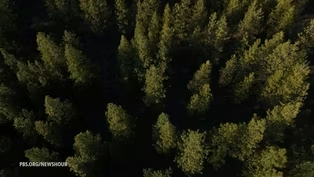
Stephanie Sy reports on an effort to boost the integrity of carbon markets and to open them up to small rural American landowners.
It's part of our ongoing series Tipping Point.
WAYNE STRADER, Family Forest Carbon Program Participant: What's nice with this section it, has some nice trees in it, though.
STEPHANIE SY: On an unusually warm early spring morning, Wayne and Michelle Strader walked through the woods with a forester.
MAN: We got a good diversity of hardwoods here, exactly what we're looking for to enroll, nationally regenerating hardwood forest.
STEPHANIE SY: The expertise Isaac Sloan (ph) brings in helping them manage their forest land is one of the reasons the Straders chose to participate in the Family Forest Carbon program.
For committing to defer harvesting most trees on their land, they also receive an annual stipend that's paying for the climate change-causing carbon their forest sequesters.
WAYNE STRADER: It was about what's doing right for the environment, but also being able to utilize the land and get something out of the land, as opposed to it just sitting there not producing any income or something of that nature.
STEPHANIE SY: Almost 40 percent of the forested land in the United States is owned by people like the Straders with relatively small acreages.
This program gives those landowners an opportunity to capitalize on the growing demand for carbon credits, which large corporations purchase to offset their own emissions.
RITA HITE, President and CEO, American Forest Foundation: They're not getting rich, but this is an annual source of income that helps them pay the bills and keep going as a family landowner.
STEPHANIE SY: Rita Hite leads the American Forest Foundation, which developed the program with The Nature Conservancy.
Since launching in 2020, it has enrolled 200,000 acres across 20 states, paying between $200 and $260 an acre over the course of a 20-year contract.
RITA HITE: Forests already, right now, capture and store about 15 percent of our annual emissions, right?
So they're already doing this hard job.
And we expect, over the life of this program, with just the offers we have right now, to enroll about a million acres.
So it's an opportunity for probably about 1 to 2 percent of the families out there that are owning forests.
STEPHANIE SY: But voluntary carbon markets have not always been transparent.
Recent research found only about a quarter of projects that sold offsetting carbon credits by preventing deforestation actually delivered real emission reductions.
REBECCA SANDERS-DEMOTT, Clean Air Task Force: I think we have a lot of credits that are circulating that may not represent the climate benefit that they are intended to.
STEPHANIE SY: Rebecca Sanders-DeMott at the Clean Air Task Force co-authored a study that scored 20 different methods that have been used to help the climate credits from forests.
Not a single one was classified as robust enough to guarantee credits were delivering the climate benefits they claimed to.
REBECCA SANDERS-DEMOTT: We have to remember companies buy these credits to offset their emissions.
But if the credits they're using aren't high quality and don't represent the climate benefit that they're supposed to, it can actually cause more harm than good, because we think we're making progress, and we're not.
STEPHANIE SY: Markets for carbon credits have also faced some political headwinds.
RITA HITE: Corporations typically pre this administration would be shouting from the rooftops their purchase of carbon credits.
Now they're doing it quietly, right?
STEPHANIE SY: But they're still doing it?
RITA HITE: But they're still doing it.
And there is a race to integrity, where we know that that claim of carbon capture and storage is real.
STEPHANIE SY: The project starts somewhere around these pines, right?
MICHELLE STRADER, Family Forest Carbon Program Participant: Right.
STEPHANIE SY: Michelle and Wayne Strader say they see the climate threat coming for their own forest, now filled with invasive grass and vines and scarred by severe storms.
And they're happy to have a climate-friendly option that offsets some of their costs.
WAYNE STRADER: And as we kind of look through, I mean, there's still some bigger trees in here that could be taken out now and allow some of the other smaller stuff to continue to grow up.
But now that it's in the forest program, I'm going to leave them be.
STEPHANIE SY: In fact, the Straders are logging some of their acreage not in the program right now.
But the 168 acres in the program will remain largely off-limits from harvesting until the 2040s.
MICHELLE STRADER: You're getting monies every year and eventually starts to go up, whereas, if you timber hard timber, you get paid once.
WAYNE STRADER: The one parcel was 40 acres.
It was purchased just as a timber track.
That was kind of the intent of why it was purchased that we would timber it to get some of the value back out of what we paid into the investment.
So I think the program is definitely encouraged.
STEPHANIE SY: What did you end up doing with that 40 acres?
WAYNE STRADER: It's in the program and it's -- right now, we're not doing anything with it.
It's growing naturally and reducing carbon.
STEPHANIE SY: How do you know that you're not just paying people for something they would have done already, that they wouldn't already be taking care of and preserving their forests with the side effect of it capturing carbon RITA HITE: This is at the heart of integrity.
We want to make sure that we're not just paying landowners for things they would have already done, because, if that's the case, then you don't actually get additional carbon.
The atmosphere doesn't feel a difference.
STEPHANIE SY: The Family Forest Carbon program tries to account for this by comparing the plots of land in the program with control plots that are not, but with similar types of trees, owners, and even ground slope, then seeing how they measure over time.
It's an approach known as a dynamic baseline.
RITA HITE: So, at the end of the day, our enrollees essentially have to outcompete their neighbors.
We're only issuing credits if we actually measure the carbon and see the difference, right?
We're not projecting and saying, OK, we think we're going to generate these credits, and we're going to tell you credits right now off of that.
No, we're doing it based off of real-time data capture.
REBECCA SANDERS-DEMOTT: These dynamic baselines that use data from other locations are a real step forward.
STEPHANIE SY: In Sanders-DeMott's study, the method that the Family Forest Carbon program is using was the only one to score as -- quote -- "satisfactory."
REBECCA SANDERS-DEMOTT: Science is evolving really rapidly in this space, but forest carbon credits and their accounting is always going to be really difficult.
It's certainly not a system that we can rely on to solve both our fossil fuel emissions reductions, nor to really provide the funding we need to get all that we can out of our forest.
MICHELLE STRADER: I always thought when I was growing up that I was a water baby, but I'm not.
I'm a forest baby.
STEPHANIE SY: For Wayne and Michelle Strader, who moved to this rural stretch of West Virginia from urban Pennsylvania, protecting the forest goes beyond just the carbon being collected.
When you come out here and you look at this project, are you thinking about climate change?
Are you thinking about those big picture issues and the role you're playing?
WAYNE STRADER: I don't want to say it's the forethought, but, I mean, it's always in the back of your mind that what we're doing is making an impact on our future.
MICHELLE STRADER: Here, it's kind of -- it's just a way of life.
You do think about it, but, for me, I'm thinking more about the beauty of it and how I'd be broken-hearted this was gone.
STEPHANIE SY: Taking care of the land they love while playing a small role in the big fight against manmade climate change.
For the "PBS News Hour," I'm Stephanie Sy in Upshur County, West Virginia.
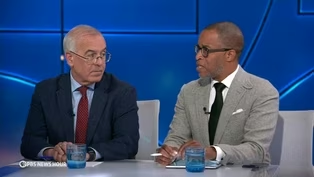
WILLIAM BRANGHAM: Even as another Cabinet member departs his administration, the president demonstrates once again his vice-like grip on Republican primary voters, while Democrats release a clumsy analysis of why they lost to Trump in the first place.
So, for more on the week in politics, we turn to Brooks and Capehart.
That's "The Atlantic"'s David Brooks and Jonathan Capehart of MS NOW.
Gentlemen, so nice to see you.
JONATHAN CAPEHART: Hey, William.
WILLIAM BRANGHAM: Jonathan, as I just mentioned, once again the president, faced with two Republican thorns in his side, Thomas Massie and Bill Cassidy, the president says, I want you primary voters to chuck these two guys out and put my loyalists in their stead.
And they do.
They get rid of two popular local political leaders.
What do you make of this ongoing ability that he has?
JONATHAN CAPEHART: Well, I mean, on one hand, this is nothing new.
If you pay attention to the polls, you know that, one, the president only cares about his standing among Republicans, particularly MAGA Republicans, and, two, Republicans by and large are still lockstep behind the president, although overall less than they were before.
But MAGA Republicans haven't really moved.
They have stayed with the president, and not just in getting rid of Cassidy in Louisiana, but also a few local legislators in Indiana who defied the president in his wishes for redistricting.
So if you are a sitting member of any legislature and you have gone sideways with the president and the president then says, I'm backing your opponent, you have to... WILLIAM BRANGHAM: Quaking in your boots.
JONATHAN CAPEHART: You have to fear.
And that primary was Saturday night.
And on my show, we were talking all about Louisiana.
My thought immediately went to Texas, because if you were John Cornyn in that moment, you were quaking in your boots because you were waiting for the president to endorse you.
And what did he do on Tuesday?
He didn't endorse Senator Cornyn.
He endorsed Ken Paxton, a farther right Republican, in the race for the Senate.
And so... WILLIAM BRANGHAM: ... with a fair amount of political baggage too.
JONATHAN CAPEHART: So much baggage, he's a Samsonite store.
JONATHAN CAPEHART: And even Republicans will say that about him.
WILLIAM BRANGHAM: What do you make of all this?
DAVID BROOKS: Yes, Trump has done something previous presidents have not done, or at least not done effectively.
He really cares about his party.
A lot of presidents, it was all about themselves.
And so, whether you're like it or not, ever since the first term, Trump has said, I want this to be a MAGA party.
And he's willing to take a short-term hit, apparently, in the midterms, lose a few seats if he can maintain this will be a MAGA party for the next generation, the next 30 years.
And that's sort of an impressive calculation, but - - because he really does care about the party and legacy.
Where it's going to hit him is short term, and I think the pain will be significant.
You get rid of John Cornyn.
John Cornyn was playing the game -- sort of get rid of anyway.
Was playing the game that I'd say two or three dozen Republican senators are playing, which is, I don't love this guy Trump, but I will play along enough... WILLIAM BRANGHAM: Weather the storm.
DAVID BROOKS: ... and you don't kill me.
That's the assumed, the unstated deal they have all made.
And Trump says, throw out the deal.
Cornyn, you have been pretty loyal to me.
JONATHAN CAPEHART: Right.
DAVID BROOKS: But you're not 100 percent.
I'm going with Ken Paxton.
So every other Republican senator, who's in that case, of which there are a lot, are looking around saying, what happened to our deal?
And John Cornyn, by the way, is a pretty popular guy in the Senate.
Remember, he came very close to winning the Senate majority leader.
He's got a lot of friends and supporters in the Republican Caucus, and he campaigned for a whole bunch of them.
And so a lot of Republicans are looking around and thinking, whoa, this deal has been broken.
I got to do some thinking here.
WILLIAM BRANGHAM: And according to my colleague Lisa Desjardins, the move against Cornyn, as well as this really unprecedented anti-weaponization fund that the president set up, almost $2 billion to potentially give out to people who claim they have been victims of political persecution, legal political persecution, that did seem to drive a GOP mini-revolt this week.
Jonathan, do you see a Republican resistance growing here?
JONATHAN CAPEHART: Sure.
It might be a one-cell organism right now.
(LAUGHTER) WILLIAM BRANGHAM: Tiny little amoeba.
JONATHAN CAPEHART: But real quickly, this deal that you're talking about, Republicans have to understand -- and Cornyn is the latest example -- that deal is a one-way street.
You can do all the things, and the president is not going to do anything for you.
When it comes to this weaponization fund, or as, I have heard it called, the thug fund, and the revolt against it, against the fund, against the ballroom, against doing anything on reconciliation to fund ICE, I mean, all of that happened after he endorsed, the president endorsed Ken Paxton, because Senator Cornyn is so popular among Republicans and they were extremely angry with the president and what he did.
And this is the way they are showing their frustration, showing their anger.
But sometimes I kind of wonder if they're going to be like -- what was that general, the Russian general who got in the tanks in 2023 and rolled to Moscow, but didn't quite get there against Putin?
DAVID BROOKS: ... his name.
JONATHAN CAPEHART: Prigozhin, General Prigozhin.
I wonder if this revolt that we're seeing is going to be the GOP equivalent of that.
They're showing some backbone right now, but when they come back from their recess, will they still be in revolt mode?
WILLIAM BRANGHAM: You mentioned that this is -- some people call this weaponization fund a thug fund.
My colleague Liz Landers talked to Enrique Tarrio, the leader of the Proud Boys, a white supremacist, organizer, a lead organizer of January 6, and he was thrilled by the idea of this fund.
He thinks he's owed tens of millions of dollars for what he has been through.
Do you think, David, if in fact, money starts to flow to people who there is very good evidence assaulted officers or were deeply involved in January 6, that this will further that revolt?
DAVID BROOKS: Possibly.
And it wasn't just the fund.
Derek Thompson, an independent journalist, mentioned, what happened this week?
Trump got out of $100 million IRS fund.
He had the immunity from future tax investigations, this $1.8 billion slush fund, insider trading about $1 billion.
This was like the Coachella of political corruption all in one week.
And you take a look at that, and you're like, I don't care who you are.
If you have got a shred of integrity, you're like, what is going on here?
Walter Olson, who is a prominent legal analyst, said it was the biggest act of political corruption of his lifetime.
DAVID BROOKS: And so it's just mind-boggling.
I try not to be like Trump is atrocious here every week.
I try to -- like, I don't want to be part of the same old monoculture.
WILLIAM BRANGHAM: We appreciate that.
DAVID BROOKS: But Trump is not helping.
WILLIAM BRANGHAM: No, this was... DAVID BROOKS: This was an astounding week of atrocious behavior.
WILLIAM BRANGHAM: And seemingly, from the Republican Party, not really the commensurate response.
DAVID BROOKS: Right.
And, there, I'm probably four notches thinking they're more offended than Jonathan is, that there might be some action.
A lot of things are happening.
He's losing a war.
His approval is down into the 30s.
I have always thought, when it gets down to 35, 33, things begin to look very different.
They know the midterms are probably going to be pretty bad.
So there's just -- if it's not now, never.
WILLIAM BRANGHAM: Right.
DAVID BROOKS: That would be my line.
WILLIAM BRANGHAM: Right.
We also saw this week this very ham-handed release of the DNC's autopsy.
This is basically an unfinished document that -- I mean, if a high school or college student had submitted this thing, you would give them an F if you were feeling generous.
What does this tell you about the Democratic Party?
JONATHAN CAPEHART: Well, what this tells you is why the Democratic chairman didn't want to release it.
And a source said to me early on before the release -- why aren't you releasing it?
Does it have damning -- does it doesn't have damning information?
Does it call on the carpet sacred cows within the party?
And the person said, no, it's just -- it's so poorly done that it would be horrendous to release it.
Now that it's out -- and your description of it is terrific.
I just called it a trash can of warmed-over conclusions with none of the introspection of, say, the autopsy of 2012... JONATHAN CAPEHART: ... when Mitt Romney lost to President Obama.
I think right now what Democrats need to do is stop with the fighting with each other, looking at this at this terrible -- whatever this is, this autopsy, such as it is, focus on the here and now.
And what the leadership of the Democratic Party should be doing is figuring out how to channel the anger, the palpable anger among Democrats into what their priorities are going to be if they take back the House and maybe even if they take back the Senate, and then how they're going to drive that to '28.
But right now they're not there yet.
I mean, the last minute we have, David, one of the things in that autopsy was Democrats have to stop being so anti-Trump and come up with a positive message as to why you would vote Democratic.
Do you think they're going to do this?
DAVID BROOKS: No.
They have got to ask some questions.
The first is, why are center-left parties in seemingly terminal decline all around the world, in Germany, in France, in Scandinavia, in Central Europe.
Center-left parties are just going boom, boom, boom.
Why?
DAVID BROOKS: What's the problem?
The fastest growing states in this country are Republican states.
Most of the fastest shrinking states are Democratic states.
Why is that?
What's the problem here?
What's wrong with blue governments?
That's going to mean there's going to be more House seats in red states after 2030 than there are now.
Why are Democratic approval ratings or favorability ratings lower than Republican favorability ratings?
These are structural issues.
It's not just about messaging.
The abundance agenda is fine.
Affordability, good issue.
But the center-left parties all around the world are facing deep structural issues related to the economic structure of the information age.
And if they're not thinking in those terms, they're missing the big picture.
WILLIAM BRANGHAM: David Brooks, Jonathan Capehart, thank you both so much.
JONATHAN CAPEHART: Thanks, William.
DAVID BROOKS: Thank you.
WILLIAM BRANGHAM: Be sure to tune into "Washington Week With The Atlantic" tonight here on PBS.
Jeffrey Goldberg and his panel discuss Defense Secretary Pete Hegseth's controversial management of the world's most powerful military.
And watch "Horizons" tomorrow for a look at UAPs, which are what we used to call UFOs, and the possibility of life beyond earth.
Here's an excerpt.
GARRETT GRAFF, Historian: Part of what has transpired particularly over the last 25 or 30 years is rapidly advancing scientific and astronomical understanding of the size, scale, and scope of the universe that makes clear that life probably exists all over our universe, likely even intelligent life exists all over our universe, that, as late as the 1990s, we did not know that there was a single planet outside our own solar system.
And we now understand that potentially effectively every star likely has planets orbiting it.
Some chunk of those would be in what are known as the habitable zone for scientists, and that potentially that there are something on the order of one sextillion habitable planets across our universe.
So you can think life is unlikely, you can think intelligent life is unlikely, but do you really think Earth is a one-in-sextillion chance across the universe?
WILLIAM BRANGHAM: That's on "Horizons" this weekend.
And be sure to watch "Compass Points," where Nick Schifrin and his panel discuss the standoff between Iran and the U.S., as President Trump weighs potential new strikes.
You can watch both "Horizons" and "Compass Points" on our YouTube channel or wherever you get your podcasts and on your local PBS station.
Check your local listings.
That is the "News Hour" for tonight.
I'm William Brangham.
On behalf of the entire "News Hour" team, thank you so much for joining us.
Brooks and Capehart on Trump's loyalty demands
Video has Closed Captions
Brooks and Capehart on Trump's loyalty demands (10m 50s)
Carbon program pays landowners to keep forests standing
Video has Closed Captions
Carbon credit program pays small landowners to keep forests standing (8m 9s)
Gabbard’s record and impact on U.S. intelligence community
Video has Closed Captions
Tulsi Gabbard’s record and impact on the U.S. intelligence community (10m 4s)
News Wrap: Rubio meets NATO allies amid troop questions
Video has Closed Captions
News Wrap: Rubio meets with NATO allies amid troop level confusion (7m 15s)

Shein's purchase of sustainable Everlane sparks outcry
Video has Closed Captions
Shein's purchase of sustainable fashion brand Everlane sparks outcry (6m 14s)
What's behind the 'learning recession' for American students
Video has Closed Captions
What's behind the decade-long 'learning recession' for American students (8m 19s)
Providing Support for PBS.org
Learn Moreabout PBS online sponsorship
- News and Public Affairs

Today's top journalists discuss Washington's current political events and public affairs.

- News and Public Affairs

FRONTLINE is investigative journalism that questions, explains and changes our world.
 New Episode
 New Episode






 New Episode
 New Episode
 New Episode
Support for PBS provided by:
Major corporate funding for the PBS News Hour is provided by BDO, BNSF, Consumer Cellular, American Cruise Lines, and Raymond James. Funding for the PBS NewsHour Weekend is provided by...