
Prairies: Life on the Plains
Episode 4 | 24m 57sVideo has Closed Captions
Often overlooked, tallgrass prairies are among the most biodiverse ecosystems on Earth.
Often overlooked, North America’s prairies are among the most dynamic and biodiverse ecosystems on Earth. Journeying into tallgrass remnants, explorer Ariel Waldman reveals a hidden world where bison shape the land, microscopic wildlife thrive in moss and soil, and fire renews life above ground. From towering grasses to underground networks, the prairies emerge as resilient yet fragile landscapes.
Problems playing video? | Closed Captioning Feedback
Problems playing video? | Closed Captioning Feedback
Prairies: Life on the Plains
Episode 4 | 24m 57sVideo has Closed Captions
Often overlooked, North America’s prairies are among the most dynamic and biodiverse ecosystems on Earth. Journeying into tallgrass remnants, explorer Ariel Waldman reveals a hidden world where bison shape the land, microscopic wildlife thrive in moss and soil, and fire renews life above ground. From towering grasses to underground networks, the prairies emerge as resilient yet fragile landscapes.
Problems playing video? | Closed Captioning Feedback
Where to Watch Life Unearthed with Ariel Waldman
Life Unearthed with Ariel Waldman is available to stream on pbs.org and the PBS app.
Providing Support for PBS.org
Learn Moreabout PBS online sponsorship[exciting piano and string music] There's a hidden world thriving in the heart of North America, a wilderness that is rarely seen.
I want to show you one of the most dynamic ecosystems on the entire planet, but it's one that's become virtually invisible to us: the prairies.
Here, grasses grow taller than people, sheltering a dazzling array of wildlife, all perfectly adapted to this flourishing habitat.
To truly see the prairies as the lush, jungle-like landscape that they are, you need to view them from a different perspective.
[grass rustling] I'm journeying deep into this remarkable ecosystem.
Cameras and microscopes in hand, to discover and document the incredible creatures and landscapes found here.
The prairies are a vibrant tapestry, full of secrets about the interwoven nature of life that we're still trying to unfold.
We'll explore how the most fragile pieces of the prairies are what gives it its strength.
Because understanding the prairies means understanding their future.
[calm lonely guitar music] You don't really notice them at first.
Just a blur through the window on a country road, past crops, scattered fence posts, maybe a few cows.
Nothing that demands your attention.
But the prairies have never needed to shout.
For thousands of years, after glaciers no longer dominated the land, the prairies were North America's beating heart.
A grassland that made up the continent's largest continuous ecosystem.
Today, only relatively small patches remain.
Out here, the horizon stretches out across the expanse.
It feels calm.
Easy to mistake it for empty, even.
But look closer and you'll find there's life in every square inch.
[delightful orchestral music with guitar] This place holds some of the smallest animals on the planet, and some of the heaviest.
And all kinds of shapes and sizes in between.
Getting to the prairies isn't about braving the elements.
It's about learning to see what has always been here.
There are no mountains to summit, no jungles to cut through, just long stretches of dirt and gravel roads to navigate.
My destination?
A remnant tallgrass prairie, tucked between farms, protected only by chance, and now the site of restoration efforts.
Tallgrass prairies get their name from the towering grasses that can grow over six feet tall, thanks to increased rainfall.
I'm here to explore what makes this ecosystem tick.
And to see who calls the prairies their home.
This is the Nachusa Grasslands in Illinois, the site of a few remnants of prairie.
In the state of Illinois alone, there used to be 21 million acres of prairie, but today there's less than 100th of one percent.
But don't mistake these patches of prairie for being puny.
The prairies are the kind of place that rewires how you observe.
This landscape rewards curiosity.
The trick is knowing how to look.
In a sense, there's a magic trick being performed right before your eyes.
If you look in any direction, there seems like maybe not a lot is going on here.
But if you stop and you listen for just a little bit, suddenly the prairies become alive.
[thunder and rain] [bird song and frog calls and water drops] [bird song] [bison grunting while brushing through grass] [bee buzzing] [birds chirping] From the vibrant wildflowers that paint the grasslands in seasonal colors to the countless species of birds, insects, and mammals, the prairies are a stage for nature's grand stories.
[evening insects whirring] [bison grunt] Perhaps the grandest amongst wildlife in the prairies are the bison.
In a sense, they are the elephants of North America.
[bison grunt] When measured by weight, they are the largest land mammal on the continent.
Weighing in at 2,000 pounds, a full grown bull will eat 30 pounds of grass each day.
But even among these towering giants, it's the smallest members of the herd that often steal the show.
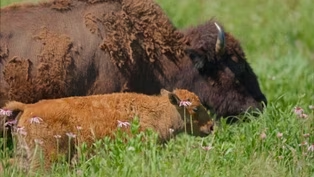
Born with a reddish hue and an unsteady gait, baby bison bring a burst of joy to the wide open plains.
And in the prairies, these calves signal hope for a thriving future.
Here at the Nachusa Grasslands, there's a herd of 100 bison that have been reintroduced to this landscape, and every year they have around 30 baby bison or so.
And you can see them out there.
[bison grunting and chewing] [playful orchestral music] Getting to watch them kind of frolic around, have zoomies across the prairies is just a wonderful sight.
[birds chirping] The return of warm weather on the prairie brings more than just newborn calves.
It's also when the bison begin to shed their thick winter coats.
And that shaggy fur doesn't go to waste.
What falls to the ground quickly becomes useful to other prairie residents.
In the spring, the bison shed their winter coats, in these really incredibly soft and fluffy mounds.
And birds will actually catch this and, and use it for their nests and so will other prairie creatures.
So the bison being here are actually supporting many other creatures here on the prairie.
Bison have actively shaped the prairies for thousands of years.
Sculptors of the land with every hoof step, every mouthful of grass.
One of their more novel behaviors leaves a visible mark on the land.
Many marks, in fact.
Wallowing.
Using their hooves an entire bodies, they roll around in the grass to form a shallow crater in the ground, kicking up clouds of dirt in the process.
Each takes their turn or nudges others along when they think they've had too long of a turn.
Or at least they can try.
Even bison calves get in on the action.
This act of wallowing serves many purposes in addition to just scratching an itch.
By coating their skin in dirt they're able to deter biting insects, cool off from the harsh sun, and even mark their territory with their scent.
Over time, these wallowing spots deepen and become permanent features of the prairie landscape, creating micro habitats that support some of its tiniest inhabitants.
[wings buzzing] Prairie plants set up shop around the edges of bison wallows, and native bees dig burrows in the exposed soil.
When it rains, bison wallows even become temporary ponds for creatures like the tadpole shrimp: a crustacean measuring in only a couple of inches in length.
The imprint bison leave on the land goes far beyond their wallows.
Wallows are just one reminder of how deeply woven bison once were into the fabric of the prairie.
Just two centuries ago, tens of millions of bison roamed across North America in what was known as the Great Bison Belt.
[bison grunting] But by the late 1800s, they were nearly wiped out, slaughtered in a campaign to oppress Native American tribes.
[somber orchestral music] Today, efforts are underway to bring them back to native lands and restore their place in the prairie.
As a result, bison herds are growing once again.
[calm uplifting string music] Each new calf is a sign of recovery, not just for the species, but for the prairies they help sustain.
[bird song] [evening insects whirring] [crickets chirping] In another corner of the prairies, millions of animals can be found roaming the terrain.
But despite their abundance, they're not so easy to see.
As I was walking around the prairies and looking for different interesting wildlife, I had to stop at this rock.
You might not think that a rock would actually be very interesting for wildlife documentation, but I love it because of all the moss and lichen that are here.
Because when I see this, I see the microscopic world that lives here.
[curious orchestral music] Within the carpet of moss that covers rocks, trees and soil in tallgrass prairies exist entire microscopic habitats.
One common creature you can reliably find rummaging around in moss are tardigrades.
Tardigrades are also known as water bears because they're aquatic animals, technically.
But they're also known as moss piglets because moss beds like these are what they love to feast on.
While tardigrades can be found living all over the Earth, they've also become famous for their ability to survive a vacuum of space.
[intense guitar music] Launched on a satellite and without tiny spacesuits, they were exposed to space for ten days.
Upon returning back to Earth, scientists found that most of them had survived the journey.
Mars and tardigrades alike are able to survive extreme environments, including drought.
When they dry out, they lose almost all of their water kind of going into suspended animation.
But when water returns, they spring back and you can see it if we add a little bit of water.
[curious synth music] Within seconds, dried moss beds expand and unfurl.
And dehydrated tardigrades begin to spring back to life.
[underwater bubble sounds] Other microscopic wildlife embedded in the moss begin to wake up, too.
Springtails poke around, or, more accurately, spring, to get around.
Bacteria dance under the canopy of roots.
Ciliates, little single celled creatures, swim around, sweeping up food.
With the help of hair-like structures on the outside of their body, they're able to navigate at speed across the vast microcosmos contained within just a drop of water.
It's a world most of us never see; an entire ecosystem springing to life in a handful of moss.
But dig below the moss just a bit, and you'll find that the soil beneath the prairie grasses holds an even more astonishing cast of microscopic characters.
Part of the invisibility of the prairies is that we only experience them aboveground.
But the grass and everything we see out here is just the tip of the iceberg.
[calm orchestral music] Tallgrass prairies like this one have naturally nutrient-rich soil that provide a home for a number of animals.
By far the most abundant of animals that live in these soils are nematodes.
For every living human on this planet, there exist approximately 57 billion nematodes.
That's a lot of nematodes.
Prairie soils are like a tropical rainforest when it comes to nematodes.
In fact, there are more species of nematodes in prairie soils than there are in tropical rainforests, making it one of the most biodiverse places on Earth for these tiny animals.
While they may be some of the tiniest players in the prairie, they make a big impact; collectively eating as much grass underground as a small herd of bison do above ground; effectively recycling plants on a massive scale.
The thought that most of the activity in the prairies happens below our feet, out of sight, has always fascinated me.
[thoughtful orchestral music] To explore this invisible realm, I traveled 500 miles west to Kansas to visit the Konza Prairie, named after the Konza people.
I set out in search of a gully where erosion has carved away the earth to reveal the intricate layers below.
While there's a lot going on aboveground under the surface, underground is the majority of biomass.
Much of what happens underground remains a mystery.
But recent research has uncovered the complex relationships between plants and fungi, like how they interact, cycle nutrients and potentially communicate with one another about their environment.
[uplifting orchestral music] While our attempts to understand these interactions are only at the beginning, the physical importance of their presence is something that can be seen with the naked eye.
What you can see behind me is soil clumping together in amongst all these roots.
And what's happening is the roots are producing sugar, and in the soil exists fungi and bacteria.
And that sugar feeds those fungi and bacteria in the soil, and together those roots, that sugar, that fungi, that bacteria, come together to form a glue that holds all of this soil together in an aggregate.
[UTV driving] You can also see this relationship in action with just a few basic materials.
So what I've got here are three jars of different types of soil.
Conventional agricultural soil.
Prairie restoration soil.
And this one with all the roots in it, is native prairie soil.
And what I'm about to demonstrate is how the microbial living glue that holds prairie soils together is very different from what you'll see in the conventional agricultural soil, that doesn't really have as much of that glue in it.
And so I'm going to pour some water in here so we can see the differences in action.
[investigative synth and orchestral music] By just pouring water over each jar of soil, you can quickly see the contrast in how each type responds.
Without native microorganisms and plants present, the conventional agricultural soil collapses after just a few short minutes.
This is a pretty exciting experiment to run, because you get to see in real time how agricultural soil, conventional agricultural soil, is actually eroding, and doesn't have that living glue to hold it together.
Whereas, the prairie restoration soil, which has been restored over about 20-ish years, and the native prairie soil have held together pretty great.
So you can see just in this small jar how valuable prairie soil is to us.
It filters water, and it also provides a healthy ecosystem for all wildlife.
Biological forces help shape the prairies underground.
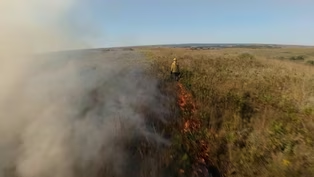
But there's another force shaping these ecosystems aboveground: fire.
[intense rock music] The tallgrass prairies we know today may seem timeless, but they are a relatively new ecosystem on Earth, having emerged only eight to 10,000 years ago with the retreat of the glaciers, long after Native Americans were already inhabiting and farming the area.
They're a unique ecosystem that has never known a time without humans.
[smoldering ashes] The prairies evolved with fire, and not just from natural causes like lightning strikes, but also from prescribed burns by the Kaw and other indigenous nations in the area.
And today, I got to witness a prescribed burn here on the Konza prairie.
And for me, this is really exciting because it's really getting to witness ecosystem management in action.
[rock music intensifies as flames intensify] I tagged along with the prairie fire crew to see the action up close.
They moved with practiced precision, lighting drip torches and setting fire to carefully chosen sections of grass.
Watching a controlled burn felt less like destruction and more like choreography.
A skillfully orchestrated effort.
Fire might seem dramatic, but on the prairie it's a tool carefully used to maintain balance.
These landscapes have evolved to not only withstand fire, but to thrive because of it.
Without fire, many native plants and animals would be unable to get a foothold amongst more aggressive competitors that could crowd them out permanently if left undisrupted.
[calm orchestral music] What's truly incredible to witness is how quickly the land responds Within just two days of being reduced to ashes, green blades of grass can already be spotted reaching out into the sun amongst the soot.
As they unfurl, they lay the foundation for a new season of growth.
[wind blowing] What remains of the prairies today is a sliver of wilderness that has rarely been seen for 200 years.
[bird song and somber orchestral music] After the invention of the steel plow in 1837 that could efficiently tear up the tangles of native prairie plants, it was within the span of just a couple of decades most of this land was destroyed and converted into conventional agriculture.
On windy days, you can still see the aftermath in the form of dust storms of soil that is no longer anchored to the ground.
[somber orchestral music] Grasslands, including prairies, are the most endangered ecosystem on Earth, and they remain the most threatened due to lack of protection.
Part of the solution to protecting the prairies relies on us to change our perspective.
I grew up in Kansas, somewhat near the prairies, a place where, well, a lot of people call it flyover country because they think there's nothing to see here or just a big, featureless expanse.
And I sort of internalized that growing up.
I thought that I lived in a place where there wasn't much to see, but I couldn't have been more wrong.
The prairies are a biodiversity hub.
You just need to know where to look.
[goose calling] Changing how we see the prairies is the first and most important step to securing their future.
[uplifting orchestral music] The prairies are incredibly resilient, but they're also fragile.
Fragile to one thing: us.
Once they've been dug up or cemented over, they're gone.
And once they're gone, they're gone forever.
The prairies may be vulnerable, but they're far from helpless.
With care, science, and respect for the indigenous and local knowledge that's come before us, we have the tools to protect what remains and expand the footprint of what can be restored.
The future of the prairie isn't written in stone.
It's written in roots.
And it's up to us to keep it growing.
[uplifting piano music]
Video has Closed Captions
Clip: Ep4 | 2m 37s | The prairies evolved with fire and depend on it to thrive. (2m 37s)
Video has Closed Captions
Preview: Ep4 | 30s | Often overlooked, tallgrass prairies are among the most biodiverse ecosystems on Earth. (30s)
Providing Support for PBS.org
Learn Moreabout PBS online sponsorship
- Science and Nature

Miles O'Brien travels the world searching for solutions to today’s most urgent challenges.
 New Episode
 New Episode







 Recently Added


Support for PBS provided by: