
Reflecting on the legacy of the late Rev. Jesse Jackson
Clip: Season 54 Episode 11 | 8m 14sVideo has Closed Captions
The civil rights leader was on ABJ when his Rainbow PUSH Coalition held its annual summit in Detroit
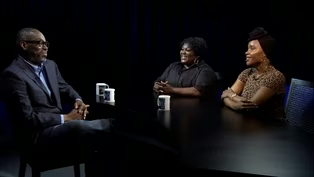
We’ll reflect on the legacy of the late Rev. Jesse Jackson by looking back at the last interview he did on American Black Journal in 2015. He talks about his Rainbow PUSH Coalition’s “Global Automotive Summit,” which took place in Detroit that year. He also speaks about his efforts to create more leadership opportunities for minorities in the automotive industry.
Problems playing video? | Closed Captioning Feedback
Problems playing video? | Closed Captioning Feedback
American Black Journal is a local public television program presented by Detroit PBS
Reflecting on the legacy of the late Rev. Jesse Jackson
Clip: Season 54 Episode 11 | 8m 14sVideo has Closed Captions
We’ll reflect on the legacy of the late Rev. Jesse Jackson by looking back at the last interview he did on American Black Journal in 2015. He talks about his Rainbow PUSH Coalition’s “Global Automotive Summit,” which took place in Detroit that year. He also speaks about his efforts to create more leadership opportunities for minorities in the automotive industry.
Problems playing video? | Closed Captioning Feedback
How to Watch American Black Journal
American Black Journal is available to stream on pbs.org and the free PBS App, available on iPhone, Apple TV, Android TV, Android smartphones, Amazon Fire TV, Amazon Fire Tablet, Roku, Samsung Smart TV, and Vizio.
Providing Support for PBS.org
Learn Moreabout PBS online sponsorshipThe nation has said its final goodbyes to civil rights leader, Reverend Jesse Jackson, who died last month at the age of 84.
Memorial services were held in Chicago and South Carolina, celebrating his life and legacy.
Jackson spent his entire adult life advocating for universal human rights and economic justice.
He was a guest on this show in 2015 when his Rainbow PUSH Coalition held its Annual Global Automotive Summit right here in Detroit.
Here's a portion of that conversation.
This is a wonderful program.
The question I have, though, first is, the automotive industry has been around for more than a hundred years.
You would think that by now, we would not really be talking about opportunities for minorities.
- A history of racial discrimination.
We've worked for a long time on this, when the line was really, real hard and dirty work.
We consume, we over-index consumers when it comes to business of the matter.
We got our first... - We buy lots of... - Car dealership in 1966.
That's over 50 years ago.
And yet there's nothing in the industry we cannot do.
The focus right now is on additional jobs, as all the dealerships and suppliers.
And then there is legal and administrative and advertising and marketing, it's a whole range of stuff.
- Yeah.
- And so, we are really indexing far beneath our capacity in the industry, and so what we did... Mercedes-Benz, for example, Mercedes-Benz, 360 dealerships, six African American.
We indexed around 25%.
- Yeah.
- VW, you know, about the same.
So it's global because we'd rather take delegations led by Mr.
John Graves and others to Japan to meet with Honda, Nissan and Toyota.
We have to go to Germany to meet with VW and Mercedes-Benz in light of what has happened with VW because the violation of the law by VW is a big deal to everybody.
- Sure.
- It's not just emissions of soil, of dirt, but it's also omissions of equal opportunities.
We're really not looking for diverse.
We're looking for fair trade.
We're looking for two ways.
We trade with you, trade with us.
- You trade with us.
- With our share of dealerships and franchises and suppliers.
- Do you find that there's a difference between the way the Detroit Three automakers deal with this and the foreign?
You have a bigger challenge with the foreign automakers?
- Well, they're coming up fast now.
Toyota has specifically, but General Motors has taken the lead in so many areas.
When Leon Sullivan was put on the board some years ago, they led the drive for affirmative action.
GM led the drive to get us out of South Africa on conditions that made sense.
And so, there's a sensitivity to GM, Ford and Chrysler.
Ford and Chrysler are no longer American-owned, but there's a legacy of history there.
And it comes in part out of UAW, out of worker sensitivity.
But we must not, because these companies are now producing so much.
But they're going south.
They're not coming back to Detroit, they're going... VW's in Chattanooga, Tennessee.
- Right.
- Toyota's in Plano, Texas and in Mississippi.
VW is going to South Carolina.
They're going to basic right-to-work law states.
And so, as they come under those conditions, we have to reassess how we relate to the growing industry, 'cause once the civil rights barriers came down and bridges were built, then these industries began to go south.
And with that comes a whole new economic agenda.
- It's different, it's different.
It's still different for African Americans.
Opportunity is still different in those states.
- Well, particularly beyond the working on the basic assembly line.
And those are good jobs, by the way.
But beyond that, we have the right to be dealers, and in proportion to our investments.
Dealers and franchises.
But then even the high tech has become such a big dealer.
You can't drive these cars now without having a great sense of technology.
And we spent a lot of time this year tying in Silicon Valley in the automotive industry.
- Yeah.
- And that's the most insensitive industry going.
You would think since it's so... - Silicon Valley.
- Since it's relatively new, it would be much better.
But it's not.
189 board members, 36 white women board members, three Blacks.
- Is that right?
- And one Latino.
In the C-suites, 360, three blacks, one Latino.
- [Stephen] Wow.
- Board members at Apple has zero, Facebook zero.
That's changing now because HP now put on four Black board members last week.
And Apple now has put on Jim Bell on their board.
So, we're fighting to get board positions in C-suites, but also to get STEM education to our children, to get for young boys and young girls.
We have a tech center at the Rainbow PUSH in Chicago.
We want a thousand churches.
We use some of that empty unused Sunday school space, we can teach children the apps, codes and financial literacy and marketing.
- And that's where it started.
I mean, they have gotta be up on those things just to compete for any job.
- Which they can do, because we don't have a talent deficit.
- [Stephen] Right.
- It's an opportunity deficit.
There's nothing we cannot do.
Every time I think about the automotive industry, the most sensitive job in the whole industry, the designer.
The chief designer in the world is Ed Welburn.
- Mm-hmm, right.
- In the whole world.
Ed at GM, he sits at a desk every day and looks at six continents.
And he has to pass on every design.
He grew up in the South, you know, went to Howard University, learned his art, his form.
But we don't see that face in the auto industry.
Women are running manufacturing plants and we're trying to get them to expose what we can do, 'cause if we can be president of the United States, we can be president of auto companies.
- Right.
(laughs) The contraction in the auto industry has gotta also have set us back in terms of this.
And not just in terms of... - Those who had legacy kept inside track, you know.
Effort and excellence means a lot.
But access and inheritance means more.
- [Stephen] Yeah.
- It's why we struggle to keep on to our one shop, which is almost cost-ineffective now.
Some of them kept their multiple dealerships.
So, we had maybe seven to 900 dealerships 10 years ago.
Now selling around 246.
- Yeah.
- So it was a radical drop in dealership.
Not in purchasing, but in dealerships and suppliers.
- But in ownership.
- Yeah, that's right.
- Yeah.
You've had these summits several times.
Talk about some of the things that you've learned from having people just sit and talk about this.
What are the people's reactions?
What's the movement that we're seeing?
- Well, it's the infrastructure, you know, when you have people like Vivian Picard and Jim Farmer... - Yeah.
- At GM Motors.
Their sensitivity is a... They have direct access to Mary Barra.
- Right.
- That's a big deal, you know.
They're not just fronting, they're really representing.
We're learning having access matters at the highest levels.
- Yeah.
- Because when you leave out Blacks and browns, you're leaving out, what, market, money, talent, location, and growth.
So you're not just doing us a favor doing it.
Inclusion leads to growth.
Then with growth, everybody wins.
- Everybody makes more money, sure.
- So we're over-indexing, but it's like a one-eyed quarterback.
You just can't see the field.
You can't see the opportunities unless... And it seems, ironically, some of the foreign companies have come in.
They've seen the market more clearly than the historical companies.
They've seen this through the lens of historical race.
- [Stephen] Sure.
- And they cannot see the marketplace.
So a company like Toyota's gonna go shot to number one.
- [Stephen] Right.
- They don't have the same historical barriers that these companies have.
- Yeah.
Uh... - I think... Make your point.
- Yeah, go ahead.
So, one of the things that's really interesting to me about this work is, when I think about you and I think of footage that I see of you from the '60s and the things that you were doing in the '60s and '70s, fighting for legal equality and progress in this nation, that's really different from the kind of work that you have to do now, which is about opening up economic doors.
- We're free, but not equal.
Disney’s “The Lion King” is back at the Detroit Opera House
Video has Closed Captions
Clip: S54 Ep11 | 16m 2s | ABJ sits down with Zama Magudulela, who plays Rafiki, and Thembelihle Cele, who plays Nala. (16m 2s)
Providing Support for PBS.org
Learn Moreabout PBS online sponsorship
- News and Public Affairs

Top journalists deliver compelling original analysis of the hour's headlines.

- News and Public Affairs

FRONTLINE is investigative journalism that questions, explains and changes our world.












Support for PBS provided by:
American Black Journal is a local public television program presented by Detroit PBS