
Trump dealt major blow by Supreme Court
Clip: 2/21/2026 | 9m 50sVideo has Closed Captions
Trump dealt major blow by Supreme Court
President Trump is days away from delivering his State of the Union address and was just dealt a major blow by the Supreme Court. The panel discusses how Trump is responding to the ruling against his tariffs.
Problems playing video? | Closed Captioning Feedback
Problems playing video? | Closed Captioning Feedback
Major funding for “Washington Week with The Atlantic” is provided by Consumer Cellular, Otsuka, Kaiser Permanente, the Yuen Foundation, and the Corporation for Public Broadcasting.
Trump dealt major blow by Supreme Court
Clip: 2/21/2026 | 9m 50sVideo has Closed Captions
President Trump is days away from delivering his State of the Union address and was just dealt a major blow by the Supreme Court. The panel discusses how Trump is responding to the ruling against his tariffs.
Problems playing video? | Closed Captioning Feedback
How to Watch Washington Week with The Atlantic
Washington Week with The Atlantic is available to stream on pbs.org and the free PBS App, available on iPhone, Apple TV, Android TV, Android smartphones, Amazon Fire TV, Amazon Fire Tablet, Roku, Samsung Smart TV, and Vizio.
Buy Now

10 big stories Washington Week covered
Washington Week came on the air February 23, 1967. In the 50 years that followed, we covered a lot of history-making events. Read up on 10 of the biggest stories Washington Week covered in its first 50 years.Providing Support for PBS.org
Learn Moreabout PBS online sponsorshipVivian Salama: President Trump is days away from delivering his State of the Union address and his speech comes at a moment of deep division, challenges to core elements of his agenda, friction with allies abroad, and questions about the balance of power here in Washington.
Joining me tonight to discuss this and more, Peter Baker is chief White House correspondent for The New York Times, Eugene Daniels is a senior Washington correspondent and a co-anchor of The Weekend at MS NOW, Lisa Desjardins is the Congressional correspondent for PBS NewsHour, and Susan Glasser is staff writer at The New Yorker.
Thank you all so much for joining me.
So, the Supreme Court dealt a major blow to President Trump's economic agenda today, striking down the broad global tariffs that he imposed through this authority that's known as the International Emergency Economic Powers Act.
The Supreme Court held that the president lacked authority to leave these sweeping tariffs without explicit Congressional approval.
Peter, the president came out to the podium today and tried to respond to the Supreme Court's decision.
How did that play out?
Peter Baker, Chief White House Correspondent, The New York Times: Yes, he took it graciously, of course.
Vivian Salama: Yes, obviously.
Peter Baker: He attacked the Supreme Court justices and said that they were unpatriotic, that they should be ashamed of themselves, their parents should be ashamed, that their family should be ashamed of them, that they had been influenced by foreign interests.
It's a kind of reaction we shouldn't be surprised by, but not the kind of reaction we normally see from a president toward a Supreme Court ruling.
And it's just -- he sees the Supreme Court as a political body.
He doesn't see it as a judicial body in that sense.
They're supposed to rule for me because I appointed them.
He gives that impression about the three justices he put on there, two of whom went against him today, Amy Coney Barrett and Neil Gorsuch.
And he then, you know, made clear he wasn't going to basically bow down just because they have made this ruling.
By the end of the day, he'd already put out a new order trying to re-impose tariffs under a different legal authority.
Vivian Salama: So, he said today that because he couldn't use that legal authority, he would impose 10 percent tariffs on countries around the world using different authorities.
He actually took the Truth Social around the same time that he was at the podium, you know, opposed through his account.
And he said this was an important case to me, more as a symbol of economic and national security than anything else.
The good news is that there are methods, practices, statutes, and other authorities as recognized by the entire court and Congress and even -- and are even stronger than the IEEPA tariffs available to me as president of the United States.
So, Susan, obviously, he's looking for workarounds here.
Susan Glasser, Staff Writer, The New Yorker: Yes.
I mean, the Supreme Court was very clear.
That's not how our system is supposed to work, and I think that's really powerful, if you read these decisions.
You know what's supposed to happen in a situation like this?
The Supreme Court told the president of the United States very clearly, if you want these tariffs, get Congress to pass a law to issue these tariffs.
Donald Trump has ruled out doing that.
And, of course, he doesn't actually have the votes, even though it's a Republican-controlled House and a Republican-controlled Senate.
He's trying to bypass the way our system is supposed to work.
And I think it's really notable here that one of the justices who concurred in the majority opinion, Justice Gorsuch, as you mentioned, he's a Trump appointee, he's a real conservative.
He's ruled against, you know, many, many, many beloved issues of liberals.
And yet what he wrote in his concurrent is something that you're seeing passed around Washington today a lot, he said, essentially, if you bypass Congress and the system is not supposed to work, so that one man has this much power.
Vivian Salama: I mean, talk to me also about the way that the president has used this as basically a central tool in dealing with countries, allies and adversaries alike, you know, imposing tariffs on India because it was buying Russian oil and for other reasons as well, imposing it on European allies because he wanted to compete on steel and aluminum.
I mean, it's sweeping.
How are you -- what are you hearing from sources abroad about how the Supreme Court ruling has been received, but also how President Trump has conducted himself through his economic agenda?
Susan Glasser: That's exactly right.
This is a pillar of how he was using his aggrandizement and his aggressive view of the powers, the sweeping powers of the American presidency, to rewrite international diplomacy, which for Donald Trump is very much about economics anyways.
You know, Europeans are already so terrified about the unraveling of our decades-long alliance, you know, that there was real questions as recently as last weekend, the Munich Security Conference.
You know, is this an alliance where the United States has gone so far off the rails?
Are there checks and balances left in the system?
And I think there'll be a little bit of relief that, okay, it seems that the Supreme Court is still, at a certain point, willing to step in and check and balance, but the fact that Trump immediately then is trying to circumvent the Supreme Court's ruling.
And let's be clear, that's what he's doing.
He is trying to circumvent the court's ruling and that's going to unleash a whole new wave of uncertainty in the economic markets.
It creates turmoil, by the way, that is affecting not just the United States but other countries around the world that we're connected to.
So, again, it's a sign of Donald Trump's chaos affecting not just Americans but people all over the world.
Vivian Salama: It's not really just a question of circumventing the court's ruling, right, Lisa, like we've seen significant reasons to be concerned about the erosion of the independence of the judiciary.
I mean, just this week we saw a huge banner with President Trump's picture on it go up outside the Department of Justice, which is pretty astonishing.
So, today, you know, we were just saying that President Trump called Justices Neil Gorsuch and Amy Coney Barrett, two of the justices he nominated in his first term, an embarrassment to their families.
He said they were making a big mistake.
You cover the Hill.
You know, how are these attacks being received, particularly among Republicans who do believe in essence of the independence of the judiciary and other branches?
Lisa Desjardins, Congressional Correspondent, PBS NewsHour: Somewhere in Fitbit headquarters, they are noticing heart rates going up among Republicans wearing those watches.
I think that Republicans right now are concerned about their ability not just to hold the House but really to have even a close margin in the House because things are not going the way.
They need Trump to be charming Trump, not angry Trump.
We'll get into that in the State of the Union.
But when it comes to tariffs, Susan mentioned that our allies are terrified about what this means, the unraveling of like the European alliances.
I think a lot of Republicans on the Hill are terrified of a potential tariff vote if the president decides he does want to go to the Hill with this and what that would mean for the unraveling of the very tricky MAGA moderate alliance of voters that they all need and they don't want to take those tariff votes.
The House and Senate have both passed bills opposing tariffs in the past, but it hasn't led to serious consequences.
Vivian Salama: But are they ready for that kind of a fight with Trump, especially for an issue that's so near and dear to his heart?
Lisa Desjardins: No.
It would be a very difficult vote for most Republicans.
But I'll tell you who would love it.
Democrats.
They are ready for this.
Let's talk about tariffs as much as we want to talk about how they say he's failing on inflation and failing on prices.
They think this is a good example of an economic agenda failing, and Republicans have to figure out their message.
Vivian Salama: Okay.
So, Eugene, in 2025, economic growth slowed compared to the year before.
And economists say it was largely driven by President Trump's tariffs, as well as the government shutdown that we saw in the fall.
Many economists believe the tariffs are hurting the country.
Many people in states that backed Trump overwhelmingly are being -- are feeling the pain of these tariffs.
So, why is President Trump so dedicated to still - - or why is he so committed to this policy?
Eugene Daniels, Senior Washington Correspondent, MS NOW: He has been obsessed with the idea of tariffs forever, right?
When he was a businessman in New York City, that was something he talked about a lot, interestingly enough.
It is why he believes like Japan is such a powerhouse because of tariffs.
He sees it as this kind of ability and tool, and he's used it, as Susan was talking about, as a cudgel against both your enemies and your allies.
And that's why when people are -- when I talk to Republicans, I'm sure you have too, who are like, oh, if the Supreme Court will just get rid of this, these tariffs, everything will be fine.
Well, maybe we won't get this -- yes, we can move on.
That is not what's going to happen.
It was never what was going to happen.
Donald Trump truly believes that this is a way to do economics.
And when you look at his kind of economic plan, this is kind of it, right?
Like there hasn't been other bills that he's been trying to pass.
They passed the one reconciliation bill they keep talking about.
Maybe they're working on something else, but there's no real movement on that.
Lisa Desjardins: They would say tax cuts.
Vivian Salama: Right, exactly, tax cuts.
Lisa Desjardins: They would say, extending the tax cuts, they'd say, right?
Susan Glasser: So, give more money to wealthy corporations and individuals and make everyday people pay more money.
I thought it was very interesting on the politics today that you had J.B.
Pritzker, the governor of Illinois, sending Donald Trump -- it was almost a Trumpian like gesture, right?
He sent him an invoice.
He said, okay, I'd like you to pay back the people of my state for all the money that they had to pay extra for goods and services as a result last year of your tariffs.
Eugene Daniels: Because the politics of this is on Democrats' side.
Like when you look at how voters think about tariffs, they don't like tariffs.
It's not -- Republicans don't like tariffs.
Democrats don't like tariffs.
Independents don't like the concept of tariffs, because they understand that the connection between their prices going up and President Trump signing these executive voters.
Vivian Salama: But President Trump always says short-term pain, long-term gain.
You know, that's kind of his mantra on the campaign trail.
But, you know -- Eugene Daniels: Voters don't think like that.
They have bills.
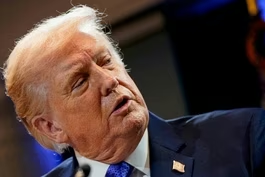
Can Trump reset the story of his second term?
Video has Closed Captions
Can Trump reset the story of his second term? (14m 22s)
Providing Support for PBS.org
Learn Moreabout PBS online sponsorship
- News and Public Affairs

Top journalists deliver compelling original analysis of the hour's headlines.

- News and Public Affairs

FRONTLINE is investigative journalism that questions, explains and changes our world.












Support for PBS provided by:
Major funding for “Washington Week with The Atlantic” is provided by Consumer Cellular, Otsuka, Kaiser Permanente, the Yuen Foundation, and the Corporation for Public Broadcasting.