
Washington Week with The Atlantic full episode, 5/22/26
5/22/2026 | 26m 46sVideo has Closed Captions
Full Washington Week with the Atlantic broadcast from May 22, 2026.
Full Washington Week with the Atlantic broadcast from May 22, 2026.
Problems playing video? | Closed Captioning Feedback
Problems playing video? | Closed Captioning Feedback
Major funding for “Washington Week with The Atlantic” is provided by Consumer Cellular, Otsuka, Kaiser Permanente, the Yuen Foundation, and the Corporation for Public Broadcasting.
Washington Week with The Atlantic full episode, 5/22/26
5/22/2026 | 26m 46sVideo has Closed Captions
Full Washington Week with the Atlantic broadcast from May 22, 2026.
Problems playing video? | Closed Captioning Feedback
Where to Watch Washington Week with The Atlantic
Washington Week with The Atlantic is available to stream on pbs.org and the PBS app.
Buy Now

10 big stories Washington Week covered
Washington Week came on the air February 23, 1967. In the 50 years that followed, we covered a lot of history-making events. Read up on 10 of the biggest stories Washington Week covered in its first 50 years.Providing Support for PBS.org
Learn Moreabout PBS online sponsorshipDefense Secretary Pete Hegsath has distinguished himself as President Trump's most pugnacious cabinet member and as a leading advocate of the war against Iran.
He is also someone who is trying to reshape the military according to his own values and beliefs.
It's safe to say that the Pentagon has never seen a secretary of defense like him.
This Memorial Day weekend, a close look at Hexet's turbulent time leading the world's most powerful military.
Next, this is Washington Week with The Atlantic.
Corporate funding provided by In 1995, two friends set out to make wireless coverage accessible to all with no long-term contracts, nationwide coverage, and 100% US-based customer support.
Consumer Cellular Freedom Calls.
Certified financial planner professionals are proud to support Washington Week with the Atlantic.
CFP professionals are committed to acting in their clients best interest.
More information at let'smakeaplan.org.
Additional funding is provided by Coup and Patricia Euan for the Euan Foundation committed to bridging cultural differences in our communities.
Sandra and Carl Delay Magneson, Rose Hershel and Andy Shreves, Robert and Susan Rosenbomb, Jay and Sharon Rockefeller, Charles Hamoy through the Charles Hamo Fund, Steve and Marilyn Kerman, Leonard and Norma Chlorine, and by contributions to your PBS station from viewers like you.
Thank you once again from the David M. Rubenstein studio at Weta in Washington, editor-inchief of The Atlantic and moderator Jeffrey Goldberg.
Good evening and welcome to Washington Week.
Here's something that I think is reasonable to state.
In previous presidencies, the weekend host of a cable television news and entertainment show might very well be offered an interview with the Secretary of Defense.
But it's hard to imagine that he would be offered the job of Secretary of Defense.
But this is what Donald Trump did when he chose Pete Hexath for the role.
As you know, by the way, Hexath has demanded to be called Secretary of War, hearkening back to the title used in World War II and earlier.
But until Congress authorizes the name change, we will use the statutory title.
Hexath has instituted so many other radical changes to the way the most powerful and lethal military in the history of the planet is run that it is hard sometimes to rank these changes in terms of their lasting impact.
But we'll try tonight with my guests.
Helen Cooper, a national security correspondent at the New York Times.
Jonathan Carl is the chief Washington correspondent for ABC News.
Missy Ryan covers the Pentagon for the Atlantic.
And Vivian Salama is a national security correspondent at the Atlantic.
Thank you all for joining me.
Um I want to start actually on domestic politics because there's been obviously a lot of action this week.
Just spend a couple of minutes on this.
Vivian, there are a bunch of contradictory signals about President Trump's political strength.
On the one hand, his poll numbers are in the basement.
On the other, he still has the power to punish his Republican enemies, as he just did with Thomas Massie of Kentucky.
Which way is all this trending?
He's trying to knock out Senator John Cornin now, much to the chagrin of Cornin's many Republican allies in the Senate.
Where is this heading?
If anything, the last month has proven to us that President Trump still has juice within the party.
Even as his poll numbers um go lower to the lowest that they've ever been, even as he struggles to um implement his domestic agenda, his foreign policy agenda, he still does have that juice.
And we've seen it in recent weeks with regard to a number of different primaries.
Earlier this month, Indiana was particularly noteworthy because five or six six challengers that President Trump endorsed um all won the GOP primary there and that was simply because they supported his redistricting push.
Now, there were all eyes were on Thomas Massie in Kentucky in particular because he's been so outspoken against President Trump in recent years.
He has gone after him on everything from Trump really did not like that guy and he did not like that guy.
He's he has criticized him left, right, and center, but Massie was one of the leading voices in the GOP with regard to releasing the Epstein files.
He was very critical on uh the president's policies about Israel.
And so all of that kind of culminated with this this primary um a former Navy Seal who challenged Massie was supported not only by the president, but you even had the secretary of defense Pete Heg go out there and support him, which is very unprecedented.
um and ultimately he lost.
Now, was it because of the fact that he had been so outspoken or is it again part of this trend?
We're going to we're going to really know that going forward with regard to Texas next week, John.
So, so so look, but but a couple of things here.
First of all, uh Trump does have still the control over the party.
I mean, there's just no question about this.
Um this is something that we also saw though in 2022.
If you remember, he was in exile, out of power, uh kind of like written off as as as as a spent force, and he went around and started endorsing in primaries, and he won in race after race after race.
And what happened in the fall?
Well, Republicans suffered um significant losses.
uh they they uh were up against you running in a situation where you had President Biden with low approval rating, high inflation, all the conditions for a big red wave and it didn't materialize in part because many of those candidates, particularly Senate candidates that Trump had either recruited or endorsed, uh ended up losing.
So winning in primaries doesn't necessarily mean that he has the power that's going to come uh in the fall.
One other thing is you have this phenomenon in Congress now uh because he's gone after not just um uh uh you know not just Cornin he went after Cassidy and Cassidy lost his primary uh he's uh you know he he he ran Marjgery Taylor Green out of the house.
He's now saying he wants a primary challenge against uh against Lauren Boowbert.
He's going after Republicans who are insufficiently loyal in his term including people that have been amazingly loyal to Donald Trump.
And it's created this phenomenon where a lot of those uh where at least some of those people now have renewed courage to to challenge him.
It's amazing the courage of the lame duck.
Maybe we need like a new term like the brave duck.
But Cassidy secret, you know, Cassidy who end who voted to confirm Bobby Kennedy against where he wanted to go.
Cassidy comes out and defies Trump on war powers and suddenly he's got an issue on his hands.
Brave Duck would be a great name for a Capitol Hill restaurant.
Brave Duck, if we ever if journalism doesn't work out for us, we might want to Tom Tillis.
Look at him.
I mean, Tom, these these they don't have to worry about them anymore because they're not running anymore.
There's one more underlying theme really quickly, though, and that's the redistricting opposition that some of these um candidates have put up there.
And in Indiana in particular, most of those candidates who won supported the president's midterm mid midcycle redistricting push.
That could really remake the map.
And that's a significant significant effort by the president.
Right.
Let let's go to our main uh subject though.
And you Vivian, you mentioned that Pete Hexith campaigned for against Massie.
I can't remember another time when a defense secretary involved himself at that level in partisan politics, but he does everything differently.
I want to I want to ask each of you to take a a minute or more and describe from your own reporting perspective the areas in which HEGs has had the most profound impact on Pentagon policy and culture.
Why don't we start with you Helen?
Uh well that's a that's a great question.
Um Jeff, I think I would start first with just he's instilled an atmosphere of fear uh which is pervasive now throughout the Pentagon just because he has fired or threatened to fire or forced to retire just so many of the top brass.
It used to be you spend 30 40 years of your life in the military and you rise to the level of general and yeah of course uh you serve at the pleasure of the president.
That's always been the case.
But you're not now you're not getting you're not usually fired uh for some of the reasons that Hexath has has has produced.
He has wiped out to a certain extent so many of the senior leadership and so many people who had been groomed and and were destined for greater leadership roles on the joint staff like DA Sims who was you know director of the drum joint joint staff.
You have so you saw Randy George recently the army chief of staff who's gone.
He went he got rid of uh John Failen who like a a a neighbor of and he's not military brass.
He was a Navy secretary, but he was a neighbor and a a buddy of of Donald Trump and and Pete Hexith and his deputy Fineberg went into Trump and demanded that Failen be removed.
What are the categories of targets in the uniform services that Trump that that Hexath is going after?
He's going after anybody who had anything to do with the previous administration.
And when you are what is supposed to be and the the phrase apolitical military is overused, but you it's not it's not supposed to be a partisan militaries.
They're supposed to the the military of the United States of America is supposed to be able to serve under whether Republican or general, whoever the civilian leadership is, but he is he is going after anybody who he thinks got did too well or got too far in the Biden administration or in the Obama administration before President Trump's first term.
anybody who's perceived as being not very loyal to to Donald Trump.
And that has been uh that's been sort of the the the the course that he has charted ever since he first uh uh took took the job after that very very contentious uh Senate hearing with Tom Tillis giving the US the deciding uh vote.
I wonder what would have happened to our brave duck had he been a brave duck then.
Yeah, he was he was still planning to run for re-election when he cast that vote.
So, I don't know that brave is quite the word I would use for these ducks.
Well, we're going to have a duck restaurant.
Let me go to Let me go to But also women women.
Yeah.
I want We're going to get to the DEI subject in a second because it's a big category for him and it and it obviously motivates a lot of his thinking.
But Missy, maybe this is an area you want to tackle, but to you, what what is most notable about Hegs leadership?
Sure.
I mean, there are so many different categories of norm busting behavior that Pete Hgsth has embraced since he became defense secretary.
And to Colleen's point about the apolitical nature of the military, the thing about defense secretary is it is a political job.
You're, you know, politically senate uh chosen uh Senate approved member of the president's cabinet.
But there is also a tradition where defense secretaries attempt to minimize their their overtly partisan behavior.
They try and because they are kind of the safeguard of America's sons and daughters.
They try to in the name of national security act more as a nonpartisan actor.
And Pete Hagath has totally discarded that tradition and we're seeing him lean into his role as a partisan fighter, something that he brings directly from Fox.
He uh has been incredibly adversarial.
He's actually been the leading edge of members of C Congress in having this new normal in attacking members of Congress from the oversight committees in in testimony in bringing in uh integrating religion in a new way into the military.
He brought his Christian nationalist pastor into the military.
Not only did he fire these 21 general and flag officers, but he's also just kind of brought this spirit as a brawler into his role.
And I think that that has actually worked for him very well with the only person that that matters and that's Donald Trump.
uh the the impact on the institution though I think is far more corrosive and I think that we are starting to see that in the behavior of the senior uniformed officers for example in the recent posture hearings when we had you know the chairman of the joint chiefs the central command commander come before Congress and talk about the their priorities about the role in Iran specifically and they seem to be in taking some kind of troubling lessons from from Pete Hegathth uh in terms of um pushing back in a new way against the the uh members of Congress who are asking them hard questions.
Right.
John, I want before I I I go to you, I want to play uh a I can't I don't know what to describe.
A cartoon.
I guess it's just a cartoon that was put out in a in a kind of a South Park style cartoon that was just put out by the Pentagon.
um that is quite notable for those of us who covered secretaries of defense like Bob Gates or Chuck Hegel or so.
Why don't you just watch this for a minute and I'll you'll see what I mean.
We are defending the homeland.
We're funding the Golden Dome, a next generation multi-layered missile shield over the United States.
It will protect our communities from airborne threats and ensure that America will never be held hostage by foreign powers.
I mean, you know, he's the jingoism is he's he's good at it.
I mean, he's I I would I covered Donald Rumsfeld.
I covered Bob Gates.
I was a Pentagon correspondent for several years.
I never saw anything remotely like that.
But in terms of the the the bigger picture, the the the purging of the generals and the and the admirals, and it's, you know, what are we at?
you're at nearly 20 uh flag officers that have either retired early or or have been fired or resigned.
Uh and and it's even gone to the point of like of of colonels who are uh in the line to become onear uh flag officers.
Uh he's gone down to pick that and and he's not you know it is his right.
It is it is his right.
It it is it is not though that these are political uh uh officers.
I mean far from he's not firing people because they've been incompetent.
You sure about the it being his right with the colonel's with the colonel at that level it might be statuto secretary is not it's only at the general level it's it's two and above two stars and above above yes it's not at that he's not supposed to be going into but yet he's doing it but he is doing it he's doing it and and like I mean Rand General Randy George I mean I you can't say what that guy's politics was this was a revered army leader this is the chief of staff of the army chief of staff of of of the army uh Admiral Lisa Franketti these were not people that were like, you know, big they weren't out campaigning for candidates in Kentucky.
These were not people that were involved politically.
Um but but but in addition to that, you've had the purging of the press.
I mean, I think it's a notable thing.
Now, maybe, you know, I'm I'm a former Pentagon correspondent.
I went to that building virtually every day when I was covering.
I walked the halls.
That's how I, you know, that's how I learned the place.
I traveled not just with the Secretary of Defense.
I traveled with the chairman of the Joint Chiefs of Staff.
I traveled with the uh the the the secret then secretary of the army, the combatant commander for Pacific Command.
I mean I this was stuff you could do as a Pentagon correspondent and that's all been pushed aside.
Um and it's like he doesn't want to face not any disscent because not a matter of dissent but even questions right that that veer from the orthodoxy.
Vivian, before I I I go to you, let's watch him talk about the subject that we've all alluded to here, his um campaign against quoteunquote wokeness and DEI policies in the pending.
This is you all recall his gathering of 800 flag officers, generals, and admirals u a little while back where it was mainly a lecture about physical fitness, which we're all for in the military, and and wokeness.
Um watch this with me.
This administration has done a great deal from day one to remove the social justice, politically correct, and toxic ideological garbage that had infected our department to rip out the politics.
No more identity months, DEI offices, dudes in dresses.
No more climate change worship.
No more division, distraction, or gender delusions.
No more debris.
As I've said before and will say again, we are done with that.
I mean, the only dudes in dresses that I remember seeing were were Clinger in MASH.
I mean, is this was this a thing that was really affecting?
I think there were a handful of people across the branches.
I'm not I'm not sure what number.
I've heard 15, something along those lines.
Very small.
Um, but Vivian, talk talk about if we're trying to understand what motivates him most deeply.
Pete Hex because it's important to try to understand it.
It feels like the the maximum energy is his discussion about DEI, affirmative action and so on gender.
One of the things that he has written as sort of his mission statement, if you will, is maximum lethality not tapid legality, violent effect, not politically correct.
And this is one of the which I believe was written by Chat GBT, by the way.
Entirely possible.
Entirely possible.
A little music under that.
I know.
I know a little bit of like a scratch.
He's a good TV guy.
He's got little uh yeah sayings.
So I want to get to that actually, Jeff, in a sec.
But you know, this is something that the president has talked about, but definitely Pete Haggath believes deeply in this concept that the wokeness um from the left has driven the country um into no man's land that that they are coming in to correct the you know the what was wrong and get the train back on the tracks.
They feel especially um given sort of the Christian um the Christian background that Missy was talking about.
He believes that the country has basically lost its way and that he is he's he's on a mission to try to correct that.
But you talked about the TV element of it and I want to emphasize because one of the big questions you get is why is he still in his job?
Administration officials I talked to constantly complain about him.
He is not wellliked among the senior leadership level in the at the White House and a lot of different agencies, but the president still believes a that he he didn't want to shake up a a Senate confirmed uh secretary, but also the fact that he has this ability as a television a former television reporter to kind of deliver the message to the president in a way the president understands it resonates with him that has kept him in his job in a lot of ways.
Absolutely.
No, I mean he certainly was hired to be a culture warrior.
That's what has but that's what brought him there that and the um advocating for people who had been convicted or accused of war crimes that the the relationship that he developed with President Trump uh during his first term but also it's something that actually animates him I think on a deeper level here's somebody who you know he attended Princeton University he attended Harvard and these are largely liberal organizations and he was kind of a part of a smaller group of consocial conservative And I think that that kind of I'm the underdog.
I'm pushing back against this oppressive dominant culture in that context is something that we see transferring into, you know, what he talks about about the political elite, about the, you know, the foreign policy establishment.
And I think that that is a really sort of central part of his worldview.
I would just want to when we're talking about DEI, we're talking about his anti-woke war.
I just would like to put some of this into a little bit of perspective.
The Pentagon has always proud the American military had prided itself about its integration.
They were you know one of the first to integrate and the minority representation and uh the military had at I think 42% representative uh minority like in the late uh uh uh around 2018 2019 2020.
But if you look at looked at the people who were in the leadership roles of the military, all of them were white men.
There weren't women and there weren't black people.
There were not Hispanics.
That was it.
It was white men.
You walk down this hallway in the E-ring of the Pentagon.
And you all you see are the portraits like the the Millie portrait that Petok portraits portraits of white guy after white guy after white guy.
I remember one afternoon uh these were the chairman of the joint chiefs of staff and I remember one afternoon standing at the end because the press hallway, the old press hallway was near there and watching as each uh one black officer after the other walk down that hallway and I kept watching each one pause when he got to Colin Powell.
And there was like this moment where you stop and you're like, "Oh yeah."
And then you keep going because at that time there had only been one black chairman of the joint chiefs of staff and it had been Colin Powell.
And then Lloyd Austin came in.
You have a black defense secretary.
And not soon after that, President Biden appointed uh Charles uh CQ Brown as the chairman of the Joint Chiefs of Staff.
And you had two black men leading the military.
And I remember a black Marine saying to me, "This is never going to fly."
And there was this belief that there is no way this military was ready to be led by.
And it would have been the same way if you had been two women leading the military.
It just wasn't ready for that.
And I think what you're seeing in many ways with Pete Hexet is sort of the embodiment of what you know what that what that Marine was afraid of.
Right.
Helen, let me keep with you just for a minute.
There's so many topics to cover that we're not going to have time for, including the non-tempid legality issues surrounding the boat strikes.
Uh, but let me ask you about the most important issue of the moment, the Iran war.
Hexath big advocate for it.
What is his role in strategy and what is his role in in communicating to the president what is actually happening on in the in the in the region?
In strategy, Hexath has no role.
um he is not looked at for strategy.
I was talking to a couple of military officials about who is talking to Trump, who is in the room.
It's not Hex may be in the room, but no, Hex Trump goes to Hex to be the mouthpiece.
He's there to uh to sort of, you know, cheerlead and we hit blah blah blah, we hit this many targets and all of that, but nobody in the White House, least of all Susie Wallace, is looking at Pete Hexth for strategy.
That is Dan Kaine, the chairman of the Joint Chiefs of Staff.
and that is um uh Brad Admiral Brad Cooper who's the head of Sententcom.
They're the ones who are talking about the operational stuff and they're the ones who are unfortunately with President and I say unfortunately because I think uh we're now at a place in the with the Iran war where we're in a a situation that Trump has not been able to extract himself and he wants to.
um they're presenting they will present all of the military options that they that they can and give them to you and their way of saying we don't think you should do this is to say you can do this but the result will be this and it's risky and it's that but they never say don't do this that's the political position is not involved in that I do agree I I agree with Helen 100% but and but I do worry that the people who are presenting the operational options are are because of this culture of fear and because there has There have been instances of self-censorship within the military, within the Pentagon in terms of people getting shot down for pointing out risks in a way that is seen as politically unpalatable that there's not a wholesome discussion of, you know, the downsides of any particular course of action.
And actually, as Vivian and I have reported with at the Atlantic, there's skepticism within the government's highest levels about the case that was made for Iran and the information um including from Vice President Vance and and his staff about the reliability of of what the Pentagon is kind of trying to sell as the Iran war.
I I will say yeah, the last 30 seconds he he is he does go to the White House with General Kaine.
He is there when the president gets briefed.
I agree he's not the one laying out the strategic options, but he is there and there is no sign at all that uh President Trump has any lack of confidence in Pete's Hegath.
As Trump sees it, the military's performed amazingly well.
Venezuela, the operations in Iran, he's happy with him.
We'll leave it there, but we'll be talking about this again.
Um we're going to thank you.
But first, let me thank our guests for joining me and thank you at home for watching us.
For a look at the president's Iran war exit strategy, please read Robert Kagan's latest piece at theatlantic.com.
I'm Jeffrey Goldberg, wishing you a meaningful Memorial Day.
Good night from Washington.
Corporate funding for Washington Week with the Atlantic is provided by Certified Financial Planner Professionals are proud to support Washington Week with the Atlantic.
CFP professionals are committed to acting in their clients best interest.
More information at let'smakeplan.org.
Consumer Cellular.
Additional funding is provided by Coup and Patricia Euan through the Euan Foundation committed to bridging cultural differences in our communities.
Sandra and Carl Delay Magnus, Rose Hershel and Andy Shrieves, Robert and Susan Rosenbomb, Jay and Sharon Rockefeller, Charles Hamo through the Charles Hamoy Fund, Steve and Marilyn Kerman, Leonard and Norma Chlorifine, and by contributions to your PBS station from viewers like you.
Thank you.
You're watching PBS.
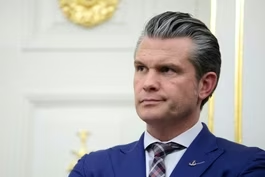
Hegseth’s turbulent time leading the U.S. military
Video has Closed Captions
Hegseth’s turbulent time leading the U.S. military (17m 55s)
Providing Support for PBS.org
Learn Moreabout PBS online sponsorship New Episode
- News and Public Affairs

Top journalists deliver compelling original analysis of the hour's headlines.

- News and Public Affairs

FRONTLINE is investigative journalism that questions, explains and changes our world.
 From My Station
 New Episode
 New Episode
 New Episode
 New Episode
 New Episode
 New Episode
 New Episode
 New Episode
Support for PBS provided by:
Major funding for “Washington Week with The Atlantic” is provided by Consumer Cellular, Otsuka, Kaiser Permanente, the Yuen Foundation, and the Corporation for Public Broadcasting.