Here and Now
William Casey Crump on State Funds to Address PFAS Pollution
Clip: Season 2400 Episode 2437 | 4m 58sVideo has Closed Captions
William Casey Crump on the town of Stella remediating PFAS-contaminated water supplies.
State Town Board Chairperson William Casey Crump discusses how the northern Wisconsin community seeks to use its share of $125 million in state funding to remediate PFAS-contaminated water supplies.
Problems playing video? | Closed Captioning Feedback
Problems playing video? | Closed Captioning Feedback
Here and Now is a local public television program presented by PBS Wisconsin
Here and Now
William Casey Crump on State Funds to Address PFAS Pollution
Clip: Season 2400 Episode 2437 | 4m 58sVideo has Closed Captions
State Town Board Chairperson William Casey Crump discusses how the northern Wisconsin community seeks to use its share of $125 million in state funding to remediate PFAS-contaminated water supplies.
Problems playing video? | Closed Captioning Feedback
How to Watch Here and Now
Here and Now is available to stream on pbs.org and the free PBS App, available on iPhone, Apple TV, Android TV, Android smartphones, Amazon Fire TV, Amazon Fire Tablet, Roku, Samsung Smart TV, and Vizio.
Providing Support for PBS.org
Learn Moreabout PBS online sponsorshiptoward green Bay as well.
Mayor, thanks very much.
>> Thanks for having me.
>> Now that 125 million state dollars are coming to the rescue for communities across Wisconsin, poisoned by the forever chemicals PFAs, the question is, when will the money come and how much will go where those questions are front of mind.
In the town of Stella, population about 650, with some of the highest concentrations of PFAs in the country.
Town Chair William Casey Crump is here, and thanks very much for being here.
>> Thank you for having me.
>> So what was your reaction when you learned the funds would finally be released?
>> It was it was a relief, to be honest.
It's been, you know, two years or three years roughly, I think, since those funds were originally talked about.
And to have the Senate and the governor finally come to an agreement and get that stuff signed off on and get it out is, is the first of of many steps yet to come, I think.
>> Yeah.
Because what do you know about how much Stella will receive?
>> That's the great unknown.
I talked to DNR yesterday as a matter of fact.
And and we're going to they're still trying to figure out exactly who's going to control the money, how it's going to be distributed.
They're not even sure themselves exactly.
You know, whether it's going to be municipalities like Stella that end up getting some of the money or, or our residents, I should say not not necessarily municipality or it's going to be public water works that get the money.
You know, we've got Wausau, we've got Tomahawk and some and Rhinelander Yvonne that have well, issues for their township, for their towns.
Whereas out here in Starks we're individual wells.
And so each homeowner is responsible for that.
And so it's very important, hopefully, that there will be some of that money that will go directly to those residents.
>> Because would that be priority one for the funds?
And Stella Private Wells.
>> I would love to see it become priority one.
Either that or treatment systems.
The way it is right now is the DNR did have some funds that they made available for people to have their wells.
Redrilled the problem is when those Re drills were done, they still had PFAs in their water, which made their water undrinkable.
Some of them came up, still had PFAs, but it was below the level.
So the second area secondary treatment on that is to put in a water treatment system in your home.
It's, it's we don't want or I, I, I feel like we don't want a kitchen faucet treatment.
We want a whole house treatment system.
Because if you're only getting your drinking water from your kitchen sink, it's very hard to brush teeth.
It's very hard to, you know, take showers.
It's it makes it much more difficult.
So that's why a whole house system would be important.
And those are expensive.
So again, money for that would be a blessing.
>> Why not jump right to the whole house system instead of going through drilling new wells or deeper wells?
>> Well, I think that if they can get clean water and they can get a, a well that works, that's a much longer term solution.
And also it's, it's not it's not going to be any more of a great cost on the residents.
The whole home treatments require filters.
Those filters run 300 to $500.
They recommend you change those quarterly.
There's two filters.
So that's $1,000 each time they have to change the filter.
So that's roughly 4000 a year.
That's very, very rough on our on our families out here.
We're not a rich community.
We're not vacation homes.
We're farmers.
We're ranchers.
We're small, you know, we're we're blue collar people.
>> So we've reported on this, but what is the known source of the PFAs in your community?
>> Well, it's definitely there is a lot of information that points to the paper mills, the sludge from the paper mills.
And I'm not sure if you know how that works.
And I won't go into great detail on that.
But when they wash the paper, all of that water gets collected.
All the stuff that comes off the paper gets collected.
And it was looked at back in the 60s and 70s as a very, very high nutrient rich fertilizer.
So they spread it on the fields out here for years and years and years.
The property that I own, they spread it clear back into mid 70s, I think up until probably the time we bought the land.
And so paper mill has been a big part of that.
And the paper mill here made microwave popcorn bags.
Those bags are lined, were lined with PFAs to keep them from leaking, to keep the butter and the oil inside it from leaking out.
And that's where the majority of the PFAs came from when they were treating those microwave popcorn bags.
That's what we've been told.
That's what the history shows.
And that, of course, is what the DNR pointed to in their announcement of a linked source.
But the paper mill Ahlstrom, who is like the third owner, I think since I've lived here in the last 20 years, they have stepped forward and they are providing some drinking water to families that are have concerns.
The problem with that is it's not a solution.
>> Well, we will keep watching the situation
 New
NewHere & Now opening for March 27, 2026
Video has Closed Captions
Clip: S2400 Ep2437 | 1m 20s | The introduction to the March 27, 2026 episode of Here & Now. (1m 20s)
 New
NewInside Wisconsin Politics: The 2026 State Supreme Court Race
Video has Closed Captions
Clip: S2400 Ep2437 | 7m 49s | Inside Wisconsin Politics on the 2026 state Supreme Court race and voter awareness. (7m 49s)
 New
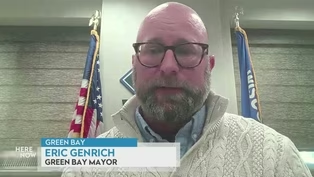
NewMayor Eric Genrich on Property Tax Bills and School Vouchers
Video has Closed Captions
Clip: S2400 Ep2437 | 6m 32s | Eric Genrich on why Green Bay itemizes private school voucher costs on property tax bills. (6m 32s)
 New
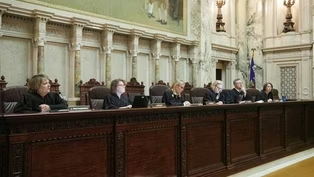
NewWisconsin's 2026 Supreme Court Race and the Issue of Recusal
Video has Closed Captions
Clip: S2400 Ep2437 | 5m 24s | Candidates in Wisconsin's 2026 Supreme Court race share how they consider recusal. (5m 24s)
 New
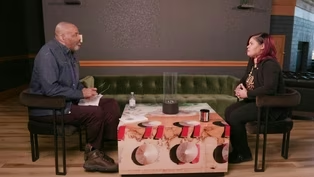
NewIn Focus with Dr. Tamika L. Johnson: Traumas Teachers Endure
Video has Closed Captions
Clip: S2400 Ep2437 | 45m 37s | Dr. Tamika L. Johnson on teaching amid loss of life, angry parents and food insecurity. (45m 37s)
Providing Support for PBS.org
Learn Moreabout PBS online sponsorship
- News and Public Affairs

Top journalists deliver compelling original analysis of the hour's headlines.

- News and Public Affairs

FRONTLINE is investigative journalism that questions, explains and changes our world.












Support for PBS provided by:
Here and Now is a local public television program presented by PBS Wisconsin